Basic Algebra Vocabulary
By the end of this lesson, you’ll be able to:
- Understand the difference between expressions, equations, and inequalities.
- Identify terms, variables, coefficients, and constants in algebraic expressions.
- Recognize what makes an expression linear versus nonlinear.
- Use correct mathematical language when simplifying or evaluating.
Key Ideas
Before working with equations and functions, it’s important to understand the basic building blocks of algebra.
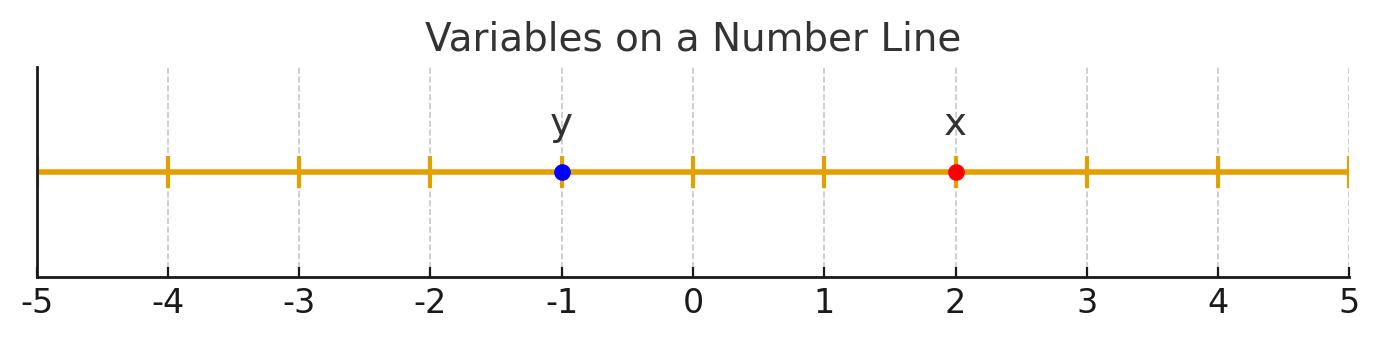
Variables
Symbols that represent unknown or changeable values.
Common letters: \(x\), \(y\), \(n\), \(t\).
Constants
Fixed numbers such as \(3\), \(-5\), or \(\tfrac12\).
Terms
Parts of an expression separated by + or − signs.
Examples:
- In \(5x - 3\), the terms are \(5x\) and \(-3\).
- In \(2x + y - 7\), the terms are \(2x\), \(y\), \(-7\).
Coefficients
The number multiplying a variable.
- In \(7x\), the coefficient is 7.
- In \(-x\), the coefficient is -1.
Expressions
A mathematical phrase without an equality or inequality sign.
Examples:
- \(3x - 4\)
- \(2(x + 5)\)
- \(7y + 1\)
Expressions can be simplified or evaluated, but not solved.
Equations
A statement showing two expressions are equal:
\[
3x + 4 = 19
\]
Equations can be solved because they have an equals sign.
Inequalities
Statements comparing two expressions using >, <, ≥, or ≤:
\[
2x - 5 < 9
\]
Inequalities can be solved, often producing a range rather than a single value.
Like Terms
Terms with the same variable and same exponent.
- \(3x\) and \(-5x\) → like terms
- \(2y\) and \(2x\) → not like terms
- \(x\) and \(x^2\) → not like terms
Simplifying
Rewriting an expression in a cleaner, equivalent form.
- distribute
- combine like terms
- remove unnecessary parentheses
Example:
\[
5x + 3 - 2x = 3x + 3
\]
Evaluating
Substituting a value for a variable.
Example:
Evaluate \(3x - 1\) for \(x = 4\):
\[
3(4) - 1 = 11
\]
Linear Expressions
Expressions where the highest exponent on any variable is 1.
Examples:
- \(3x + 7\)
- \(2y - 5\)
Not linear: \(x^2\), \(3^x\), \(xy\), \(\sqrt{x}\).
| Expression Type | Examples | Key Features |
|---|---|---|
| Linear | \(2x + 5\), \(-3x\), \(4 + \tfrac12 x\) | Variable has exponent 1; graph is a straight line; constant rate of change. |
| Nonlinear | \(x^2\), \(3x^3 - 2\), \(\sqrt{x}\), \(\frac{1}{x}\) | Variable has exponent not equal to 1 (2, 3, 1/2, -1, etc.); graph is curved; rate of change varies. |
Common Problem Types
1. Identifying parts of an expression
Example:
In \(4x - 9\):
- variable → \(x\)
- coefficient → 4
- constant → \(-9\)
- terms → \(4x\), \(-9\)
2. Determining linear vs. nonlinear
Examples:
- \(7x + 3\) → linear
- \(5x^2 - 1\) → not linear
- \(3\sqrt{x}\) → not linear
3. Expression vs. Equation vs. Inequality
- \(2x + 5\) → expression
- \(2x + 5 = 19\) → equation
- \(2x + 5 \le 19\) → inequality
4. Combining like terms
\[ 8x - 3x + 7 = 5x + 7 \]
5. Evaluating expressions
Example:
Evaluate \(2n - 5\) when \(n = -3\):
\[
2(-3) - 5 = -11
\]
Strategies
- Identify the type first: expression, equation, or inequality.
- Circle or underline like terms before combining.
- Write coefficients explicitly when helpful:
- \(-x = -1x\)
- \(-x = -1x\)
- Check the highest exponent to decide whether something is linear.
- Substitute carefully when evaluating.
Worked Examples
Example 1
Identify the terms, coefficients, and constant in:
\[
7x + 4 - 3x
\]
Step 1: Break the expression into terms: \(7x\), \(4\), \(-3x\)
Step 2: Identify coefficients: 7 and -3
Step 3: Identify the constant: 4
Step 4: Combine like terms: \(7x - 3x = 4x\)
Answer:
terms = \(7x\), \(4\), \(-3x\)
coefficients = 7, −3
constant = 4
simplified expression = \(4x + 4\)
Example 2
Is \(3x^2 - 5x + 1\) linear?
Step 1: Check the highest exponent.
Step 2: The highest exponent is 2 (from \(x^2\)).
Answer: Not linear.
Example 3
Evaluate \(6 - 2y\) when \(y = -4\).
Step 1: Substitute \(y = -4\)
\(6 - 2(-4)\)
Step 2: Multiply: \(-2(-4) = 8\)
Step 3: Add: \(6 + 8 = 14\)
Answer: \(14\)
Example 4
Expression or equation?
\[
5(x - 2)
\]
Step 1: Check for an equals sign.
There is none.
Answer: Expression.
Example 5
Simplify:
\[
4(a + 1) - (2a - 3)
\]
Step 1: Distribute:
\(4a + 4 - 2a + 3\)
Step 2: Combine like terms:
\(4a - 2a = 2a\)
Step 3: Combine constants:
\(4 + 3 = 7\)
Answer: \(2a + 7\)
- Trying to “solve” expressions that have no equals sign.
- Mixing unlike terms (such as adding \(x\) and \(x^2\)).
- Forgetting \(-x\) means “\(-1x\).”
- Mixing up simplify (rearrange) with evaluate (substitute).
- Thinking \(5x\) is a constant—it is not.
Practice Problems
- Identify the coefficient and constant in \(9x - 12\).
- Is \(2x + 5y\) linear?
- Evaluate \(3x - 4\) when \(x = -2\).
- List the terms in \(7y - 3 + y\).
- Expression, equation, or inequality: \(5 - 2n \le 9\).
1. Identify the coefficient and constant in \(9x - 12\).
- coefficient = 9
- constant = -12
2. Is \(2x + 5y\) linear?
Both variables have exponent 1 → linear.
3. Evaluate \(3x - 4\) at \(x = -2\).
\(3(-2) - 4 = -6 - 4 = -10\)
4. Terms in \(7y - 3 + y\).
\(7y\), \(-3\), \(y\)
5. \(5 - 2n \le 9\) is an:
Inequality
Summary
- Expressions, equations, and inequalities serve different purposes.
- Terms, variables, coefficients, and constants form the structure of algebra.
- Linear expressions have variables only to the first power.
- Simplifying rewrites expressions; evaluating substitutes values.
- Rewrite \(-x\) as \(-1x\) when needed to clarify signs.
- Identify and group like terms before combining them.
- Check the highest exponent to determine whether an expression is linear.