Circle Basics
By the end of this lesson, you’ll be able to:
- Identify and compute radius, diameter, circumference, and area of circles.
- Convert between radius and diameter.
- Use circle formulas to solve for missing measurements.
- Decide when to leave answers in terms of \(\pi\) and when to approximate.
- Interpret circle measurements in real-world problems.
Key Ideas
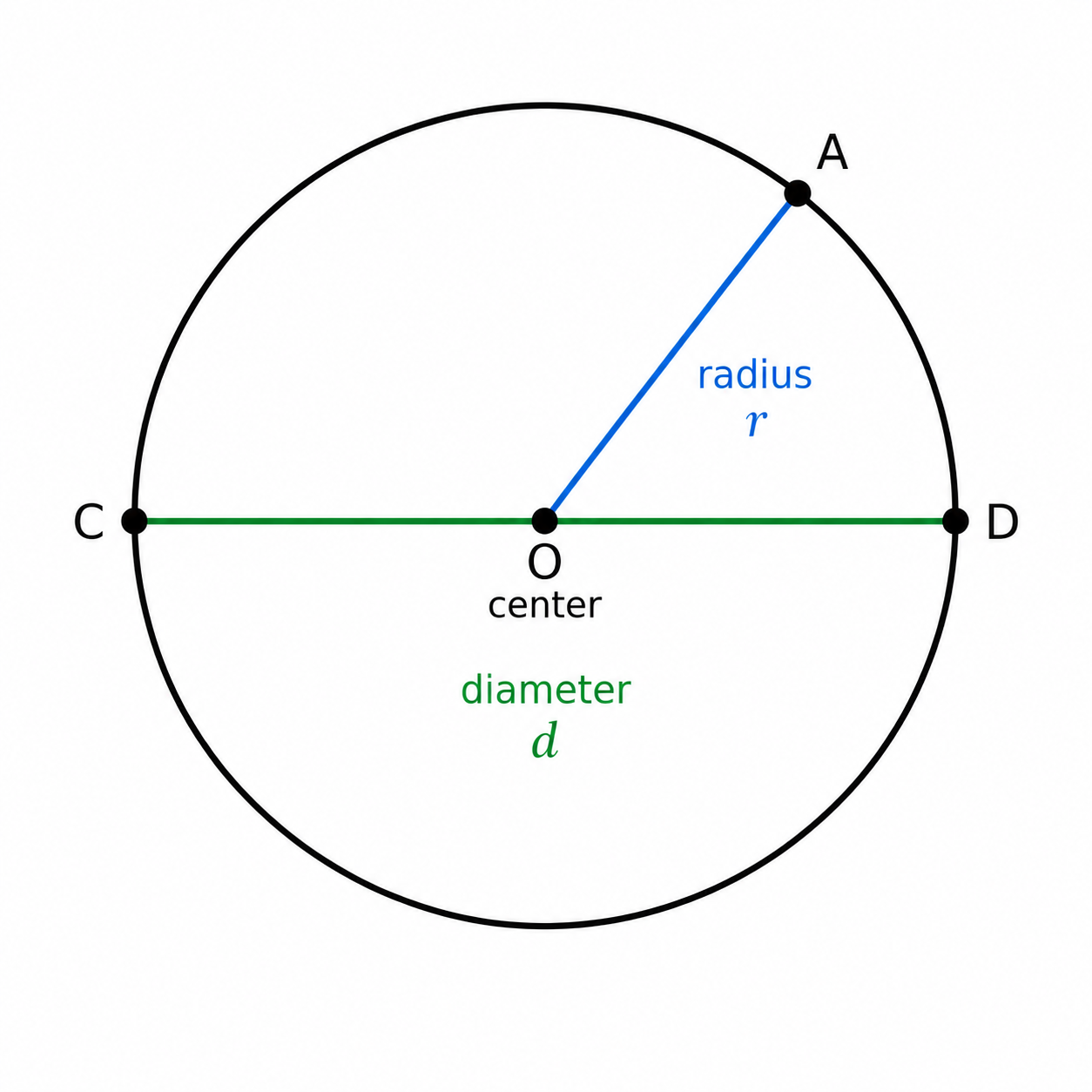
A circle is the set of all points that are the same distance from a central point.
Radius
The radius, \(r\), is the distance from the center of a circle to any point on the circle.
Diameter
The diameter, \(d\), is the distance across the circle through its center.
The diameter is twice the radius:
\[ d=2r \]
So the radius is half the diameter:
\[ r=\frac d2 \]
Circumference
The circumference is the distance around a circle.
Using the radius:
\[ C=2\pi r \]
Using the diameter:
\[ C=\pi d \]
These formulas are equivalent because:
\[ d=2r \]
Area
The area of a circle measures the amount of space inside the circle.
\[ A=\pi r^2 \]
Common Problem Types
1. Converting Between Radius and Diameter
Use:
\[ d=2r \]
or:
\[ r=\frac d2 \]
2. Finding Circumference
If the radius is given, use:
\[ C=2\pi r \]
If the diameter is given, you can use:
\[ C=\pi d \]
3. Finding Area
Use:
\[ A=\pi r^2 \]
The radius must be squared before multiplying by \(\pi\).
If the diameter is given, find the radius first.
4. Solving for a Missing Radius or Diameter
Sometimes the circumference or area is given and you must work backward.
For circumference, solve:
\[ C=2\pi r \]
For area, solve:
\[ A=\pi r^2 \]
5. Exact vs. Approximate Answers
An answer such as:
\[ 14\pi \]
is an exact answer.
If a decimal approximation is requested, use:
\[ \pi\approx3.14 \]
or the \(\pi\) button on a calculator.
Unless a problem asks for a decimal, it is usually best to leave the answer in terms of \(\pi\).
6. Real-World Circle Problems
Circle formulas can appear in problems involving:
- wheels
- tires
- clocks
- circular tables
- satellite dishes
- fountains
- circular tracks
The key is to decide whether the problem is asking about:
- the distance around the circle → circumference, or
- the space inside the circle → area.
Strategies
- Identify whether the given measurement is a radius or a diameter.
- If a diameter is given and you need area, divide by 2 first to find the radius.
- Use \(C=2\pi r\) when the radius is known.
- Use \(C=\pi d\) when the diameter is known.
- For area, remember to square the radius:
\[ A=\pi r^2 \]
- Keep answers in terms of \(\pi\) unless a decimal approximation is requested.
- If circumference or area is given, work backward algebraically to find the radius.
- Check units: circumference uses ordinary units, while area uses square units.
Worked Examples
Example 1 — Circumference From Radius
Find the circumference of a circle with radius 7.
We are given the radius, so use:
\[ C=2\pi r \]
Substitute:
\[ C=2\pi(7) \]
Simplify:
\[ C=14\pi \]
Therefore:
\[ \boxed{14\pi} \]
If a decimal approximation were requested:
\[ 14\pi\approx43.98 \]
Example 2 — Area From Diameter
Find the area of a circle with diameter 10.
The area formula requires the radius, not the diameter.
First find the radius:
\[ r=\frac{10}{2}=5 \]
Now use:
\[ A=\pi r^2 \]
Substitute:
\[ A=\pi(5^2) \]
\[ A=25\pi \]
Therefore:
\[ \boxed{25\pi} \]
Example 3 — Find Radius From Circumference
A circle has circumference:
\[ 18\pi \]
Find its radius.
Start with:
\[ C=2\pi r \]
Substitute:
\[ 18\pi=2\pi r \]
Divide both sides by \(2\pi\):
\[ r=9 \]
Therefore:
\[ \boxed{r=9} \]
Example 4 — Find Radius From Area
A circle has area:
\[ 81\pi \]
Find its radius.
Start with:
\[ A=\pi r^2 \]
Substitute:
\[ 81\pi=\pi r^2 \]
Divide by \(\pi\):
\[ 81=r^2 \]
Take the square root:
\[ r=9 \]
Therefore:
\[ \boxed{r=9} \]
- Forgetting that the diameter is twice the radius.
- Using the diameter directly in the area formula.
- Forgetting to square the radius in \(A=\pi r^2\).
- Using \(2\pi r\) for area or \(\pi r^2\) for circumference.
- Converting to a decimal too early when an exact answer in terms of \(\pi\) is expected.
- Forgetting that area uses square units.
Practice Problems
A circle has radius 3. Find its area.
A circle has diameter 16. Find its circumference.
A wheel has circumference \(18\pi\). Find its radius.
A circle has area \(64\pi\). Find its radius.
1. The radius is 3.
Use the area formula:
\[ A=\pi r^2 \]
Substitute:
\[ A=\pi(3^2) \]
\[ A=9\pi \]
Therefore:
\[ \boxed{9\pi} \]
2. The diameter is 16.
Since the diameter is already known, use:
\[ C=\pi d \]
Substitute:
\[ C=\pi(16) \]
Therefore:
\[ \boxed{16\pi} \]
3. We are given:
\[ C=18\pi \]
Use:
\[ C=2\pi r \]
Substitute:
\[ 18\pi=2\pi r \]
Divide both sides by \(2\pi\):
\[ r=9 \]
Therefore:
\[ \boxed{r=9} \]
4. We are given:
\[ A=64\pi \]
Use:
\[ A=\pi r^2 \]
Substitute:
\[ 64\pi=\pi r^2 \]
Divide both sides by \(\pi\):
\[ 64=r^2 \]
Take the square root:
\[ r=8 \]
Therefore:
\[ \boxed{r=8} \]
Summary
- Radius and diameter are related by:
\[ d=2r \]
- Circumference:
\[ C=2\pi r=\pi d \]
- Area:
\[ A=\pi r^2 \]
- Use circumference for the distance around a circle.
- Use area for the space inside a circle.
- Keep \(\pi\) exact unless a decimal approximation is requested.
- Given a diameter and need area? → divide by 2 first.
- Given a radius and need circumference? → use \(2\pi r\).
- Given a diameter and need circumference? → use \(\pi d\).
- Given circumference? → divide by \(2\pi\) to find the radius.
- Given area? → divide by \(\pi\), then take the square root.
- Area uses square units.