Complementary Angle Identity
By the end of this lesson, you’ll be able to:
- Recognize complementary angles in right triangles.
- Use the complementary-angle identities relating sine and cosine.
- Explain why \(\sin\theta\) and \(\cos(90^\circ-\theta)\) are equal.
- Use complementarity to simplify trig expressions without extra calculation.
Key Ideas
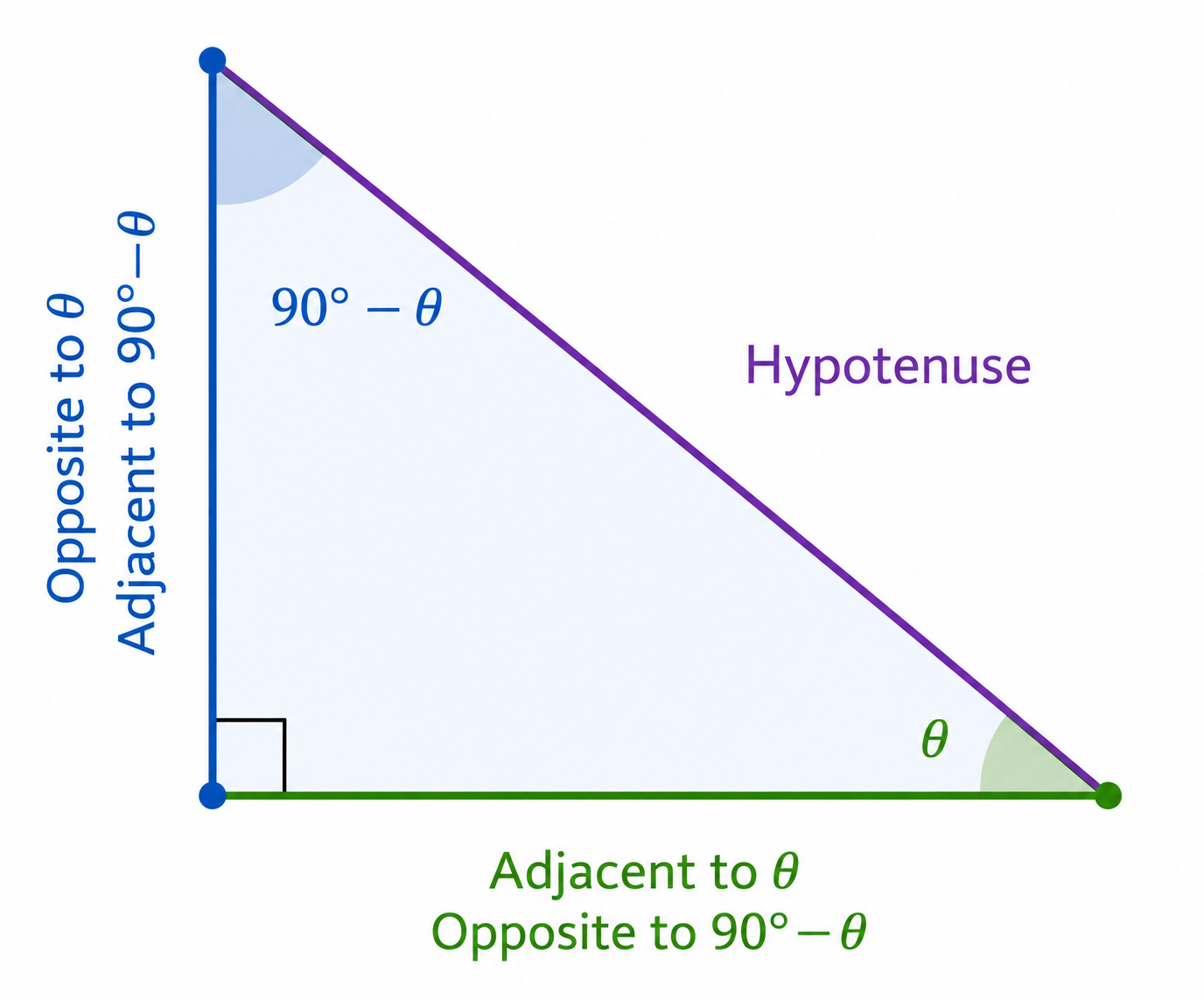
In every right triangle, one angle measures:
\[ 90^\circ \]
Since the angles of a triangle add to:
\[ 180^\circ \]
the other two acute angles must add to:
\[ \boxed{90^\circ} \]
So if the acute angles are \(\theta\) and \(\phi\):
\[ \theta+\phi=90^\circ \]
Therefore:
\[ \phi=90^\circ-\theta \]
Angles whose measures add to \(90^\circ\) are called complementary angles.
Complementary Trig Identities
For complementary acute angles:
\[ \boxed{ \sin\theta=\cos(90^\circ-\theta) } \]
and:
\[ \boxed{ \cos\theta=\sin(90^\circ-\theta) } \]
For example:
\[ \sin30^\circ=\cos60^\circ \]
and:
\[ \cos25^\circ=\sin65^\circ \]
Common Problem Types
1. Relating Sine and Cosine
Suppose you see:
\[ \sin30^\circ \]
The complement of \(30^\circ\) is:
\[ 90^\circ-30^\circ=60^\circ \]
Therefore:
\[ \boxed{ \sin30^\circ=\cos60^\circ } \]
2. Rewriting an Expression
Suppose you see:
\[ \cos(90^\circ-\theta) \]
Use the complementary-angle identity:
\[ \cos(90^\circ-\theta)=\sin\theta \]
Therefore:
\[ \boxed{ \cos(90^\circ-\theta)=\sin\theta } \]
No calculator is needed.
3. Finding a Missing Ratio
Suppose:
\[ \sin\theta=\frac45 \]
Find:
\[ \cos(90^\circ-\theta) \]
Use:
\[ \cos(90^\circ-\theta)=\sin\theta \]
Therefore:
\[ \boxed{ \cos(90^\circ-\theta)=\frac45 } \]
4. Recognizing Complementary Angles
To determine whether two angles are complementary, add them.
For example:
\[ 32^\circ+58^\circ=90^\circ \]
Therefore:
\[ \boxed{32^\circ\text{ and }58^\circ\text{ are complementary}} \]
5. Finding the Other Acute Angle
If one acute angle in a right triangle is:
\[ 37^\circ \]
then the other must be:
\[ 90^\circ-37^\circ \]
\[ =53^\circ \]
Therefore:
\[ \boxed{53^\circ} \]
Strategies
- If two angles are complementary, their sum is:
\[ 90^\circ \]
- When you see:
\[ 90^\circ-\theta \]
look for a complementary-angle identity.
- Switch:
\[ \sin \leftrightarrow \cos \]
when moving between complementary angles.
- Remember that opposite and adjacent switch roles when the reference angle changes.
- The hypotenuse does not change.
- Use the identity before reaching for a calculator.
Worked Examples
Example 1 — Rewrite Using Complementarity
Find an equivalent expression for:
\[ \cos(90^\circ-25^\circ) \]
Use:
\[ \cos(90^\circ-\theta)=\sin\theta \]
Let:
\[ \theta=25^\circ \]
Then:
\[ \cos(90^\circ-25^\circ)=\sin25^\circ \]
Since:
\[ 90^\circ-25^\circ=65^\circ \]
this also tells us:
\[ \boxed{ \cos65^\circ=\sin25^\circ } \]
Example 2 — Use a Known Ratio
Given:
\[ \sin\theta=\frac45 \]
find:
\[ \cos(90^\circ-\theta) \]
Use the identity:
\[ \cos(90^\circ-\theta)=\sin\theta \]
Substitute:
\[ \cos(90^\circ-\theta)=\frac45 \]
Therefore:
\[ \boxed{\frac45} \]
Example 3 — Find the Other Acute Angle
A right triangle has one acute angle measuring:
\[ 41^\circ \]
The two acute angles must add to:
\[ 90^\circ \]
So the other angle is:
\[ 90^\circ-41^\circ \]
\[ =49^\circ \]
Therefore:
\[ \boxed{49^\circ} \]
Example 4 — Compare Two Trig Expressions
Are the following equal?
\[ \sin38^\circ \]
and:
\[ \cos52^\circ \]
Check whether the angles are complementary:
\[ 38^\circ+52^\circ=90^\circ \]
Yes.
Therefore:
\[ \boxed{ \sin38^\circ=\cos52^\circ } \]
- Forgetting that complementary angles add to \(90^\circ\).
- Switching sine and cosine without checking that the angles are complementary.
- Confusing complementary angles with supplementary angles, which add to \(180^\circ\).
- Forgetting that opposite and adjacent depend on the chosen reference angle.
- Calculating both trig values separately when the complementary identity gives the answer immediately.
Practice Problems
- Rewrite using cosine:
\[ \sin40^\circ \]
- If:
\[ \cos\theta=0.8 \]
find:
\[ \sin(90^\circ-\theta) \]
Are \(32^\circ\) and \(58^\circ\) complementary?
A right triangle has one acute angle of \(27^\circ\). Find the other acute angle.
Fill in the blank:
\[ \cos17^\circ = \sin(\underline{\hspace{1cm}}) \]
1. Use:
\[ \sin\theta=\cos(90^\circ-\theta) \]
Substitute:
\[ \theta=40^\circ \]
\[ \sin40^\circ = \cos(90^\circ-40^\circ) \]
\[ \sin40^\circ=\cos50^\circ \]
Therefore:
\[ \boxed{\cos50^\circ} \]
2. Use:
\[ \sin(90^\circ-\theta)=\cos\theta \]
We are given:
\[ \cos\theta=0.8 \]
Therefore:
\[ \boxed{ \sin(90^\circ-\theta)=0.8 } \]
3. Add the angles:
\[ 32^\circ+58^\circ=90^\circ \]
Therefore:
\[ \boxed{\text{Yes, they are complementary}} \]
4. The acute angles of a right triangle add to:
\[ 90^\circ \]
So:
\[ 90^\circ-27^\circ=63^\circ \]
Therefore:
\[ \boxed{63^\circ} \]
5. Use:
\[ \cos\theta = \sin(90^\circ-\theta) \]
Substitute:
\[ \theta=17^\circ \]
\[ 90^\circ-17^\circ=73^\circ \]
Therefore:
\[ \boxed{ \cos17^\circ=\sin73^\circ } \]
Summary
- The two acute angles in a right triangle are complementary:
\[ \theta+(90^\circ-\theta)=90^\circ \]
- Sine and cosine switch roles for complementary angles:
\[ \boxed{ \sin\theta=\cos(90^\circ-\theta) } \]
\[ \boxed{ \cos\theta=\sin(90^\circ-\theta) } \]
- The relationship works because opposite and adjacent switch roles when the reference angle changes.
- The hypotenuse stays the same.
- Complementary identities can simplify trig expressions without additional calculation.
- Complementary → adds to \(90^\circ\).
- See \(90^\circ-\theta\) → think complement.
- Switch sine ↔︎ cosine.
- Opposite ↔︎ adjacent.
- Hypotenuse stays the same.
- Use the identity before using a calculator.