Literal Equations (Solving for a Variable)
By the end of this lesson, you’ll be able to:
- Understand what a literal equation is.
- Solve formulas for a specified variable by isolating it.
- Apply rearranging skills to geometry, physics, and algebra formulas.
Key Ideas
A literal equation is an equation written with letters/variables, not just numbers.
These show up everywhere:
- \(A = \pi r^2\)
- \(d = rt\)
- \(y = mx + b\)
Solving a literal equation means rearranging it to isolate a chosen variable.
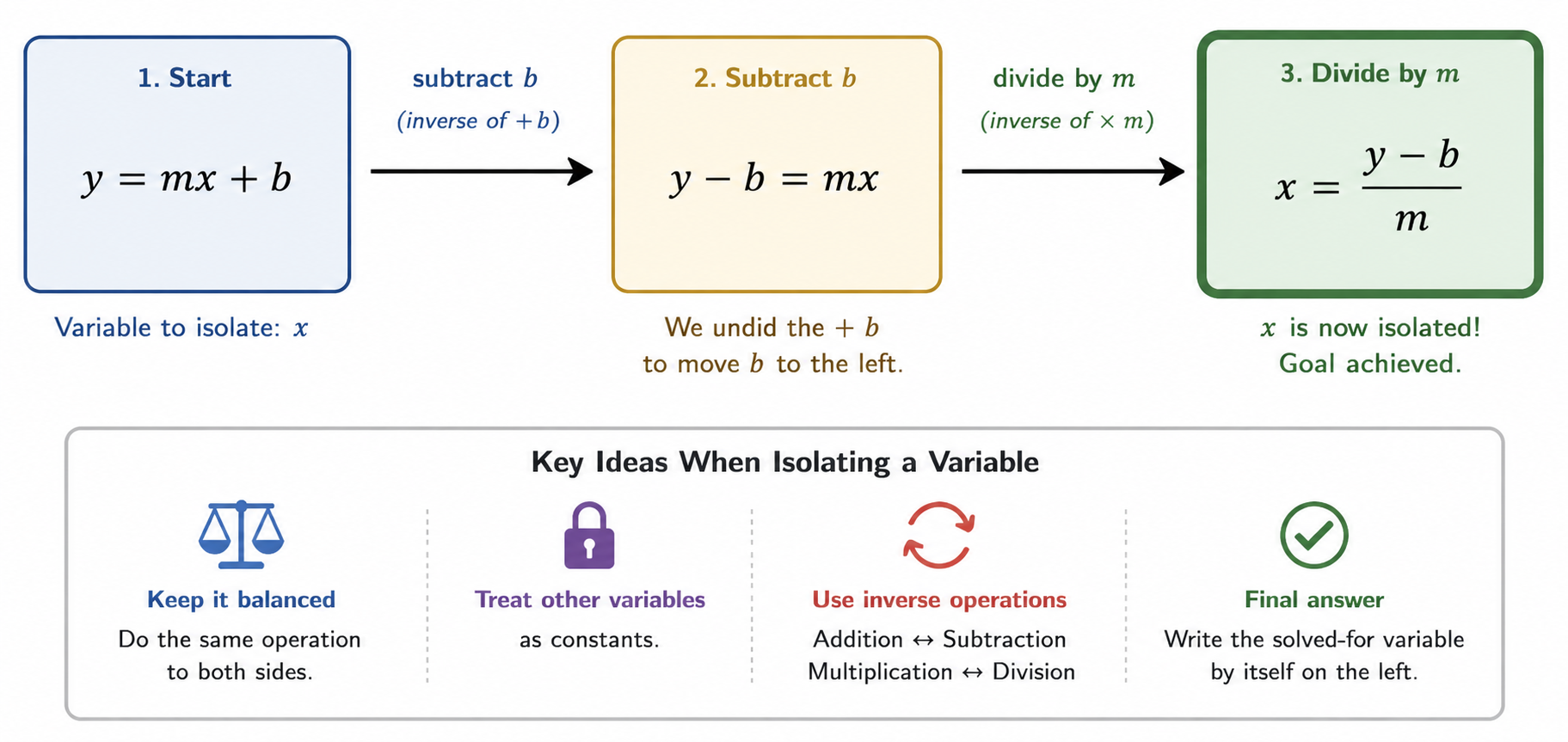
The tools are the same as for solving linear equations:
- use inverse operations
- treat other variables as constants
- keep both sides balanced
Common Problem Types
1. Rearranging Linear Equations
Typical example:
Solve \(y = mx + b\) for \(x\).
Subtract \(b\): \(y - b = mx\)
Divide by \(m\):
\[
x = \frac{y - b}{m}
\]
2. Rearranging Multiplication Formulas
Many formulas involve variables multiplied together.
Examples:
- \(d=rt\)
- \(V=lwh\)
- \(C=2\pi r\)
The strategy is to divide by the factors attached to the variable you want.
Example: Solve \(d=rt\) for \(t\).
\[ t=\frac{d}{r} \]
3. Solving Formulas with Powers and Roots
Some formulas require isolating a squared or cubed variable before taking a root.
Example: Solve \(A = \pi r^2\) for \(r\).
Divide by \(\pi\): \[ \frac{A}{\pi}=r^2 \]
Take the square root: \[ r=\sqrt{\frac{A}{\pi}} \]
4. Solving Formulas with Fractions
Strategy: clear fractions by multiplying both sides by the denominator first.
Example: Solve
\[ \frac{x+3}{5}=y \]
for \(x\).
Multiply both sides by 5:
\[ x+3=5y \]
Subtract 3:
\[ x=5y-3 \]
Strategies
- Treat every variable you’re not solving for as a constant.
- Use the same steps as solving linear equations: undo additions, subtractions, multiplications, divisions.
- If fractions appear, clear them early.
- Keep parentheses when dividing an entire expression.
- Rewrite the final answer with the target variable on the left.
Worked Examples
Example 1
Solve for \(b\):
\[
A = \frac{1}{2}bh
\]
Multiply both sides by 2: \(2A = bh\)
Divide by \(h\):
\[
b = \frac{2A}{h}
\]
Example 2
Solve for \(x\):
\[
3x - 2y = 12
\]
Add \(2y\): \(3x = 12 + 2y\)
Divide by 3:
\[
x = \frac{12 + 2y}{3}
\]
Example 3
Solve for \(h\):
\[
V = lwh
\]
Divide both sides by \(lw\):
\[
h = \frac{V}{lw}
\]
- Forgetting to divide every term when isolating.
- Dropping parentheses when dividing by a sum.
- Treating other variables as if they were changing instead of constants.
- Solving for the wrong variable or rearranging in the wrong order.
Practice Problems
- Solve \(d = rt\) for \(r\).
- Solve \(P = 2l + 2w\) for \(l\).
- Solve \(V = lwh\) for \(h\).
- Solve \(ax + b = c\) for \(x\).
- Solve \(C = 2\pi r\) for \(r\).
1. \(d = rt\) → divide by \(t\):
\(r = \dfrac{d}{t}\)
2. \(P = 2l + 2w\) → subtract \(2w\):
\(P - 2w = 2l\)
Divide by 2:
\(l = \dfrac{P - 2w}{2}\)
3. \(V = lwh\) → divide by \(lw\):
\(h = \dfrac{V}{lw}\)
4. \(ax + b = c\) → subtract \(b\):
\(ax = c - b\)
Divide by \(a\):
\(x = \dfrac{c - b}{a}\)
5. \(C = 2\pi r\) → divide by \(2\pi\):
\(r = \dfrac{C}{2\pi}\)
Summary
- Literal equations are solved by isolating the target variable using inverse operations.
- Treat all other letters as constants.
- Keep parentheses when dividing by expressions.
- Use the same logic as solving any linear equation.
- Clear fractions early by multiplying both sides by the denominator.
- Always divide every term when isolating.
- Rewrite the final equation with the solved-for variable on the left.
- Keep parentheses when dividing by sums; dropping them changes the meaning.