Evaluating Functions
By the end of this lesson, you’ll be able to:
- Substitute values correctly into functions.
- Evaluate functions given formulas, tables, or graphs.
- Interpret function outputs in applied situations.
Key Ideas
Evaluating a function means plugging in a specific input and calculating the corresponding output.
- When you see \(f(x)\), think: “the value of \(f\) when \(x\) equals something.”
- Always use parentheses when substituting negative numbers to avoid sign errors.
- Functions may be presented in several forms:
- Formulas
- Tables
- Graphs
- Formulas
Common Problem Types
1. Formula Evaluation
Plug in the value for \(x\) and simplify.
2. Table Lookup
Find the input in the table and read the output.
3. Reading From Graphs
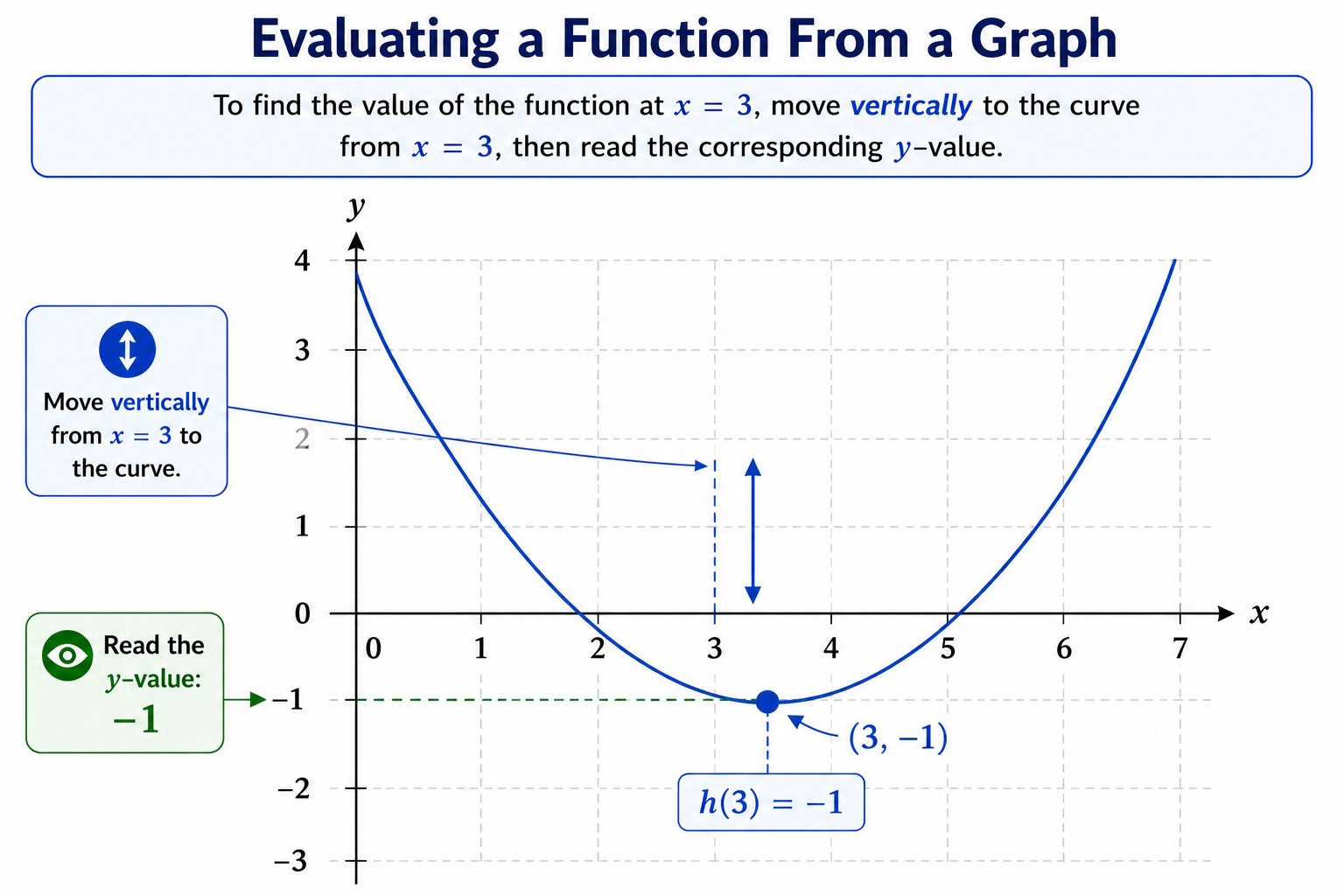
Locate the point with the given \(x\)-value and identify the \(y\)-value.
4. Applied Contexts
Interpret outputs in real-world situations (e.g., population, cost, distance).
Strategies
- Replace \(x\) with the input everywhere it appears in the formula.
- Use parentheses when plugging in negatives, powers, or expressions.
- In graphs, move vertically from the given \(x\) to find the corresponding \(y\).
- In tables, ensure you’re reading the correct row or pair.
- Reread the question—many evaluation errors come from substituting the wrong value.
Worked Examples
Example 1 — Formula Evaluation
Given:
\[ f(x) = 2x^2 - 3x, \]
find \(f(-2)\).
Solution:
Substitute \(-2\) everywhere \(x\) appears. Use parentheses around the negative input.
\[ \begin{split} f(-2) &= 2(-2)^2 - 3(-2) \\ &= 2(4) + 6 \\ &= 8 + 6 \\ &= 14 \end{split} \]
Therefore,
\[ f(-2)=14. \]
Example 2 — Table Evaluation
Use the table to find \(g(2)\).
| \(x\) | \(g(x)\) |
|---|---|
| 0 | 8 |
| 1 | 6 |
| 2 | 5 |
| 3 | 1 |
Solution:
Locate the row where the input is \(x=2\). The corresponding output is \(5\).
Therefore,
\[ g(2)=5. \]
Example 3 — Graph Evaluation
Use the graph above to find \(h(3)\).
Solution:
Start at \(x=3\) on the horizontal axis and move vertically until you reach the graph. Read the corresponding \(y\)-value.
The graph passes through the point \((3,-1)\), so
\[ h(3)=-1. \]
- Forgetting parentheses when plugging in negative numbers.
- Treating \(f(x)\) as multiplication instead of function notation.
- Reading incorrect values from a table or graph.
Practice Problems
- If \(f(x) = x^2 - 4x\), find \(f(6)\).
- If \(h(x) = \sqrt{x}\), find \(h(9)\).
- If a graph shows \((2, -5)\), what is \(f(2)\)?
- Use the table to find \(g(0)\).
| \(x\) | \(g(x)\) |
|---|---|
| 0 | 8 |
| 1 | 6 |
| 2 | 5 |
| 3 | 1 |
- Evaluate \(p(x) = 3 - x\) at \(x = -4\).
1.
\[
f(6) = 6^2 - 4(6) = 36 - 24 = 12
\]
2.
\[
h(9) = \sqrt{9} = 3
\]
3.
From point \((2, -5)\) → \(f(2) = -5\)
4.
Locate the row where the input is \(x=0\). The corresponding output is \(8\).
\[ g(0)=8 \]
5.
\[
p(-4) = 3 - (-4) = 7
\]
Summary
- Evaluating a function means plugging a value into the expression or reading it from a graph/table.
- Use parentheses when working with negative inputs.
- Tables, graphs, and formulas all represent the same input–output relationship.
- \(f(x)\) is notation, not multiplication.
- Careful substitution avoids most mistakes.
- Replace \(x\) with parentheses first, then simplify.
- Check graphs by locating the point with the given \(x\)-value.
- Tables give exact values—just read them carefully.
- Always verify you’re substituting the right input.