Piecewise Functions
By the end of this lesson, you’ll be able to:
- Read and interpret piecewise-defined functions.
- Evaluate a piecewise function at specific inputs.
- Graph basic piecewise functions using domain restrictions.
- Identify jumps, removable discontinuities, and matching endpoints.
Key Ideas
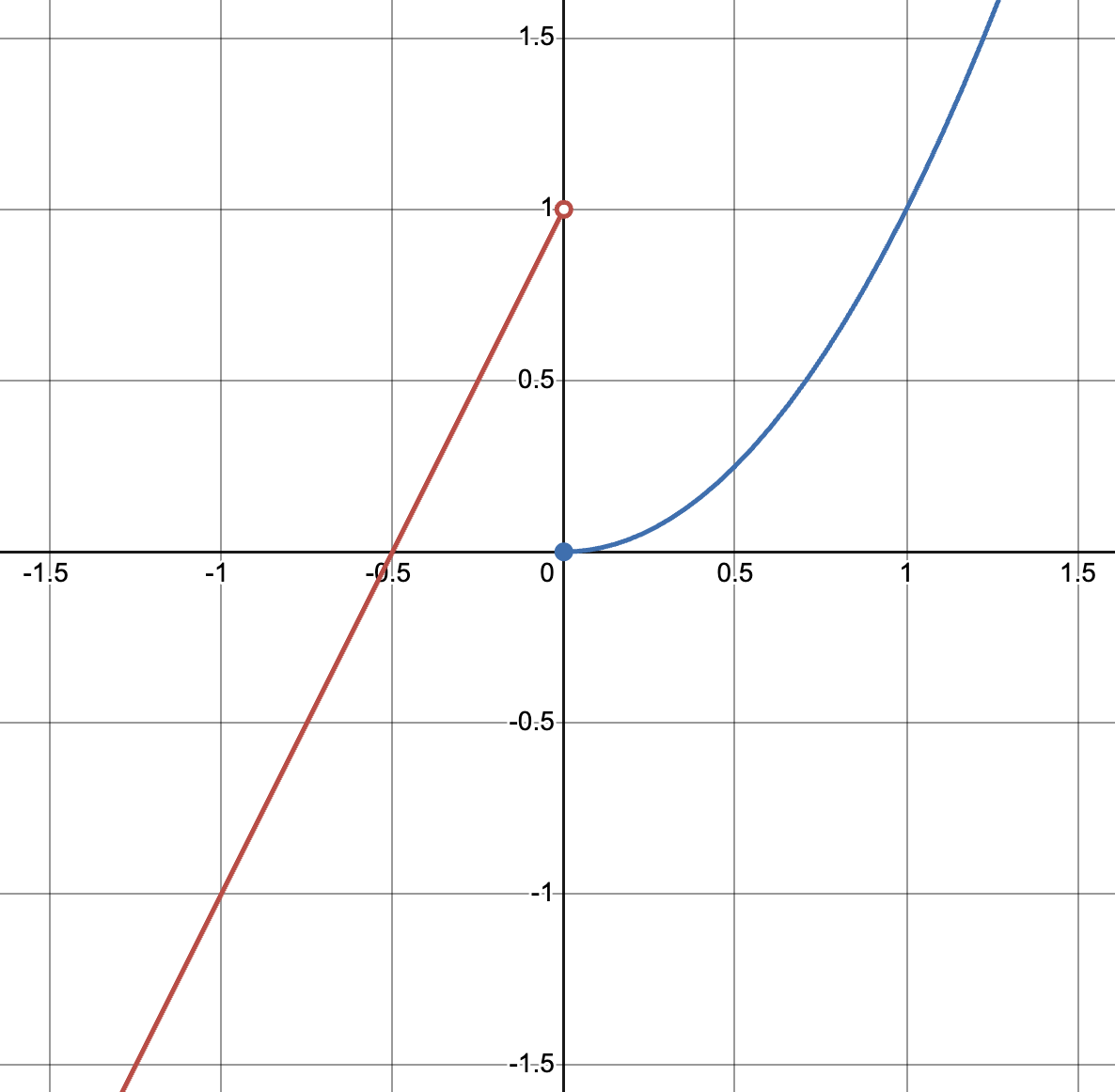
A piecewise function is defined by different rules on different parts of the domain.
Example: \[ f(x) = \begin{cases} 2x + 1 & x < 0 \\ x^2 & x \ge 0 \end{cases} \]
To evaluate:
- Pick the correct piece based on the domain restriction.
- Plug in the value using only that rule.
To graph:
- Graph each “piece” on its restricted domain.
- Use open/closed circles to show endpoints.
Common Problem Types
Evaluating Piecewise Functions
Choose the correct branch using the inequality, then substitute.
Example:
If
\[
f(x) =
\begin{cases}
3x & x < 2 \\
x+4 & x \ge 2
\end{cases}
\] then \(f(5)=9\) and \(f(1)=3\).
Determining Which Piece Applies
Many mistakes occur by plugging into the wrong rule.
Tip: Check inequalities carefully (strict vs. non-strict).
Graphing Piecewise Functions
Plot each expression on its domain.
Example: linear on one side, quadratic on the other.
Checking Continuity at Breakpoints
Compare left-hand and right-hand values.
Example:
If left-end value is 5 and right-end value is 7 → jump discontinuity.
Describing Features from Graphs
Identify:
- where the function switches
- whether endpoints are open or closed
- increasing/decreasing behavior of each piece
Strategies
- Always start by circling the inequality that includes your input.
- For graphing: write a small domain table for each piece.
- Use open circles for \(<\) or \(>\) and filled circles for \(\le\) or \(\ge\).
- Check continuity by evaluating both sides of the boundary.
- Don’t mix rules — use one piece at a time.
Worked Examples
Example 1 — Evaluate a Piecewise Function
Evaluate \(f(-3)\) and \(f(2)\) for: \[ f(x) = \begin{cases} -x & x < 0 \\ x^2 - 1 & x \ge 0 \end{cases} \]
For \(-3\): use \(-x\) → \(f(-3)=3\)
For \(2\): use \(x^2 - 1\) → \(f(2)=3\)
Example 2 — Graph a Piecewise Function
Graph: \[ g(x) = \begin{cases} 1 & x \le -1 \\ x + 2 & -1 < x < 2 \\ 4 & x \ge 2 \end{cases} \]
- Horizontal line at \(y=1\) with closed dot at \(x=-1\)
- Slanted line \(y=x+2\) between \(-1\) and \(2\), open circles at both ends
- Horizontal line \(y=4\) with closed dot at \(x=2\)
Example 3 — Continuity Check
Is \(h(x)\) continuous at \(x=1\)?
\[ h(x)= \begin{cases} 2x & x < 1 \\ 5 & x \ge 1 \end{cases} \]
Left-hand value: \(2(1)=2\)
Right-hand value: \(5\)
Not equal → jump discontinuity.
- Plugging into the wrong piece by ignoring the inequality.
- Forgetting open vs. closed circles when graphing.
- Trying to use both rules at the boundary.
- Assuming all piecewise functions are continuous (many are not!).
- Not rewriting answers clearly after evaluating.
Practice Problems
Evaluate \(f(0)\):
\[ f(x)= \begin{cases} x+3 & x < 0 \\ x^2 & x \ge 0 \end{cases} \]Evaluate \(g(4)\):
\[ g(x)= \begin{cases} -x & x < 2 \\ 3x - 5 & x \ge 2 \end{cases} \]Determine if the function is continuous at \(x=2\):
\[ h(x)= \begin{cases} x^2 - 4 & x < 2 \\ 0 & x = 2 \\ x - 1 & x > 2 \end{cases} \]Describe the graph of:
\[ p(x)= \begin{cases} 5 & x \le 1 \\ -x+2 & x > 1 \end{cases} \]
1.
Use \(x^2\) for \(x=0\):
\[
f(0)=0
\]
2.
Use \(3x - 5\):
\[
g(4)=12 - 5 = 7
\]
3.
Left-hand: \(2^2 - 4 = 0\)
Right-hand: \(2 - 1 = 1\)
Middle value: \(0\)
Left = middle but middle \(\ne\) right → not continuous.
4.
Horizontal line at \(5\) up to \(x=1\) (closed).
Downward line \(-x+2\) for \(x>1\) with open circle at the breakpoint.
Summary
- Piecewise functions use different rules on different domain intervals.
- Evaluate by choosing the correct branch.
- Graph using open/closed endpoints.
- Continuity is checked by comparing left and right values at boundaries.
- Always check which inequality includes your input.
- Open circle: \(<\) or \(>\); closed: \(\le\) or \(\ge\).
- Evaluate both sides of boundaries when testing continuity.
- Draw mini-tables for each piece when graphing.