Polynomial Division (Long & Synthetic)
By the end of this lesson, you’ll be able to:
- Divide polynomials using long division.
- Use synthetic division when the divisor has the form \((x - c)\).
- Interpret quotients and remainders clearly.
Key Ideas
- Polynomial long division works just like numeric long division—divide the leading terms, multiply back, subtract, and repeat.
- Synthetic division is a shortcut method, but it only applies when dividing by a linear divisor of the form \((x - c)\).
- Always fill in zero placeholders for missing powers before beginning division.
Common Problem Types
1. Long Division With Missing Terms
Fill in placeholders before dividing.
Example:
\[ 3x^3 - 5x + 2 \]
should be written as:
\[ 3x^3 + 0x^2 - 5x + 2 \]
2. Synthetic Division With \((x - c)\)
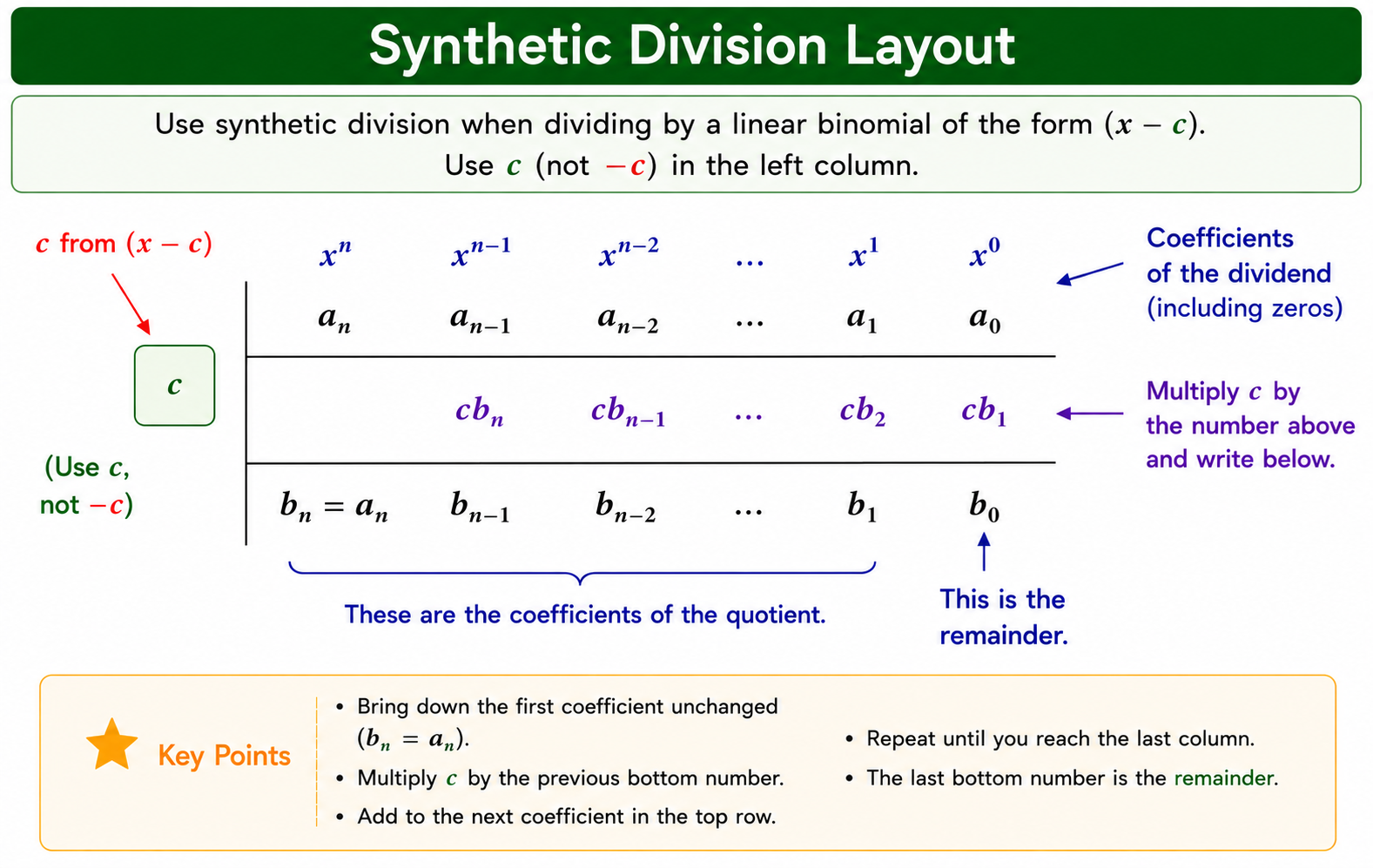
Use \(c\), not \(-c\), in the synthetic table.
3. Identifying Quotient + Remainder
If there is a remainder, write it as:
\[ \text{quotient} + \frac{\text{remainder}}{\text{divisor}} \]
4. Dividing Higher-Degree Polynomials
Expect repeated cycles of divide, multiply, subtract, and bring down.
Strategies
- Rewrite both dividend and divisor in descending powers of \(x\).
- Include zero placeholders for missing powers.
- In long division, divide only the leading terms to choose the next quotient term.
- In synthetic division, copy coefficients carefully.
- If unsure which method to use, remember:
- \((x - c)\) → synthetic division works
- anything else → use long division
- \((x - c)\) → synthetic division works
Worked Examples
Example 1 — Long Division
Divide:
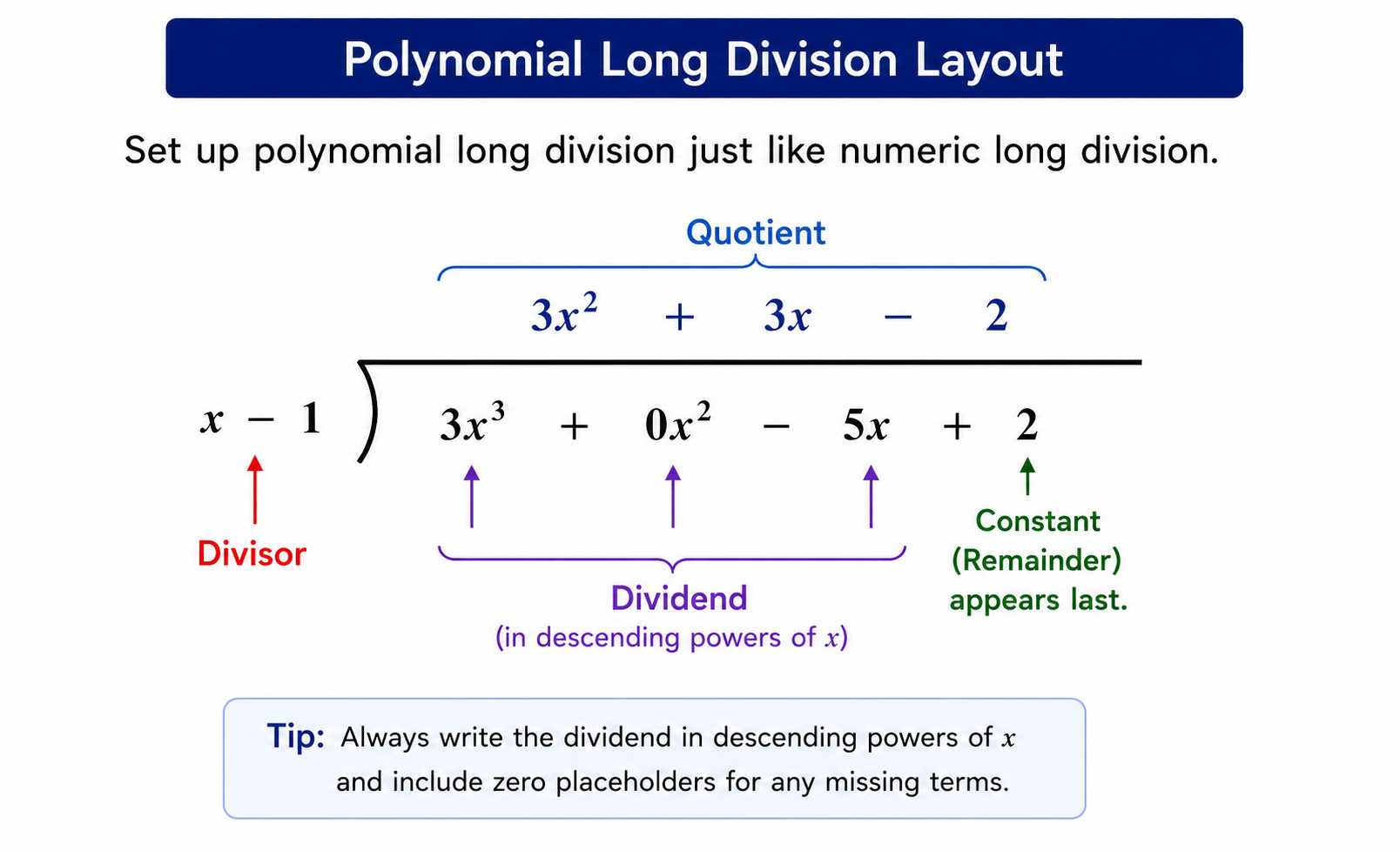
\[ (3x^3 - 5x + 2) \div (x - 1) \]
Rewrite with a placeholder term:
\[ 3x^3 + 0x^2 - 5x + 2 \]
Divide leading terms:
\[ 3x^3 \div x = 3x^2 \]
Multiply back:
\[ 3x^2(x-1)=3x^3-3x^2 \]
Subtract:
\[ (3x^3+0x^2)-(3x^3-3x^2)=3x^2 \]
Bring down \(-5x\):
\[ 3x^2-5x \]
Divide leading terms:
\[ 3x^2 \div x = 3x \]
Multiply back:
\[ 3x(x-1)=3x^2-3x \]
Subtract:
\[ (3x^2-5x)-(3x^2-3x)=-2x \]
Bring down \(+2\):
\[ -2x+2 \]
Divide leading terms:
\[ -2x \div x = -2 \]
Multiply back:
\[ -2(x-1)=-2x+2 \]
Subtract:
\[ 0 \]
Final answer:
\[ \boxed{3x^2 + 3x - 2} \]
Example 2 — Synthetic Division
Divide:
\[ 2x^3 + 3x^2 - 4x + 5 \quad \text{by} \quad (x + 2) \]
Since:
\[ x+2 = x-(-2) \]
use:
\[ c=-2 \]
Use the coefficients:
\[ 2,\;3,\;-4,\;5 \]
Synthetic division:
\[ \begin{array}{r|rrrr} -2 & 2 & 3 & -4 & 5 \\ & & -4 & 2 & 4 \\ \hline & 2 & -1 & -2 & 9 \end{array} \]
The quotient coefficients are:
\[ 2,\;-1,\;-2 \]
So the quotient is:
\[ 2x^2 - x - 2 \]
The remainder is:
\[ 9 \]
Final answer:
\[ \boxed{2x^2 - x - 2 + \frac{9}{x+2}} \]
- Forgetting zero placeholders for missing powers of \(x\).
- Using synthetic division with divisors that are not of the form \((x - c)\).
- Mixing up the sign of \(c\) when setting up synthetic division.
- Forgetting to include the remainder in the final answer.
Practice Problems
- \((x^2 + 5x + 6) \div (x + 2)\)
- \((2x^3 - x^2 + 4) \div (x - 1)\)
- \((4x^3 + 8x) \div (x + 2)\)
- \((3x^3 + 7x^2 - 2x + 8) \div (x - 3)\)
- \((x^4 - 1) \div (x - 1)\)
1.
Divide:
\[ (x^2 + 5x + 6) \div (x + 2) \]
Since:
\[ x+2=x-(-2) \]
use:
\[ c=-2 \]
Synthetic division:
\[ \begin{array}{r|rrr} -2 & 1 & 5 & 6 \\ & & -2 & -6 \\ \hline & 1 & 3 & 0 \end{array} \]
The quotient is:
\[ x+3 \]
Remainder:
\[ 0 \]
Answer:
\[ \boxed{x+3} \]
2.
Divide:
\[ (2x^3 - x^2 + 4) \div (x - 1) \]
First include the missing \(x\)-term:
\[ 2x^3 - x^2 + 0x + 4 \]
Since the divisor is \(x-1\), use:
\[ c=1 \]
Synthetic division:
\[ \begin{array}{r|rrrr} 1 & 2 & -1 & 0 & 4 \\ & & 2 & 1 & 1 \\ \hline & 2 & 1 & 1 & 5 \end{array} \]
The quotient is:
\[ 2x^2 + x + 1 \]
Remainder:
\[ 5 \]
Answer:
\[ \boxed{2x^2 + x + 1 + \frac{5}{x - 1}} \]
3.
Divide:
\[ (4x^3 + 8x) \div (x + 2) \]
First include missing terms:
\[ 4x^3 + 0x^2 + 8x + 0 \]
Since:
\[ x+2=x-(-2) \]
use:
\[ c=-2 \]
Synthetic division:
\[ \begin{array}{r|rrrr} -2 & 4 & 0 & 8 & 0 \\ & & -8 & 16 & -48 \\ \hline & 4 & -8 & 24 & -48 \end{array} \]
The quotient is:
\[ 4x^2 - 8x + 24 \]
Remainder:
\[ -48 \]
Answer:
\[ \boxed{4x^2 - 8x + 24 - \frac{48}{x + 2}} \]
4.
Divide:
\[ (3x^3 + 7x^2 - 2x + 8) \div (x - 3) \]
Since the divisor is \(x-3\), use:
\[ c=3 \]
Synthetic division:
\[ \begin{array}{r|rrrr} 3 & 3 & 7 & -2 & 8 \\ & & 9 & 48 & 138 \\ \hline & 3 & 16 & 46 & 146 \end{array} \]
The quotient is:
\[ 3x^2 + 16x + 46 \]
Remainder:
\[ 146 \]
Answer:
\[ \boxed{3x^2 + 16x + 46 + \frac{146}{x - 3}} \]
5.
Divide:
\[ (x^4 - 1) \div (x - 1) \]
First include missing terms:
\[ x^4 + 0x^3 + 0x^2 + 0x - 1 \]
Since the divisor is \(x-1\), use:
\[ c=1 \]
Synthetic division:
\[ \begin{array}{r|rrrrr} 1 & 1 & 0 & 0 & 0 & -1 \\ & & 1 & 1 & 1 & 1 \\ \hline & 1 & 1 & 1 & 1 & 0 \end{array} \]
The quotient is:
\[ x^3 + x^2 + x + 1 \]
Remainder:
\[ 0 \]
Answer:
\[ \boxed{x^3 + x^2 + x + 1} \]
Summary
- Use long division for any divisor.
- Use synthetic division only for divisors of the form \((x - c)\).
- Fill in missing powers of \(x\) before dividing.
- Write remainders as fractions over the divisor.
- Synthetic division is faster, but only when the divisor is linear and has leading coefficient \(1\).
- Always rewrite polynomials in descending order.
- For synthetic division, use the number \(c\) from \((x - c)\).
- If the divisor is \(x+2\), then \(c=-2\).
- Check your remainder: plugging \(c\) into the original polynomial should produce the remainder.
- Long division becomes easier when like terms are aligned vertically.