Polynomial Graph Behavior
By the end of this lesson, you’ll be able to:
- Describe the end behavior of a polynomial using its leading term.
- Identify roots and determine whether the graph crosses or touches the x-axis.
- Understand how degree and multiplicity shape a polynomial’s graph.
Key Ideas
Polynomial graphs follow predictable patterns based on their leading term and root multiplicities.
End Behavior
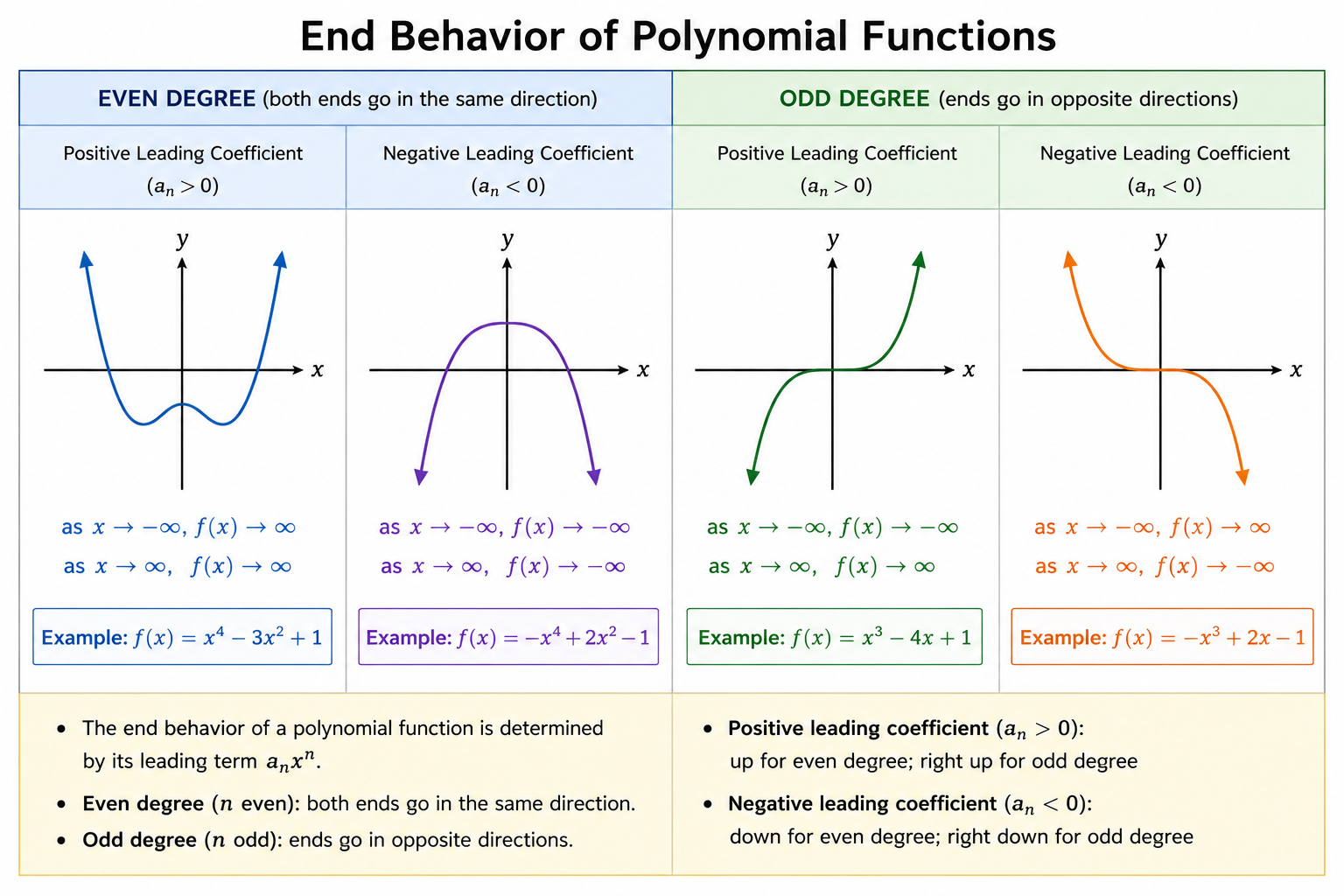
End behavior depends entirely on the leading term \(ax^n\).
- If \(n\) is even:
- \(a > 0\) → up–up
- \(a < 0\) → down–down
- \(a > 0\) → up–up
- If \(n\) is odd:
- \(a > 0\) → down–up
- \(a < 0\) → up–down
- \(a > 0\) → down–up
Roots & Multiplicity
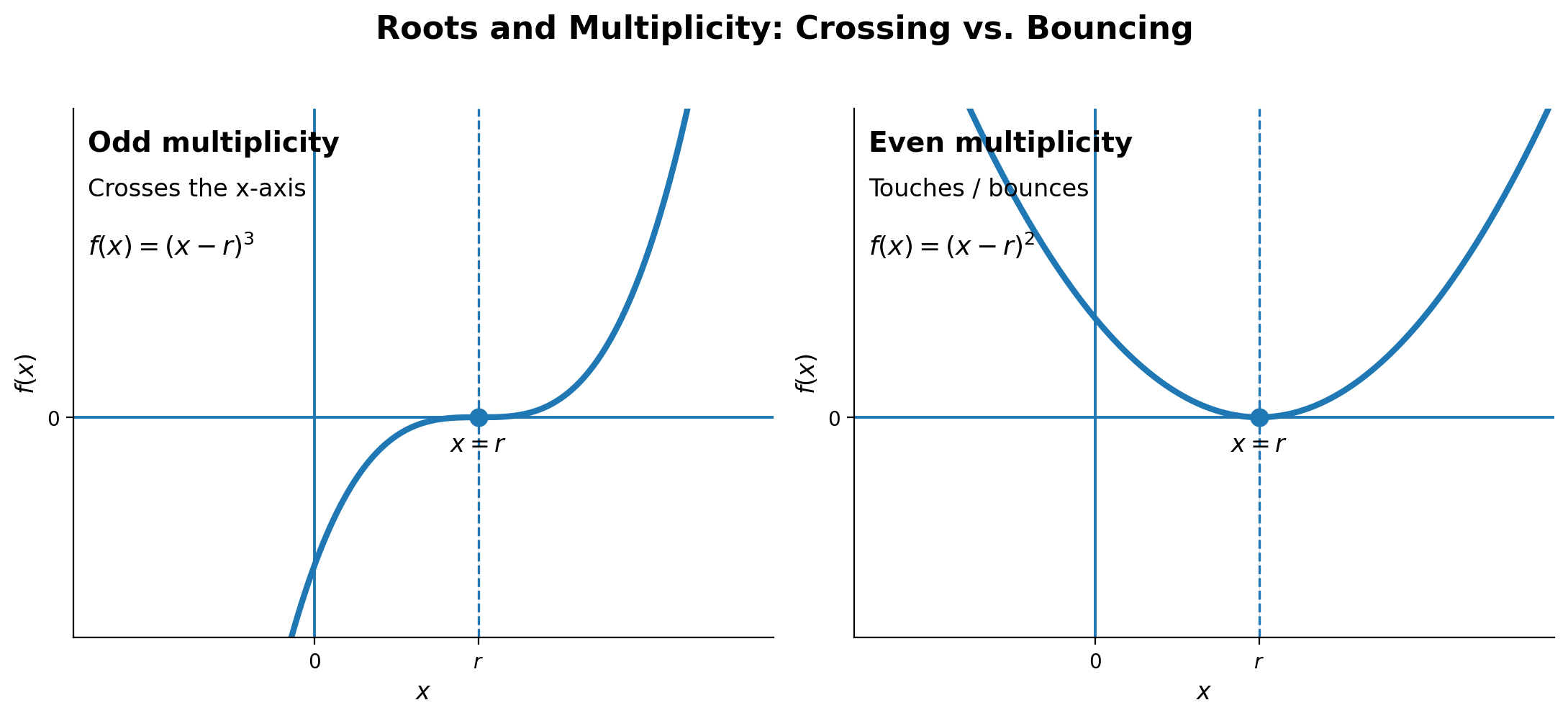
A root occurs when \(f(r) = 0\).
When written in factored form:
\[ f(x) = (x - r)^m \]- Odd multiplicity (\(m\) odd): graph crosses the x-axis
- Even multiplicity (\(m\) even): graph touches/bounces off the x-axis
- Odd multiplicity (\(m\) odd): graph crosses the x-axis
Common Problem Types
1. Determining End Behavior
Look only at the leading term’s degree and coefficient.
2. Identifying Roots From Factored Form
Each factor \((x - r)^m\) gives root \(r\) with multiplicity \(m\).
3. Predicting Crossing vs. Touching
Odd multiplicity → crossing
Even multiplicity → touching/bouncing
4. Mixed Polynomial Expressions
Sometimes you need to expand or recognize the leading term before analyzing.
Strategies
- Always rewrite the polynomial in descending powers of \(x\) before analyzing.
- Focus on the leading term for end behavior—ignore everything else.
- Use multiplicity to decide how the graph behaves at each root.
- Combine your knowledge: the degree gives overall behavior; multiplicity gives local behavior.
- If unsure, sketch rough behavior using end behavior + roots + multiplicities.
Worked Examples
Example 1 — Determine End Behavior
Analyze:
\[
f(x) = -3x^4 + 7x - 2
\]
Leading term: \(-3x^4\)
- Degree: even
- Leading coefficient: negative
End behavior: down–down
Example 2 — Analyze Multiplicity
Given:
\[
f(x) = (x + 2)^2 (x - 1)
\]
Roots:
- \(x = -2\) (multiplicity 2 → touches the x-axis)
- \(x = 1\) (multiplicity 1 → crosses the x-axis)
- Looking at the constant term instead of the leading term for end behavior.
- Assuming every root crosses the axis—multiplicity matters.
- Ignoring the sign of the leading coefficient when describing the graph’s direction.
Practice Problems
- Determine the end behavior of \(4x^5 - 7x + 3\).
- Determine the end behavior of \(-2x^6 + x^2 - 1\).
- For \(f(x) = (x - 3)^3\), does the graph cross or touch at \(x = 3\)?
- List roots and multiplicities of \((x + 5)^2 (x - 1)^4\).
- Determine the end behavior of \((x - 2)^2(x + 1)^3\).
1.
Leading term: \(4x^5\) → odd degree, positive coefficient → down–up
2.
Leading term: \(-2x^6\) → even degree, negative coefficient → down–down
3.
Multiplicity 3 (odd) → crosses
4.
Roots:
- \(x = -5\) (multiplicity 2)
- \(x = 1\) (multiplicity 4)
5.
Leading behavior: degree \(5\) (odd), positive leading coefficient → up–down
Summary
- End behavior depends only on the leading term’s degree and coefficient.
- Even degree → ends move in the same direction; odd degree → opposite directions.
- Positive coefficients lift the right side; negative coefficients pull it down.
- Multiplicity determines whether the graph crosses or only touches the x-axis.
- Factored form makes it easy to identify roots and multiplicities.
- Ignore all but the leading term when describing end behavior.
- Even multiplicity → touch; odd multiplicity → cross.
- Look for factored form—it reveals roots instantly.
- Use multiplicity + end behavior to sketch quick polynomial graphs.