Multiplying Polynomials (FOIL & Distributive)
By the end of this lesson, you’ll be able to:
- Multiply binomials and larger polynomials confidently.
- Apply the FOIL pattern when multiplying binomials.
- Use the distributive property to expand any polynomial expression.
- Combine like terms to write expressions in simplified form.
Key Ideas
Distributive property \[ a(b + c) = ab + ac \]
FOIL for binomials
Multiply:- First terms
- Outer terms
- Inner terms
- Last terms
- First terms
General polynomial multiplication
Multiply each term in the first polynomial by each term in the second, then combine like terms.
Common Problem Types
1. Binomial × Binomial
Use FOIL as a structured way to distribute.
2. Binomial × Polynomial
Distribute each binomial term across the entire second polynomial.
3. Polynomial × Polynomial
Multiply term-by-term; expect multiple like terms to combine.
4. Special Cases
Perfect square patterns such as \((a - b)^2\) or \((a + b)^2\).
Strategies
- Start by distributing systematically—FOIL is just a special case of distribution.
- Keep your work organized by lining up like terms.
- Multiply coefficients and variables separately:
\[ (ax^m)(bx^n) = abx^{m+n} \] - After expanding, always combine like terms.
- Rewrite your final answer in descending power order.
Worked Examples
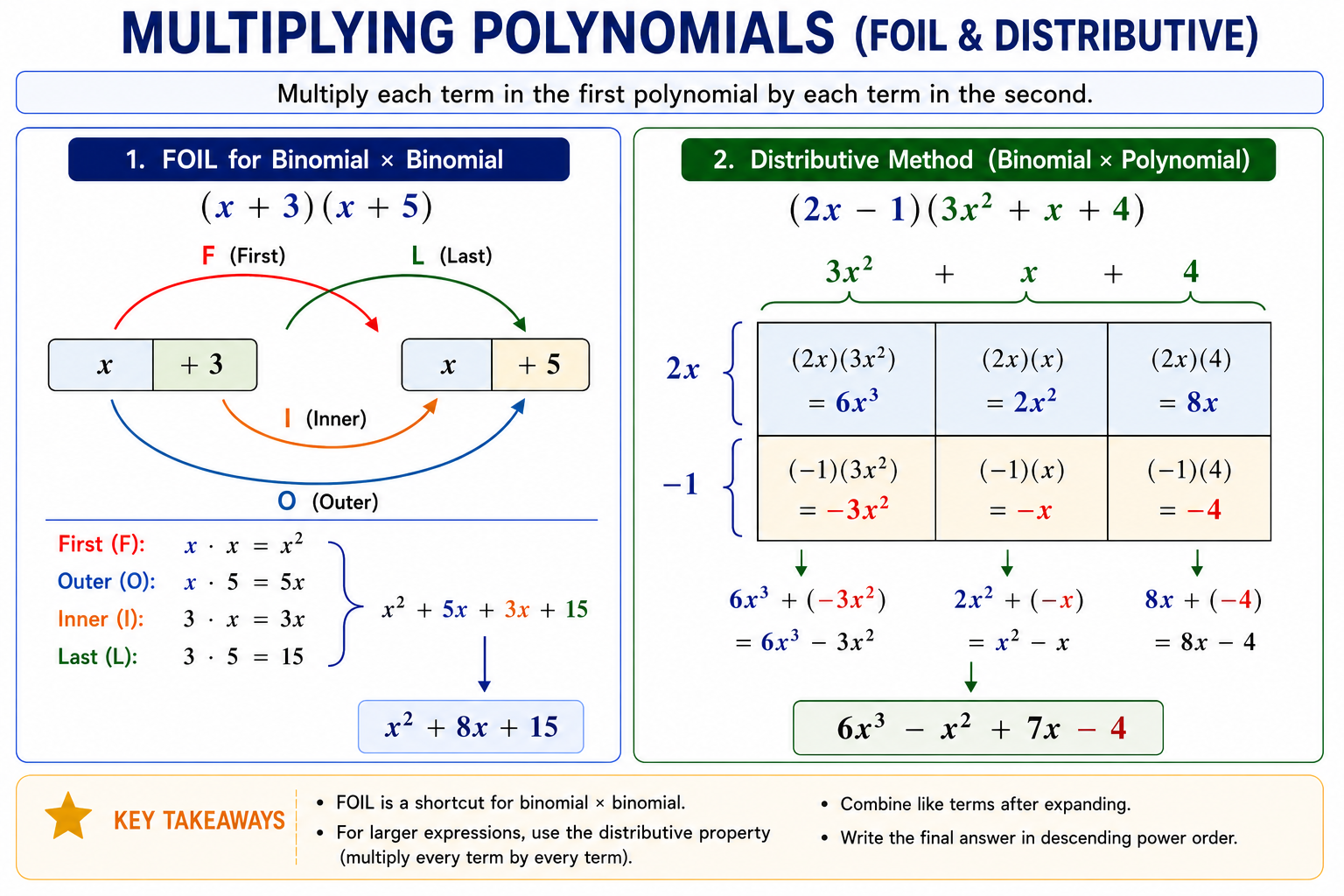
Example 1 — FOIL
Multiply:
\[
(x + 3)(x + 5)
\]
Solution:
Apply FOIL:
\[ \begin{split} \text{First: } & x \cdot x = x^2 \\ \text{Outer: } & x \cdot 5 = 5x \\ \text{Inner: } & 3 \cdot x = 3x \\ \text{Last: } & 3 \cdot 5 = 15 \end{split} \]
Combine like terms: \[ x^2 + 8x + 15 \]
Example 2 — Full Distribution
Multiply:
\[
(2x - 1)(3x^2 + x + 4)
\]
Solution:
Distribute each term in \((2x - 1)\) across \((3x^2 + x + 4)\).
\[ \begin{split} 2x(3x^2 + x + 4) &= 6x^3 + 2x^2 + 8x \\ -1(3x^2 + x + 4) &= -3x^2 - x - 4 \end{split} \]
Combine: \[ 6x^3 - x^2 + 7x - 4 \]
- Forgetting one of the FOIL products when multiplying binomials.
- Not distributing to every term in the second polynomial.
- Leaving the result uncombined—always merge like terms.
Practice Problems
- \((x + 2)(x + 7)\)
- \((2x - 3)(x - 4)\)
- \((x + 5)(x^2 - x + 3)\)
- \((3y - 1)(2y + 4)\)
- \((a - 3)(a - 3)\)
1.
\[
x^2 + 9x + 14
\]
2.
\[
2x^2 - 11x + 12
\]
3.
\[
x^3 + 4x^2 + 2x + 15
\]
4.
\[
6y^2 + 10y - 4
\]
5.
\[
a^2 - 6a + 9
\]
Summary
- Multiply polynomials using distribution (FOIL is just one case).
- Multiply each term in one polynomial by each term in the other.
- Combine like terms after expanding.
- Keep expressions in descending powers for clarity.
- Stay organized to avoid missing any products.
- FOIL is simply the distributive property applied to binomials.
- Write out all products before combining—organization prevents mistakes.
- Combine like terms carefully after multiplying.
- Use descending order to present your final answer cleanly.