Polynomial Remainder Theorem
By the end of this lesson, you’ll be able to:
- Evaluate polynomials efficiently using the Remainder Theorem.
- Use \(f(c)\) to determine the remainder when dividing by \((x - c)\).
- Recognize when a number indicates a factor (remainder 0).
Key Ideas
The Remainder Theorem gives a shortcut to polynomial division.
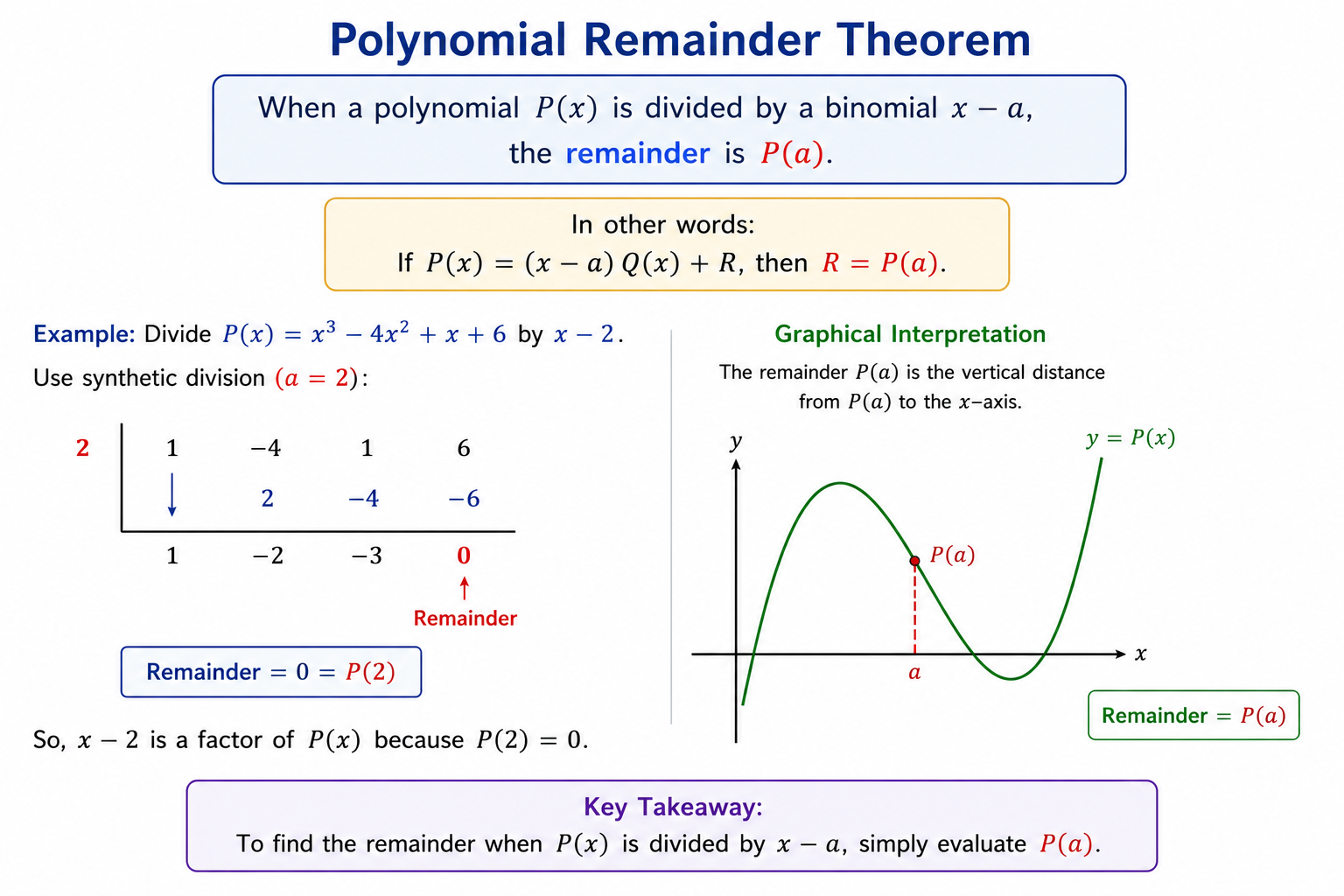
If a polynomial \(f(x)\) is divided by \((x - c)\), then:
\[ \text{Remainder} = f(c) \]
This avoids long or synthetic division and works for any polynomial.
Common Problem Types
1. Finding a Remainder
Compute \(f(c)\) directly.
2. Testing Factors
If \(f(c) = 0\), then \((x - c)\) is a factor of the polynomial.
3. Evaluating Large Polynomials
Use the theorem to evaluate without substituting carelessly.
4. Linking to Synthetic Division
Synthetic division’s final value matches \(f(c)\).
Strategies
- Substitute carefully: evaluate each term at \(x = c\).
- Keep signs clear—negative \(c\) values cause common mistakes.
- If \(f(c) = 0\), note that the divisor is a factor (Factor Theorem).
- For polynomials with many terms, compute step-by-step to avoid arithmetic errors.
- Use synthetic division whenever you want a quotient along with the remainder.
Worked Examples
Example 1 — Find a Remainder
Find the remainder when
\[
f(x) = 3x^4 - x^3 + 2x - 5
\]
is divided by \((x - 2)\).
Solution:
Evaluate \(f(2)\):
\[ \begin{split} f(2) &= 3(2^4) - (2^3) + 2(2) - 5 \\ &= 3(16) - 8 + 4 - 5 \\ &= 39 \end{split} \]
So the remainder is 39.
Example 2 — Checking a Factor
Is \((x - 3)\) a factor of \[ x^3 - 7x + 6? \]
Solution:
Compute \(f(3)\):
\[ \begin{split} f(3) &= 3^3 - 7(3) + 6 \\ &= 27 - 21 + 6 \\ &= 12 \end{split} \]
Since \(f(3) \neq 0\), \((x - 3)\) is not a factor.
- Plugging in \(-c\) instead of \(c\) for a divisor of \((x - c)\).
- Forgetting to evaluate every term of the polynomial.
- Confusing the Remainder Theorem with the Factor Theorem.
Practice Problems
- Remainder of \((x^3 - 4x^2 + x - 6)\) divided by \((x - 1)\).
- Evaluate \(f(-2)\) for \(f(x) = 2x^3 - x + 5\).
- Is \((x + 1)\) a factor of \(x^3 + 3x^2 + 3x + 1\)?
- Remainder of \(5x^4 + x\) divided by \((x - 3)\).
- Evaluate \(f(4)\) for \(f(x) = x^3 - 2x + 1\).
1.
\[
f(1) = 1 - 4 + 1 - 6 = -8
\]
2.
\[
f(-2) = 2(-8) - (-2) + 5 = -16 + 2 + 5 = -9
\]
3.
Check \(f(-1)\):
\[
(-1)^3 + 3(-1)^2 + 3(-1) + 1 = -1 + 3 - 3 + 1 = 0
\]
Yes, remainder 0 → it is a factor.
4.
\[
f(3) = 5(3^4) + 3 = 5(81) + 3 = 408
\]
5.
\[
f(4) = 64 - 8 + 1 = 57
\]
Summary
- Dividing by \((x - c)\) gives remainder \(f(c)\).
- If \(f(c) = 0\), then \((x - c)\) is a factor.
- Evaluating \(f(c)\) is usually faster than long or synthetic division.
- The theorem works for any polynomial degree.
- Synthetic division’s final value matches the remainder from the theorem.
- For divisors of \((x - c)\), plug in \(c\), not \(-c\).
- Check for factors by testing \(f(c) = 0\).
- Evaluate polynomials step-by-step to avoid arithmetic slips.
- Use synthetic division when you need both quotient and remainder.