Recognizing Quadratics
By the end of this lesson, you’ll be able to:
- Recognize quadratic expressions and quadratic equations.
- Distinguish quadratics from linear, cubic, and higher-degree expressions.
- Identify quadratics written in standard, vertex, or factored form.
Key Ideas
A quadratic in one variable is any expression that can be written as:
\[ ax^2 + bx + c, \]
where \(a \ne 0\).
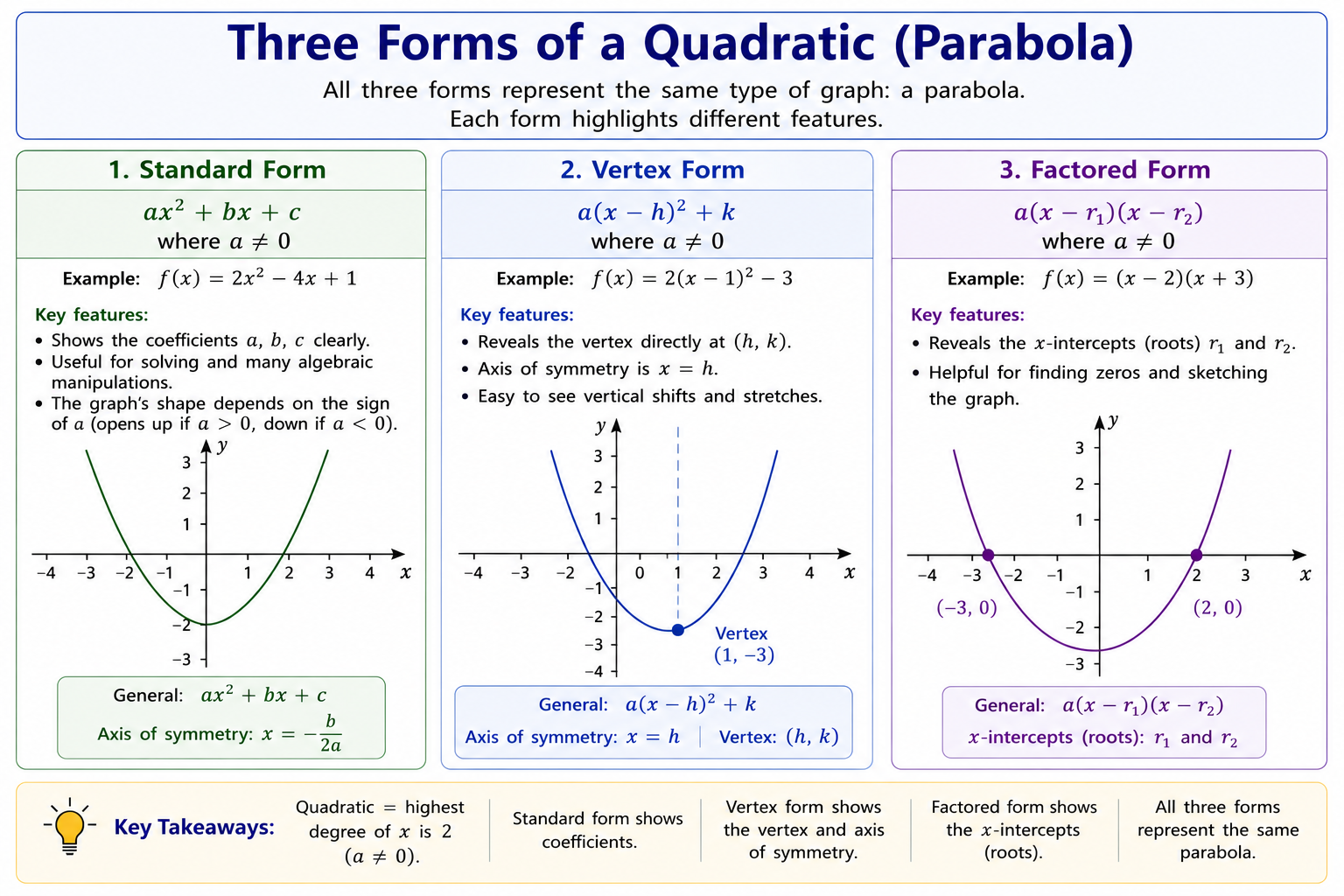
Quadratics appear in several common forms:
Standard form:
\(ax^2 + bx + c\)Vertex form:
\(a(x - h)^2 + k\)Factored form:
\(a(x - r_1)(x - r_2)\)
A quadratic equation sets a quadratic expression equal to something (often zero):
\[ ax^2 + bx + c = 0. \]
Common Problem Types
1. Identifying Quadratics
Check the highest power of \(x\)—it must be exactly 2.
2. Recognizing Forms
Expressions may look different but still represent the same quadratic.
3. Distinguishing From Other Degrees
Cubic terms (\(x^3\)) or higher automatically mean the expression is not quadratic.
4. Rewriting Between Forms
Vertex ↔︎ standard, factored ↔︎ standard, etc.
Strategies
- Expand squared binomials when needed to confirm the highest power.
- Ignore lower-degree terms—focus on the highest exponent.
- If any \(x^3\) or higher term is present, the expression is not quadratic.
- In vertex or factored form, rely on the structure rather than expanding unless necessary.
Worked Examples
Example 1 — Which expressions are quadratics?
Classify each:
- \(3x^2 - 5x + 1\)
- \(7x - 4\)
- \(x^3 + 2x^2\)
- \(5(x - 1)^2 + 3\)
Solution:
- Highest power is 2 → quadratic.
- Highest power is 1 → linear, not quadratic.
- Highest power is 3 → cubic, not quadratic.
- Expand to confirm:
\(5(x^2 - 2x + 1) + 3 = 5x^2 - 10x + 8\) → highest power 2 → quadratic.
Example 2 — Identify the form
For: \[ f(x) = 2(x - 3)^2 - 5, \]
- This is vertex form \(a(x - h)^2 + k\).
- \(a = 2\), \(h = 3\), \(k = -5\).
- The vertex is at \((3, -5)\).
- Thinking an expression is quadratic just because it contains \(x^2\) (look for \(x^3\) terms too).
- Forgetting that \(a\) must be nonzero—no \(x^2\) term → not quadratic.
- Missing quadratics written in vertex or factored form.
Practice Problems
- Is \(4x^2 + 7x\) quadratic?
- Is \(2(x + 1)^2 - 3\) quadratic?
- Is \(5x^3 - x^2 + 1\) quadratic?
- Write \(f(x) = x^2 - 6x + 9\) in vertex form.
- Is \(g(x) = 3(x - 2)(x + 5)\) quadratic?
1.
Highest power: \(x^2\) → quadratic.
2.
Expand:
\(2(x^2 + 2x + 1) - 3 = 2x^2 + 4x - 1\) → quadratic.
3.
Highest power: \(x^3\) → cubic, not quadratic.
4.
\(x^2 - 6x + 9\) is a perfect square:
\((x - 3)^2\)
Vertex form: \(f(x) = (x - 3)^2\).
5.
Expand:
\((x - 2)(x + 5) = x^2 + 3x - 10\)
Multiply: \(3x^2 + 9x - 30\)
Highest power: \(x^2\) → quadratic.
Summary
- A quadratic has highest degree 2, with \(a \ne 0\) in \(ax^2 + bx + c\).
- Quadratics appear in standard, vertex, and factored form.
- Any term with degree 3 or higher means it’s not a quadratic.
- Rewriting between forms helps reveal useful features like the vertex or roots.
- If the highest power is not exactly 2, it’s not quadratic.
- Recognize \((x - h)^2\) or \((x - r_1)(x - r_2)\) as quadratic even before expanding.
- Perfect square trinomials often convert cleanly to vertex form.
- When uncertain, expand and check the highest exponent.