Rational Equations
By the end of this lesson, you’ll be able to:
- Solve rational equations by multiplying through with the least common denominator (LCD).
- Identify and reject extraneous solutions.
- Apply denominator restrictions correctly.
Key Ideas
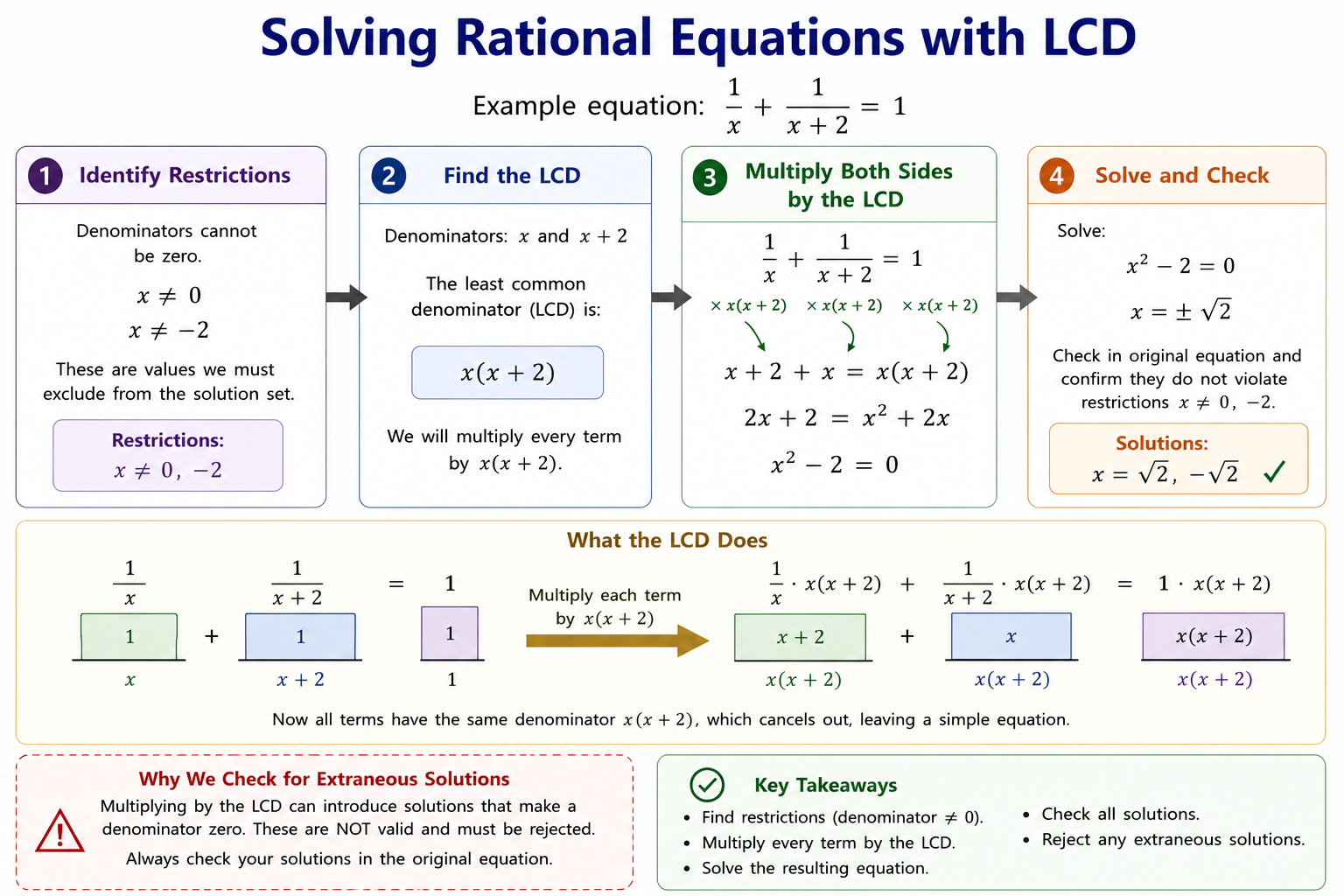
A rational equation includes at least one rational expression. Solving them requires removing denominators carefully.
General process:
- Identify restrictions (values that make denominators 0).
- Multiply the entire equation by the LCD.
- Solve the resulting simpler equation.
- Check for extraneous solutions—multiplying by the LCD can create false answers.
Common Problem Types
1. Single Rational Expression
Clear denominator and solve directly.
2. Multiple Rational Expressions
Find LCD of all denominators before multiplying through.
3. Equations Leading to Quadratics
Be prepared to factor or use the quadratic formula.
4. Extraneous Solutions
Always check solutions in the original equation.
Strategies
- Multiply both sides by the LCD before simplifying anything else.
- Keep parentheses around expressions when multiplying.
- After clearing denominators, solve using familiar algebra techniques.
- Every solution must be checked against the original restrictions.
- If a solution makes any denominator zero, discard it as extraneous.
Worked Examples
Example 1 — Simple Rational Equation
Solve: \[ \frac{3}{x} = 6 \]
Restriction:
\[
x \ne 0
\]
LCD = \(x\).
Multiply both sides by \(x\): \[ 3 = 6x \]
Solve: \[ x = \frac{1}{2} \]
Example 2 — LCD Needed
Solve: \[ \frac{1}{x} + \frac{1}{x + 2} = 1 \]
Restrictions:
\[
x \ne 0, -2
\]
LCD = \(x(x + 2)\).
Multiply each term:
\[ x + 2 + x = x(x + 2) \]
Simplify: \[ 2x + 2 = x^2 + 2x \]
Rearrange: \[ x^2 - 2 = 0 \]
Solve: \[ x = \pm \sqrt{2} \]
Both values satisfy the restrictions.
Example 3 — Possible Extraneous Solution
Solve: \[ \frac{x + 1}{x - 2} = 3 \]
Restriction: \[ x \ne 2 \]
Multiply both sides by \((x - 2)\):
\[ x + 1 = 3x - 6 \]
Solve: \[ 7 = 2x \quad \Rightarrow \quad x = \frac{7}{2} \]
Check: denominator is nonzero → valid.
- Forgetting to multiply every term by the LCD.
- Incorrect canceling (terms vs. factors).
- Skipping the extraneous solution check.
- Missing or ignoring denominator restrictions.
Practice Problems
- \(\dfrac{4}{x} = 2\)
- \(\dfrac{2}{x + 1} + \dfrac{1}{x + 1} = 5\)
- \(\dfrac{x}{x - 3} = 2\)
- \(\dfrac{3}{n} + 1 = \dfrac{5}{n}\)
- \(\dfrac{1}{y + 2} - \dfrac{1}{y} = \dfrac{1}{6}\)
1.
LCD = \(x\)
\[
4 = 2x \Rightarrow x = 2, \quad x \ne 0
\]
2.
\[
\frac{3}{x + 1} = 5
\] Solve: \[
x + 1 = \frac{3}{5} \Rightarrow x = -\frac{2}{5}
\]
3.
Multiply both sides by \((x - 3)\): \[
x = 2x - 6 \Rightarrow x = 6
\] Check: \(x \ne 3\) → valid.
4.
LCD = \(n\): \[
3 + n = 5 \Rightarrow n = 2, \quad n \ne 0
\]
5.
LCD = \(y(y + 2)\): \[
y - (y + 2) = \frac{y(y + 2)}{6}
\] Simplify and solve: \[
-2 = \frac{y^2 + 2y}{6} \Rightarrow y^2 + 2y + 12 = 0
\] \[
y = 6 \quad (\text{valid}), \quad y \ne 0, -2
\]
Summary
- Multiply both sides by the LCD to eliminate denominators.
- Always determine restrictions before solving.
- Clearing denominators often leads to linear or quadratic equations.
- Every solution must be checked for extraneous values.
- Valid solutions must not make any denominator zero.
- Always multiply every term by the LCD—no exceptions.
- Identify restrictions early to catch invalid solutions.
- After clearing denominators, the equation becomes normal algebra.
- Extraneous solutions appear often—check carefully.