Similarity & Congruence
By the end of this lesson, you’ll be able to:
- Determine whether triangles are similar or congruent.
- Use common similarity and congruence criteria.
- Match corresponding vertices and sides correctly.
- Solve for missing side lengths in similar triangles.
- Use scale factors to relate side lengths and areas.
Key Ideas
Similar Triangles (\(\sim\))
Similar triangles have the same shape but may have different sizes.
For similar triangles:
- Corresponding angles are equal.
- Corresponding side lengths are proportional.
If one triangle is a scaled version of another, its sides may look like:
\[ a,\;b,\;c \]
and:
\[ ka,\;kb,\;kc \]
where \(k\) is the scale factor.
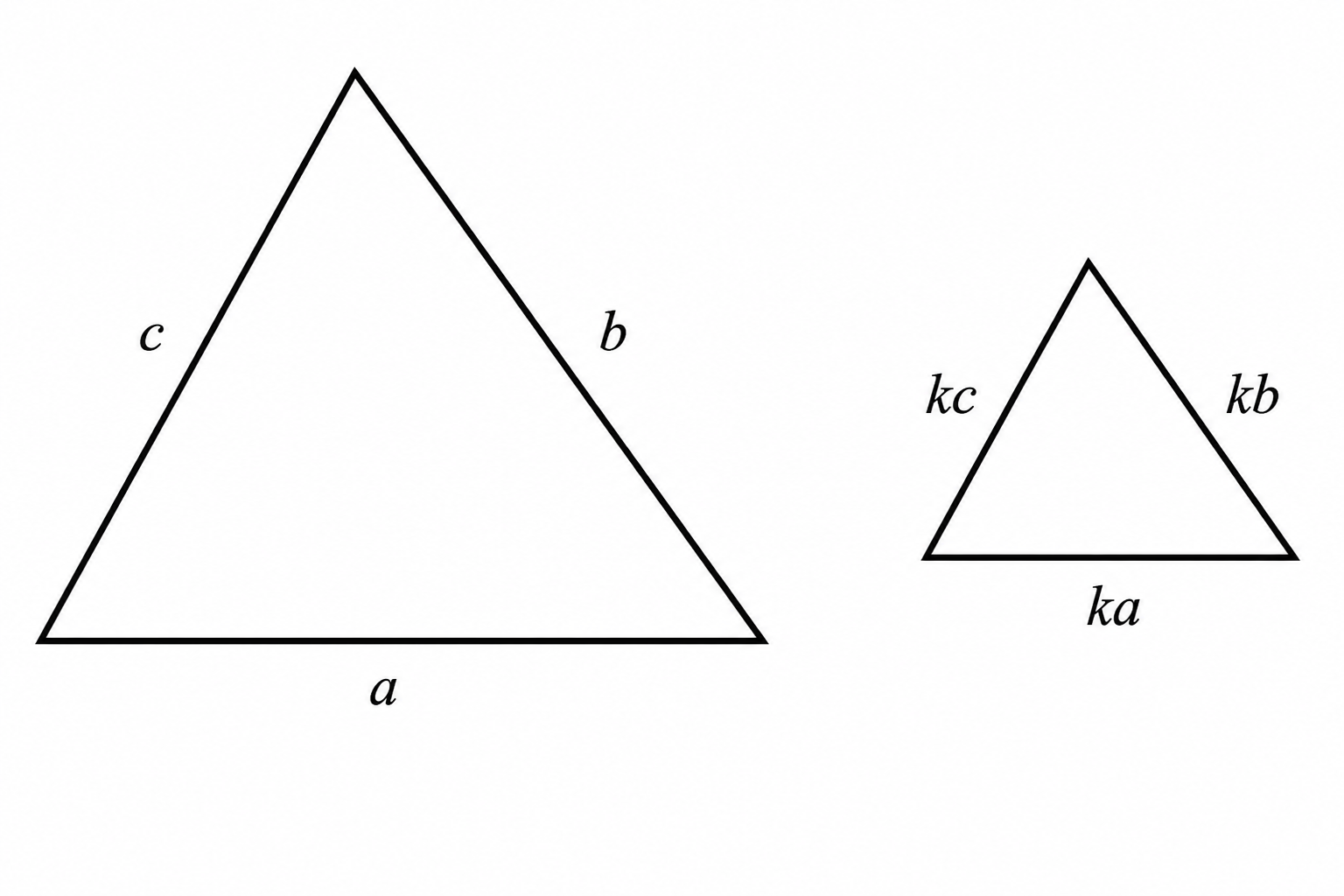
For example, if:
\[ \triangle ABC \sim \triangle DEF \]
then the order tells us which vertices correspond:
\[ A \leftrightarrow D,\qquad B \leftrightarrow E,\qquad C \leftrightarrow F \]
Therefore, the corresponding sides are:
\[ AB \leftrightarrow DE \]
\[ BC \leftrightarrow EF \]
\[ AC \leftrightarrow DF \]
and we can write:
\[ \frac{AB}{DE} = \frac{BC}{EF} = \frac{AC}{DF} \]
Congruent Triangles (\(\cong\))
Congruent triangles have the same shape and the same size.
Their corresponding:
- angles are equal, and
- side lengths are equal.
For example:
\[ \triangle ABC \cong \triangle DEF \]
means:
\[ AB=DE,\qquad BC=EF,\qquad AC=DF \]
Congruent triangles can be thought of as similar triangles with a scale factor of:
\[ k=1 \]
Similarity Criteria
You do not need to know every side and angle to prove that two triangles are similar.
AA — Angle-Angle
If two angles of one triangle are equal to two angles of another triangle, the triangles are similar.
\[ \boxed{\text{AA} \rightarrow \text{similar}} \]
Because the angles in every triangle add to \(180^\circ\), if two pairs of angles match, the third pair must also match.
SSS Similarity
If all three pairs of corresponding sides are proportional, the triangles are similar.
For example:
\[ \frac{3}{6} = \frac{4}{8} = \frac{5}{10} = \frac12 \]
Therefore, triangles with side lengths \(3,4,5\) and \(6,8,10\) are similar.
SAS Similarity
If two pairs of corresponding sides are proportional and the included angles are equal, the triangles are similar.
The included angle is the angle between the two sides being compared.
Congruence Criteria
For congruent triangles, the corresponding measurements must establish the same size as well as the same shape.
Common criteria include:
SSS — Side-Side-Side
All three pairs of corresponding sides are equal.
SAS — Side-Angle-Side
Two pairs of corresponding sides and the included angle are equal.
ASA — Angle-Side-Angle
Two corresponding angles and the side between them are equal.
AAS — Angle-Angle-Side
Two corresponding angles and a non-included corresponding side are equal.
HL — Hypotenuse-Leg
For right triangles only, equal hypotenuses and one pair of equal legs guarantee congruence.
Triangle Criteria Summary
| Criterion | Similarity? | Congruence? | Key Idea |
|---|---|---|---|
| AA | ✔️ | ❌ | Two equal angle pairs guarantee similarity |
| SSS | ✔️ | ✔️ | Similar: proportional sides; Congruent: equal sides |
| SAS | ✔️ | ✔️ | Similar: proportional sides; Congruent: equal sides |
| ASA | AA applies | ✔️ | Two angles already establish similarity |
| AAS | AA applies | ✔️ | Two angles already establish similarity |
| AAA | ✔️ | ❌ | Determines shape, but not size |
| HL | — | ✔️ | Special congruence rule for right triangles |
| SSA | ❌ | ❌ | Does not generally guarantee either |
Equal angles alone can prove similarity, but not congruence.
Two triangles can have exactly the same angles while one is much larger than the other.
Common Problem Types
1. Proving Triangles Are Similar
Look for matching angles or proportional sides.
The most common method is AA similarity.
For example, suppose two triangles each contain angles measuring:
\[ 50^\circ \quad \text{and} \quad 70^\circ \]
Two pairs of corresponding angles are equal, so:
\[ \boxed{\text{the triangles are similar by AA}} \]
You do not need to check the third angle.
2. Solving for Missing Sides
Once you know two triangles are similar, corresponding sides are proportional.
Suppose:
\[ \triangle ABC\sim\triangle DEF \]
and:
\[ AB=4,\qquad DE=10 \]
while:
\[ BC=6,\qquad EF=x \]
Match corresponding sides:
\[ AB\leftrightarrow DE \]
and:
\[ BC\leftrightarrow EF \]
Set up a proportion:
\[ \frac{4}{10}=\frac{6}{x} \]
Cross-multiply:
\[ 4x=60 \]
Divide by 4:
\[ x=15 \]
Therefore:
\[ \boxed{x=15} \]
3. Identifying Congruent Triangles
Look at the information given and determine which congruence criterion applies.
For example, suppose two triangles have corresponding side lengths:
\[ 5,\;7,\;9 \]
and:
\[ 5,\;7,\;9 \]
All three pairs of corresponding sides are equal.
Therefore:
\[ \boxed{\text{the triangles are congruent by SSS}} \]
4. Finding and Using a Scale Factor
The scale factor tells you how much larger or smaller one similar figure is than another.
For example, suppose a side of length 4 in a smaller triangle corresponds to a side of length 10 in a larger triangle.
From small to large, the scale factor is:
\[ k=\frac{10}{4}=\frac52 \]
So every length in the smaller triangle is multiplied by:
\[ \frac52 \]
to obtain its corresponding length in the larger triangle.
A scale factor depends on the direction.
Small → large:
\[ \frac{10}{4}=\frac52 \]
Large → small:
\[ \frac{4}{10}=\frac25 \]
Be clear about which figure is being scaled into which.
5. Area Relationships in Similar Figures
If two similar figures have a side-length scale factor of:
\[ k \]
then their areas have a scale factor of:
\[ k^2 \]
For example, if the side-length scale factor is 3:
\[ k=3 \]
then:
\[ \text{area scale factor}=3^2=9 \]
So the larger figure has 9 times the area of the smaller figure.
Strategies
- Match corresponding vertices first before writing a proportion.
- Use the order of a similarity or congruence statement to identify corresponding parts.
- Keep the direction of every ratio consistent.
- Look for angle markings and side markings in diagrams.
- For similarity, AA is often the quickest criterion to recognize.
- Look for parallel lines, which can create equal corresponding or alternate angles and lead to similar triangles.
- For congruence, decide whether the given information matches SSS, SAS, ASA, AAS, or HL.
- Remember that SSA generally does not work.
- When using a scale factor, lengths scale by \(k\), but areas scale by \(k^2\).
Worked Examples
Example 1 — Proving Similarity
Triangle \(ABC\) has angles:
\[ \angle A=40^\circ,\qquad \angle B=65^\circ \]
Triangle \(DEF\) has:
\[ \angle D=40^\circ,\qquad \angle E=65^\circ \]
We have two pairs of equal corresponding angles:
\[ \angle A=\angle D \]
and:
\[ \angle B=\angle E \]
Therefore, by AA similarity:
\[ \boxed{\triangle ABC\sim\triangle DEF} \]
Example 2 — Finding a Missing Side
Two triangles are similar.
A side of length 6 in the smaller triangle corresponds to a side of length 9 in the larger triangle.
Another side of length 10 in the smaller triangle corresponds to \(x\) in the larger triangle.
Set up corresponding sides in the same order:
\[ \frac{6}{9}=\frac{10}{x} \]
Cross-multiply:
\[ 6x=90 \]
Divide by 6:
\[ x=15 \]
Therefore:
\[ \boxed{x=15} \]
We could also use the scale factor. From small to large:
\[ k=\frac96=\frac32 \]
Then:
\[ 10\left(\frac32\right)=15 \]
Both methods give the same answer.
Example 3 — Identifying Congruence
Two triangles have two corresponding sides of lengths 5 and 8.
The angle between those two sides is \(60^\circ\) in both triangles.
We know:
- two corresponding sides are equal, and
- the included angle is equal.
Therefore, the triangles are congruent by:
\[ \boxed{\text{SAS}} \]
Example 4 — Area Scale Factor
Two triangles are similar with a side-length scale factor of 4 from the smaller triangle to the larger triangle.
Find the area scale factor.
Lengths scale by:
\[ k=4 \]
Areas scale by:
\[ k^2 \]
Therefore:
\[ 4^2=16 \]
So the area of the larger triangle is:
\[ \boxed{16\text{ times the area of the smaller triangle}} \]
- Mismatching corresponding vertices.
- Using non-corresponding sides in the same proportion.
- Reversing one ratio but not the others.
- Confusing similarity (\(\sim\)) with congruence (\(\cong\)).
- Assuming equal angles prove congruence—they only establish similarity.
- Using SSA as a general congruence rule.
- Forgetting that SAS uses the included angle.
- Forgetting to square the scale factor when comparing areas.
Practice Problems
Two triangles have two pairs of equal corresponding angles. Are the triangles necessarily similar? If so, state the criterion.
A side of length 6 in a smaller triangle corresponds to a side of length 9 in a larger similar triangle. Find the scale factor from the smaller triangle to the larger triangle.
Two similar triangles have a side-length scale factor of 2 from the smaller triangle to the larger triangle. By what factor does the area change?
A side of length 4 in a smaller triangle corresponds to a side in a larger similar triangle. If the scale factor from small to large is 3, find the corresponding side length.
Two triangles have corresponding side lengths \(4,6,8\) and \(4,6,8\). Which criterion proves that they are congruent?
1. Yes.
Two pairs of corresponding angles are equal.
That is enough to guarantee triangle similarity by AA:
\[ \boxed{\text{Yes, by AA similarity}} \]
2. The scale factor is the ratio:
\[ \frac{\text{new length}}{\text{original length}} \]
From the smaller triangle to the larger triangle:
\[ k=\frac96 \]
Simplify:
\[ k=\frac32 \]
Therefore:
\[ \boxed{k=\frac32} \]
3. The side-length scale factor is:
\[ k=2 \]
Areas scale by the square of the side-length scale factor:
\[ k^2=2^2 \]
\[ 2^2=4 \]
Therefore, the area of the larger triangle is:
\[ \boxed{4\text{ times as large}} \]
4. The scale factor from small to large is 3.
Multiply the smaller side by the scale factor:
\[ 4(3)=12 \]
Therefore, the corresponding side of the larger triangle is:
\[ \boxed{12} \]
5. All three pairs of corresponding sides are equal:
\[ 4=4,\qquad 6=6,\qquad 8=8 \]
Therefore, the triangles are congruent by Side-Side-Side:
\[ \boxed{\text{SSS}} \]
Summary
- Similar triangles have the same shape and proportional corresponding sides.
- Congruent triangles have the same shape and the same size.
- AA, SSS similarity, and SAS similarity can establish triangle similarity.
- SSS, SAS, ASA, AAS, and HL can establish triangle congruence.
- Corresponding vertices must be matched correctly before setting up proportions.
- If the side-length scale factor is \(k\), corresponding lengths scale by \(k\).
- Areas of similar figures scale by:
\[ k^2 \]
- Two matching angles? → AA similarity
- Three proportional sides? → SSS similarity
- Three equal sides? → SSS congruence
- Two equal sides + included angle? → SAS congruence
- Always match vertices in order.
- Lengths scale by \(k\); areas scale by \(k^2\).
- AAA proves similarity, not congruence.
- SSA generally proves neither.