Slope Concepts
By the end of this lesson, you’ll be able to:
- Understand slope as a rate of change and a measure of steepness.
- Compute slope using rise/run and the slope formula.
- Interpret positive, negative, zero, and undefined slopes.
- Identify slope from tables, graphs, and coordinate pairs.
Key Ideas
Slope tells you how quickly \(y\) changes for every step in \(x\).
It’s the mathematical version of “how steep is this line?”
The slope formula between \((x_1, y_1)\) and \((x_2, y_2)\) is:
\[ m = \frac{y_2 - y_1}{x_2 - x_1} \]
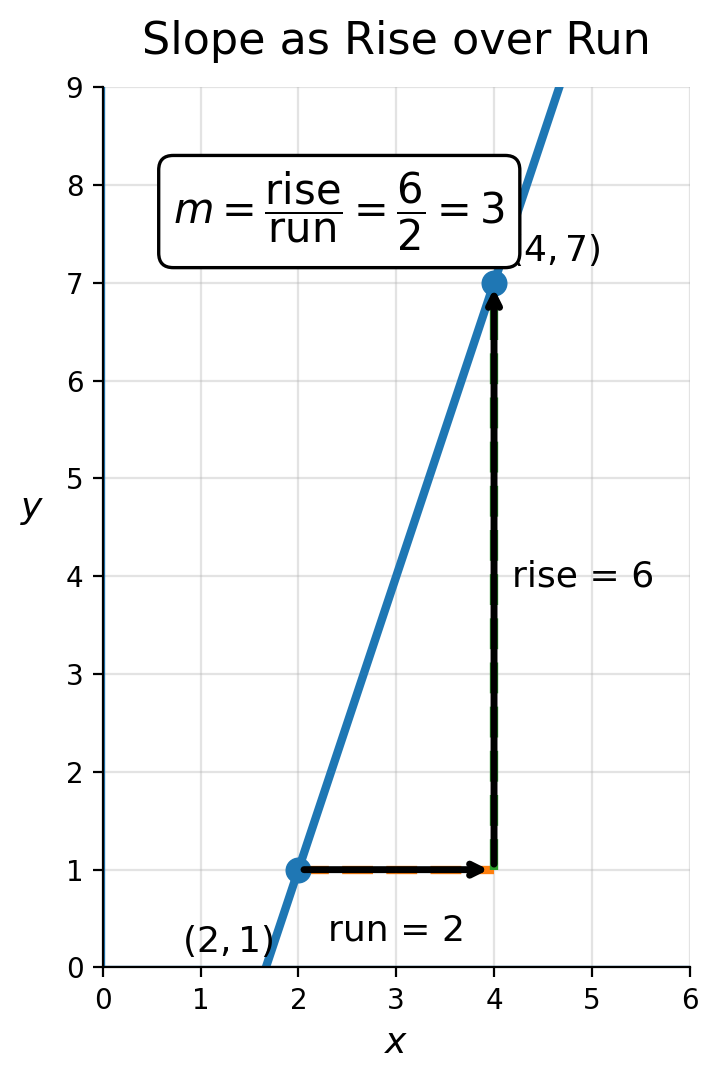
Interpreting slopes:
- Positive slope → line rises as you move right
- Negative slope → line falls as you move right
- Zero slope → horizontal line
- Undefined slope → vertical line
Common Problem Types
1. Slope from Two Points
Example: Find slope through \((2, 5)\) and \((4, 11)\).
\[ m = \frac{11 - 5}{4 - 2} = \frac{6}{2} = 3 \]
2. Slope from a Graph (Rise/Run)
Count rise (up/down) and run (right):
\[ m = \frac{\text{rise}}{\text{run}} \]
3. Slope from a Table
Example:
| x | y |
|---|---|
| 1 | 4 |
| 3 | 10 |
Slope:
\[ m = \frac{10 - 4}{3 - 1} = \frac{6}{2} = 3 \]
Strategies
- Keep the order of subtraction consistent: pair \((y_2 - y_1)\) with \((x_2 - x_1)\).
- Use a rise/run triangle when working from a graph to avoid sign confusion.
- Horizontal lines have slope 0; vertical lines have undefined slope — memorize these.
- If slope from data feels messy, jot the values into a tiny two-row table and apply the formula.
- Positive slope rises left → right; negative slope falls left → right.
Worked Examples
Example 1
Find slope through \((1, -2)\) and \((5, 6)\).
\[ m = \frac{6 - (-2)}{5 - 1} = \frac{8}{4} = 2 \]
Example 2
Slope of a vertical line \(x = 7\).
Vertical lines have undefined slope (division by zero).
- Reversing subtraction order in the slope formula.
- Dividing by zero when \(x\)-values match (vertical line).
- Misreading rise/run direction.
- Mixing slope with intercept.
Practice Problems
- Find slope through \((3, 1)\) and \((9, 13)\).
- Find slope through \((-1, 4)\) and \((2, -2)\).
- Identify slope of horizontal line \(y = -5\).
- Identify slope of vertical line \(x = 4\).
- Table: \(x = 2 \to y = 7\), \(x = 5 \to y = 19\) — find slope.
1.
\[
m = \frac{13 - 1}{9 - 3} = \frac{12}{6} = 2
\]
2.
\[
m = \frac{-2 - 4}{2 - (-1)} = \frac{-6}{3} = -2
\]
3.
Slope = 0.
4.
Slope = undefined.
5.
\[
m = \frac{19 - 7}{5 - 2} = \frac{12}{3} = 4
\]
Summary
- Slope measures how quickly \(y\) changes with respect to \(x\).
- Use the slope formula to compute slope from points or tables.
- Horizontal lines have slope \(0\); vertical lines have undefined slope.
- Stay consistent with subtraction order to avoid sign errors.
- Keep \((y_2 - y_1)\) over \((x_2 - x_1)\) — never mix the order.
- Horizontal = zero; vertical = undefined — commit these to memory.
- A rise/run triangle makes slope visible directly from the graph.
- If the number gets bigger as \(x\) increases, slope is positive; if it gets smaller, slope is negative.