Vectors
By the end of this lesson, you’ll be able to:
- Represent vectors graphically and in component form.
- Find a vector from two points.
- Add, subtract, and scale vectors using components.
- Compute magnitude and direction.
- Apply vectors to displacement, velocity, and force problems.
Key Ideas
A vector is a quantity with both:
- magnitude (length)
- direction
Unlike a regular number, a vector tells us not only how much but also which way.
Common examples include:
- displacement
- velocity
- force
- acceleration
Representing Vectors
Vectors are commonly represented as:
- an arrow in the plane
- component form
- the difference between two points
Component form:
\[ \langle a,b\rangle \]
means:
- move \(a\) units horizontally
- move \(b\) units vertically
For example,
\[ \langle 3,4\rangle \]
means:
- 3 units right
- 4 units up
Vector Components, Magnitude, and Direction
A vector can be viewed as the hypotenuse of a right triangle.
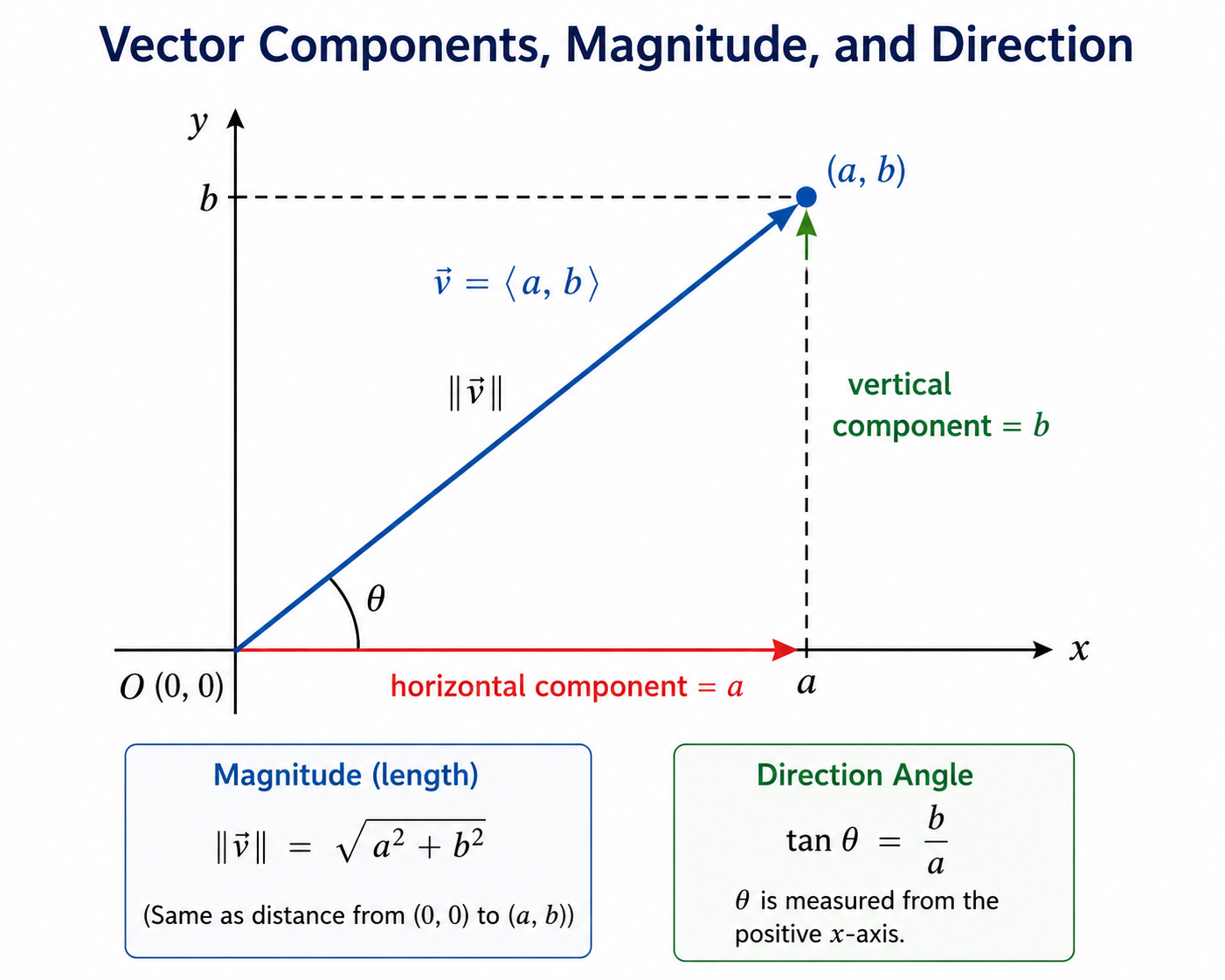
If
\[ \vec v=\langle a,b\rangle, \]
then:
- horizontal component = \(a\)
- vertical component = \(b\)
Since the horizontal and vertical components form the legs of a right triangle, the vector’s magnitude is found using the Pythagorean Theorem:
\[ \|\vec v\| = \sqrt{a^2+b^2} \]
This is also the same as the distance formula from the origin \((0,0)\) to the point \((a,b)\):
\[ d = \sqrt{(a-0)^2+(b-0)^2} = \sqrt{a^2+b^2} \]
So, you can think of magnitude as the distance from the starting point of the vector to its endpoint.
The direction angle \(\theta\) is usually measured from the positive x-axis.
To find it:
For vectors in Quadrant I,
\[ \tan\theta=\frac{b}{a}. \]
For vectors in other quadrants, use the signs of the components to determine the correct direction angle.
Use a calculator or inverse tangent to find the angle.
Be careful: the value from inverse tangent may need to be adjusted depending on the quadrant.
Vectors From Two Points
If
\[ A(x_A,y_A) \quad\text{and}\quad B(x_B,y_B), \]
then the vector from \(A\) to \(B\) is
\[ \overrightarrow{AB} = \langle x_B-x_A,\;y_B-y_A\rangle. \]
A useful memory trick:
Start at A and end at B, so compute B − A.
Example:
\[ A(1,2),\quad B(6,5) \]
Then
\[ \overrightarrow{AB} = \langle 6-1,\;5-2\rangle = \langle 5,3\rangle. \]
This means that to move from \(A\) to \(B\), you move 5 units right and 3 units up.
Vector Operations
Vectors can be added, subtracted, and multiplied by scalars.
When working in component form, vector operations are done component-by-component.
Vector Addition
To add two vectors, add their corresponding components:
\[ \langle a,b\rangle + \langle c,d\rangle = \langle a+c,\;b+d\rangle \]
Graphically, vector addition can be shown using the head-to-tail method:
- Draw the first vector.
- Place the tail of the second vector at the head of the first vector.
- The resultant vector starts at the beginning of the first vector and ends at the head of the second vector.
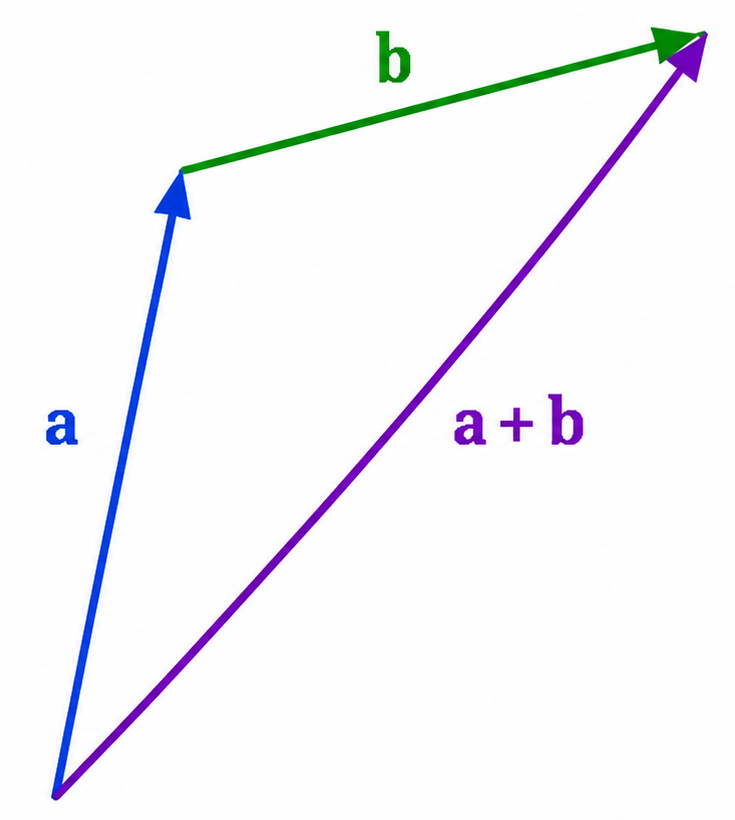
The vector
\[ \vec a+\vec b \]
represents the combined effect of moving along \(\vec a\) and then along \(\vec b\).
For example, if one vector represents walking east and another represents walking north, their sum represents your total displacement.
Because vector addition is commutative,
\[ \vec a+\vec b=\vec b+\vec a. \]
The order does not matter.
Vector addition is also associative:
\[ (\vec a+\vec b)+\vec c = \vec a+(\vec b+\vec c). \]
When adding several vectors, you may group them in any way.
Vector Subtraction
To subtract two vectors, subtract their corresponding components:
\[ \langle a,b\rangle - \langle c,d\rangle = \langle a-c,\;b-d\rangle \]
The most important idea to remember is:
\[ \vec a-\vec b = \vec a+(-\vec b) \]
Vector subtraction is really vector addition with the opposite vector.
To subtract a vector:
- Reverse the direction of \(\vec b\) to create \(-\vec b\).
- Add \(-\vec b\) to \(\vec a\) using the same head-to-tail method used for vector addition.
This is exactly the same idea as ordinary arithmetic:
\[ 5-3 = 5+(-3) \]
Vectors follow the same rule:
\[ \vec a-\vec b = \vec a+(-\vec b). \]
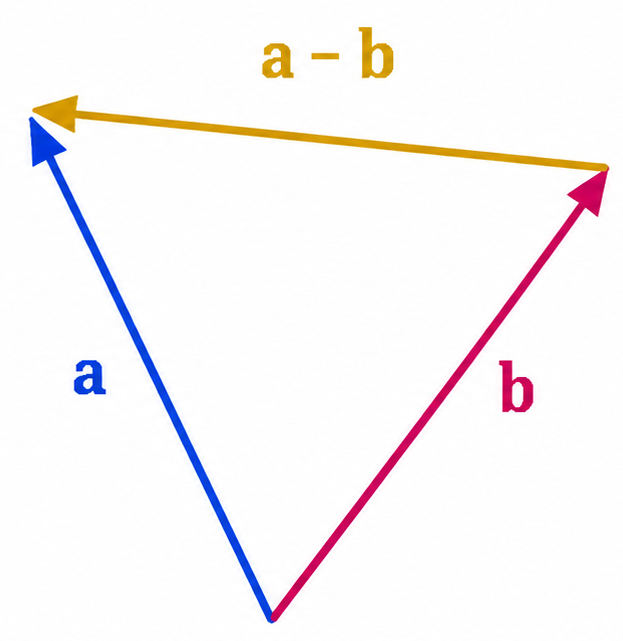
Notice that the subtraction figure can be interpreted as adding a vector that points in the opposite direction.
The vector
\[ \vec a-\vec b \]
represents the difference between the two vectors.
Another useful interpretation is:
\(\vec a-\vec b\) tells us what must be added to \(\vec b\) to obtain \(\vec a\).
In other words,
\[ \vec b+(\vec a-\vec b)=\vec a. \]
This interpretation is often useful in physics when comparing two velocities, forces, or displacements.
Scalar Multiplication
A scalar is a regular number.
Multiplying a vector by a scalar changes its length and possibly its direction.
Algebraically,
\[ k\langle a,b\rangle = \langle ka,\;kb\rangle \]
where \(k\) is the scalar.
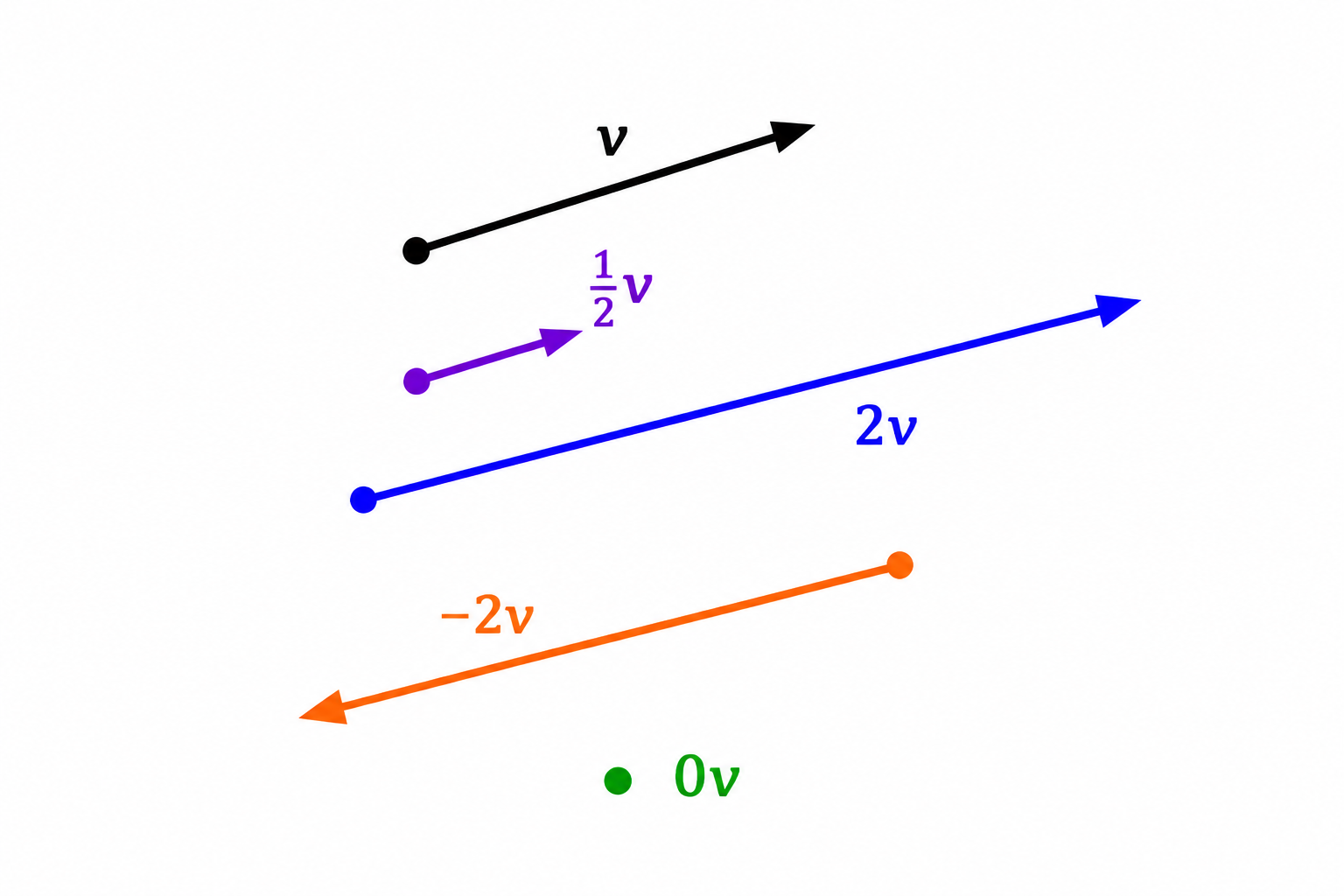
Notice the effects of scalar multiplication:
- \(2\vec v\) has the same direction as \(\vec v\) but twice the magnitude.
- \(\frac12\vec v\) has the same direction as \(\vec v\) but half the magnitude.
- \(-\vec v\) has the same magnitude as \(\vec v\) but points in the opposite direction.
- \(-2\vec v\) has twice the magnitude and points in the opposite direction.
- \(0\vec v\) becomes the zero vector.
A positive scalar changes the vector’s magnitude while preserving its direction.
A negative scalar changes the vector’s magnitude and reverses its direction.
Component Rules Summary
Addition:
\[ \langle a,b\rangle + \langle c,d\rangle = \langle a+c,\;b+d\rangle \]
Subtraction:
\[ \langle a,b\rangle - \langle c,d\rangle = \langle a-c,\;b-d\rangle \]
Scalar multiplication:
\[ k\langle a,b\rangle = \langle ka,\;kb\rangle \]
For most coordinate-based problems, component form is usually the fastest and most reliable method.
Common Problem Types
Finding a Vector From Two Points
Use the difference of coordinates.
For \(\overrightarrow{AB}\), subtract \(A\) from \(B\).
Finding Magnitude
Use the Pythagorean Theorem.
Use:
\[ \|\vec v\| = \sqrt{a^2+b^2} \]
Finding Direction
Use
\[ \tan\theta=\frac{b}{a}. \]
Then use the quadrant or diagram to make sure the angle points in the correct direction.
Adding or Subtracting Vectors
Add or subtract corresponding components.
This is usually faster than drawing the vectors.
Scalar Multiplication
Multiply every component by the scalar.
A negative scalar reverses direction.
A scalar with absolute value greater than 1 stretches the vector.
A scalar with absolute value between 0 and 1 shrinks the vector.
Displacement Applications
Vectors often represent movement.
Add movement vectors to find total displacement.
Use magnitude if the question asks for total straight-line distance from start to finish.
Strategies
- Draw arrows when possible to visualize direction.
- Use component form for calculations.
- Remember that magnitude is just the distance formula from the origin.
- Use B − A when finding a vector between two points.
- Check the quadrant when finding direction angles.
- Keep x-components and y-components separate.
- A negative scalar reverses direction.
- The zero vector has magnitude 0 and no specific direction.
Worked Examples
Example 1 — Find Magnitude and Direction
Given
\[ \vec v=\langle 6,8\rangle, \]
find its magnitude and direction.
Magnitude:
\[ \|\vec v\| = \sqrt{6^2+8^2} \]
\[ = \sqrt{36+64} = \sqrt{100} = 10 \]
Direction:
\[ \tan\theta=\frac86 = \frac43 \]
\[ \theta=\tan^{-1}\left(\frac43\right) \]
\[ \theta\approx53.13^\circ \]
So,
\[ \boxed{\|\vec v\|=10} \]
and
\[ \boxed{\theta\approx53.13^\circ}. \]
Example 2 — Add Vectors
Compute:
\[ \langle 4,-1\rangle + \langle -2,6\rangle \]
Add corresponding components:
\[ \langle 4+(-2),\;-1+6\rangle \]
\[ = \langle 2,5\rangle \]
So,
\[ \boxed{\langle 2,5\rangle} \]
Example 3 — Vector Between Two Points
Find
\[ \overrightarrow{PQ} \]
for
\[ P(-3,1),\quad Q(5,4). \]
Use B − A:
\[ \overrightarrow{PQ} = \langle 5-(-3),\;4-1\rangle \]
\[ = \langle 8,3\rangle \]
So,
\[ \boxed{\overrightarrow{PQ}=\langle 8,3\rangle}. \]
Example 4 — Displacement
A plane travels:
- 300 miles east
- 400 miles north
The displacement vector is
\[ \langle 300,400\rangle. \]
Magnitude:
\[ \sqrt{300^2+400^2} = \sqrt{90000+160000} = \sqrt{250000} = 500 \]
So the plane’s displacement is 500 miles.
Direction:
\[ \tan\theta = \frac{400}{300} = \frac43 \]
\[ \theta = \tan^{-1}\left(\frac43\right) \]
\[ \theta\approx53.13^\circ \]
So the plane travels approximately
\[ \boxed{53.13^\circ} \]
north of east.
- Mixing up direction angle and slope.
- Forgetting to square both components when finding magnitude.
- Using A − B instead of B − A when finding \(\overrightarrow{AB}\).
- Treating vectors as points rather than directed arrows.
- Mixing x-components with y-components.
- Forgetting that a negative scalar reverses direction.
- Reporting a negative magnitude. Magnitude is never negative.
- Assuming \(2\vec v\) changes direction. It does not; it only doubles the length.
Practice Problems
Find the magnitude of \(\langle -3,4\rangle\).
Add:
\[ \langle 1,2\rangle + \langle 5,-7\rangle \]
- Find
\[ \overrightarrow{AB} \]
for
\[ A(2,-1),\quad B(7,5). \]
- Multiply:
\[ -2\langle 3,-4\rangle \]
- A person walks
\[ \langle 6,2\rangle \]
miles, then
\[ \langle -4,5\rangle. \]
Find the net displacement vector.
1.
\[ \sqrt{(-3)^2+4^2} = \sqrt{9+16} = \sqrt{25} = 5 \]
So the magnitude is
\[ \boxed{5}. \]
2.
\[ \langle 1,2\rangle + \langle 5,-7\rangle = \langle 1+5,\;2+(-7)\rangle \]
\[ = \langle 6,-5\rangle \]
So the sum is
\[ \boxed{\langle 6,-5\rangle}. \]
3.
\[ \overrightarrow{AB} = \langle 7-2,\;5-(-1)\rangle \]
\[ = \langle 5,6\rangle \]
So,
\[ \boxed{\overrightarrow{AB}=\langle 5,6\rangle}. \]
4.
\[ -2\langle 3,-4\rangle = \langle -2(3),\;-2(-4)\rangle \]
\[ = \langle -6,8\rangle \]
So,
\[ \boxed{\langle -6,8\rangle}. \]
5.
\[ \langle 6,2\rangle + \langle -4,5\rangle = \langle 6+(-4),\;2+5\rangle \]
\[ = \langle 2,7\rangle \]
Net displacement:
\[ \boxed{\langle 2,7\rangle} \]
Summary
- Vectors have both magnitude and direction.
- Component form describes horizontal and vertical movement.
- Magnitude uses the same formula as the distance formula from the origin.
- To find a vector between two points, use B − A.
- Add and subtract vectors component-by-component.
- Scalar multiplication multiplies each component.
- Positive scalars stretch or shrink a vector without changing direction.
- Negative scalars reverse direction.
- Vectors model displacement, velocity, and force.
- Magnitude = distance from \((0,0)\) to \((a,b)\).
- Use B − A for \(\overrightarrow{AB}\).
- Add and subtract components separately.
- A negative scalar reverses direction.
- Check the quadrant when finding direction angles.