Coordinate Geometry Transformations
By the end of this lesson, you’ll be able to:
- Translate points and figures in the coordinate plane.
- Reflect points and figures across common lines.
- Rotate points and figures about the origin.
- Dilate figures using scale factors.
- Identify lines of symmetry.
- Recognize transformations from graphs and diagrams.
Key Ideas
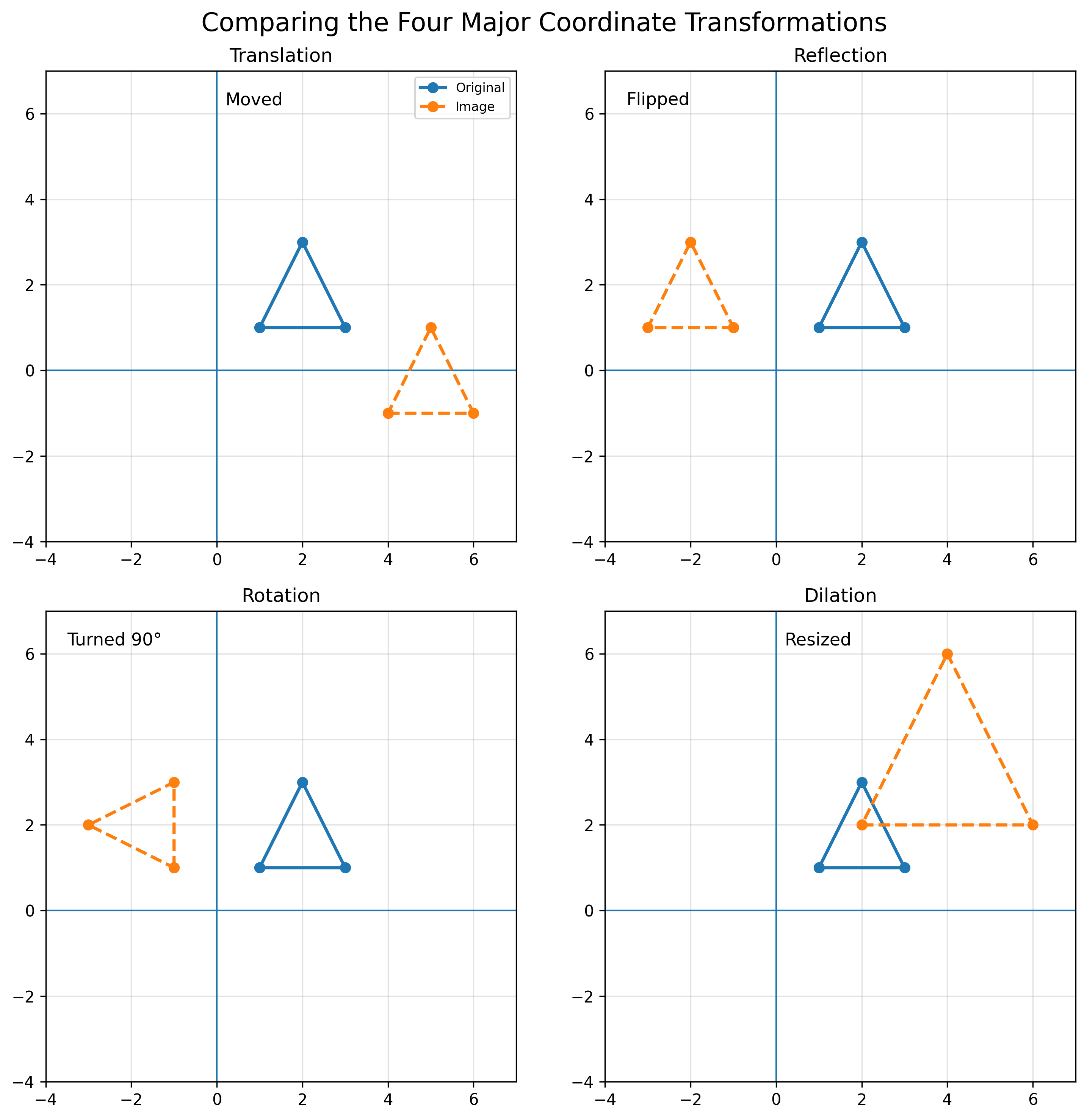
A transformation changes the position, orientation, or size of a figure in the coordinate plane.
Common transformations include:
- Translation
- Reflection
- Rotation
- Dilation
Transformations preserve some properties while changing others.
| Transformation | Changes Position? | Changes Orientation? | Changes Size? |
|---|---|---|---|
| Translation | Yes | No | No |
| Reflection | Yes | Yes | No |
| Rotation | Yes | Yes | No |
| Dilation | Yes | No | Yes |
Common Problem Types
1. Translations
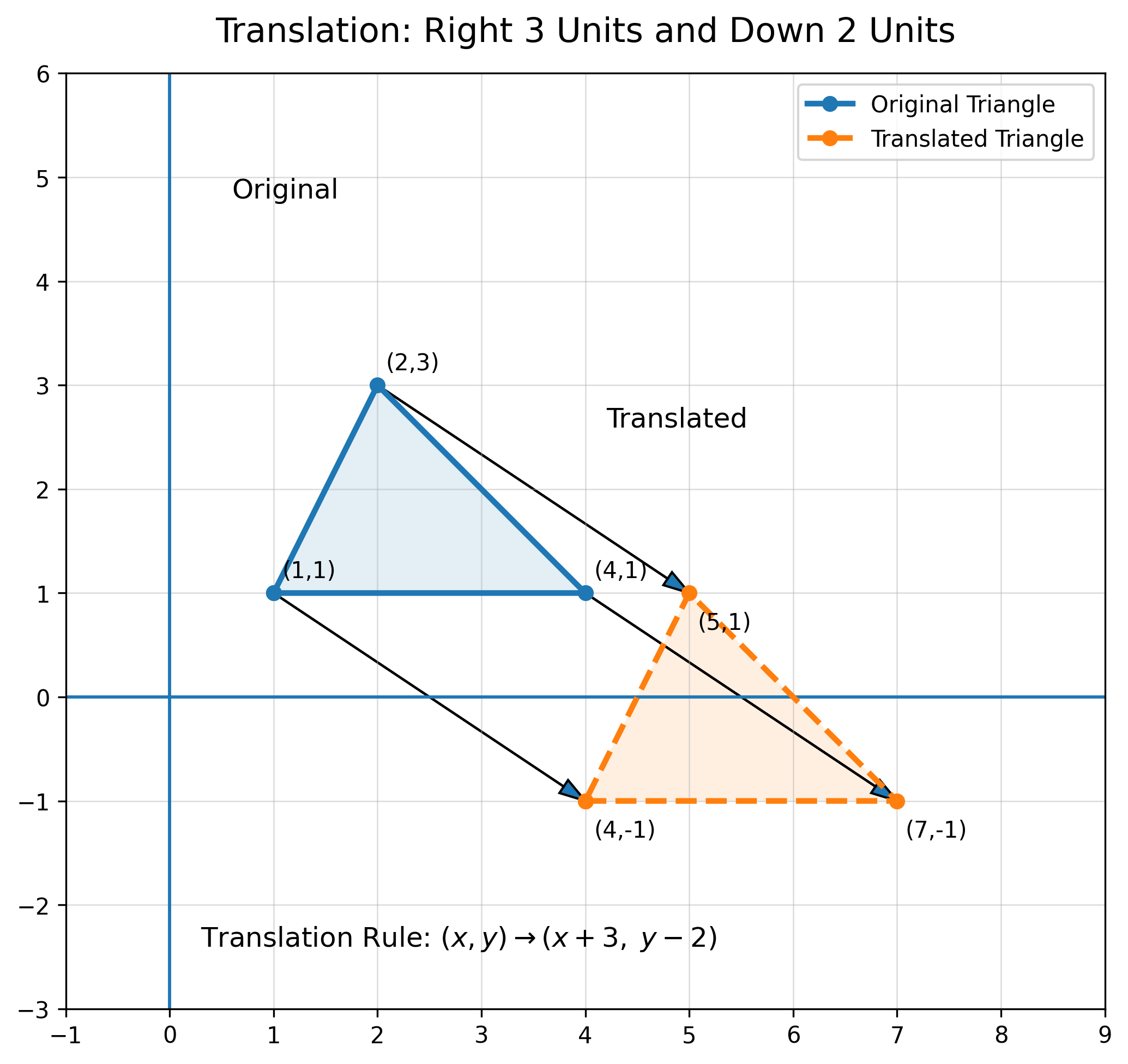
A translation slides a figure without changing its size or shape.
Coordinate rule:
\[ (x,y)\rightarrow(x+a,\;y+b) \]
where:
- \(a\) = horizontal movement
- \(b\) = vertical movement
Example:
\[ (2,3)\rightarrow(5,1) \]
This corresponds to:
\[ (x,y)\rightarrow(x+3,\;y-2) \]
2. Reflections
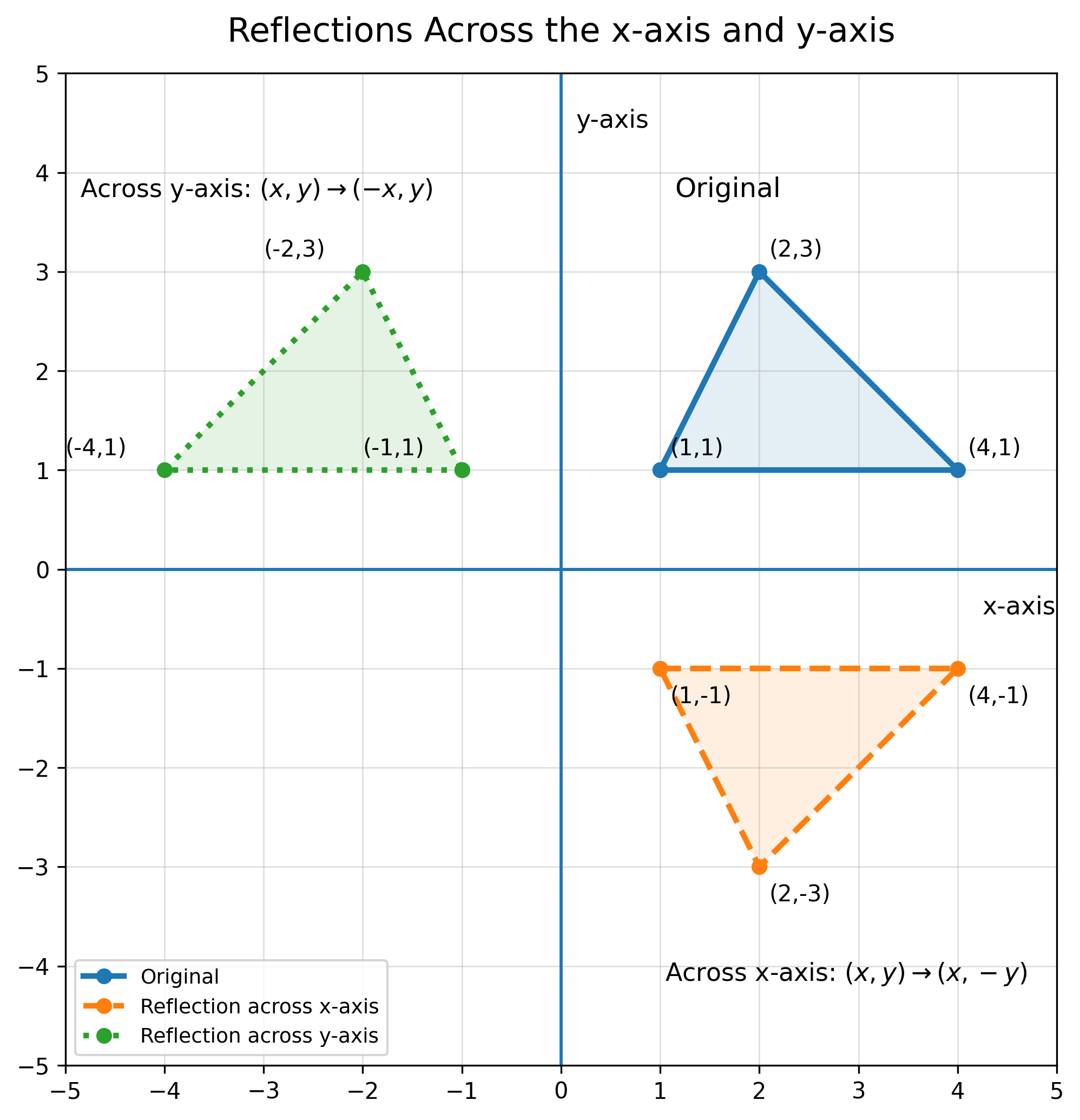
A reflection flips a figure across a line.
Common reflection rules:
| Reflection | Rule |
|---|---|
| Across x-axis | \((x,y)\rightarrow(x,-y)\) |
| Across y-axis | \((x,y)\rightarrow(-x,y)\) |
| Across origin | \((x,y)\rightarrow(-x,-y)\) |
| Across \(y=x\) | \((x,y)\rightarrow(y,x)\) |
Example:
Reflect
\[ (4,-2) \]
across the x-axis.
Apply:
\[ (x,y)\rightarrow(x,-y) \]
Result:
\[ (4,2) \]
3. Rotations
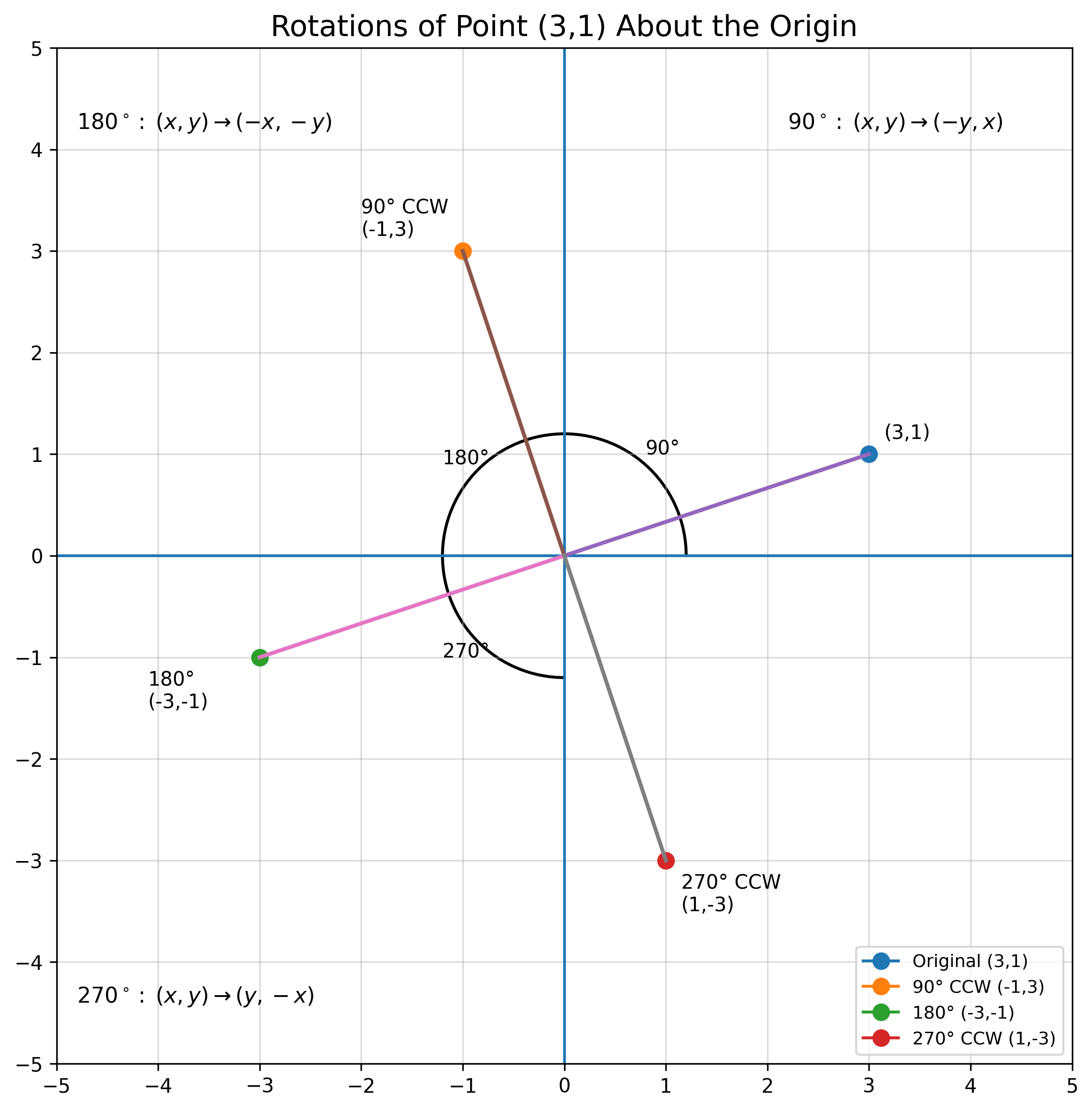
Rotations turn a figure around a fixed point.
In many coordinate-geometry problems, rotations are around the origin.
Important rules to memorize:
| Rotation | Rule |
|---|---|
| 90° Counterclockwise | \((x,y)\rightarrow(-y,x)\) |
| 180° | \((x,y)\rightarrow(-x,-y)\) |
| 270° Counterclockwise | \((x,y)\rightarrow(y,-x)\) |
Example:
Rotate
\[ (3,1) \]
90° counterclockwise.
Apply:
\[ (x,y)\rightarrow(-y,x) \]
Result:
\[ (-1,3) \]
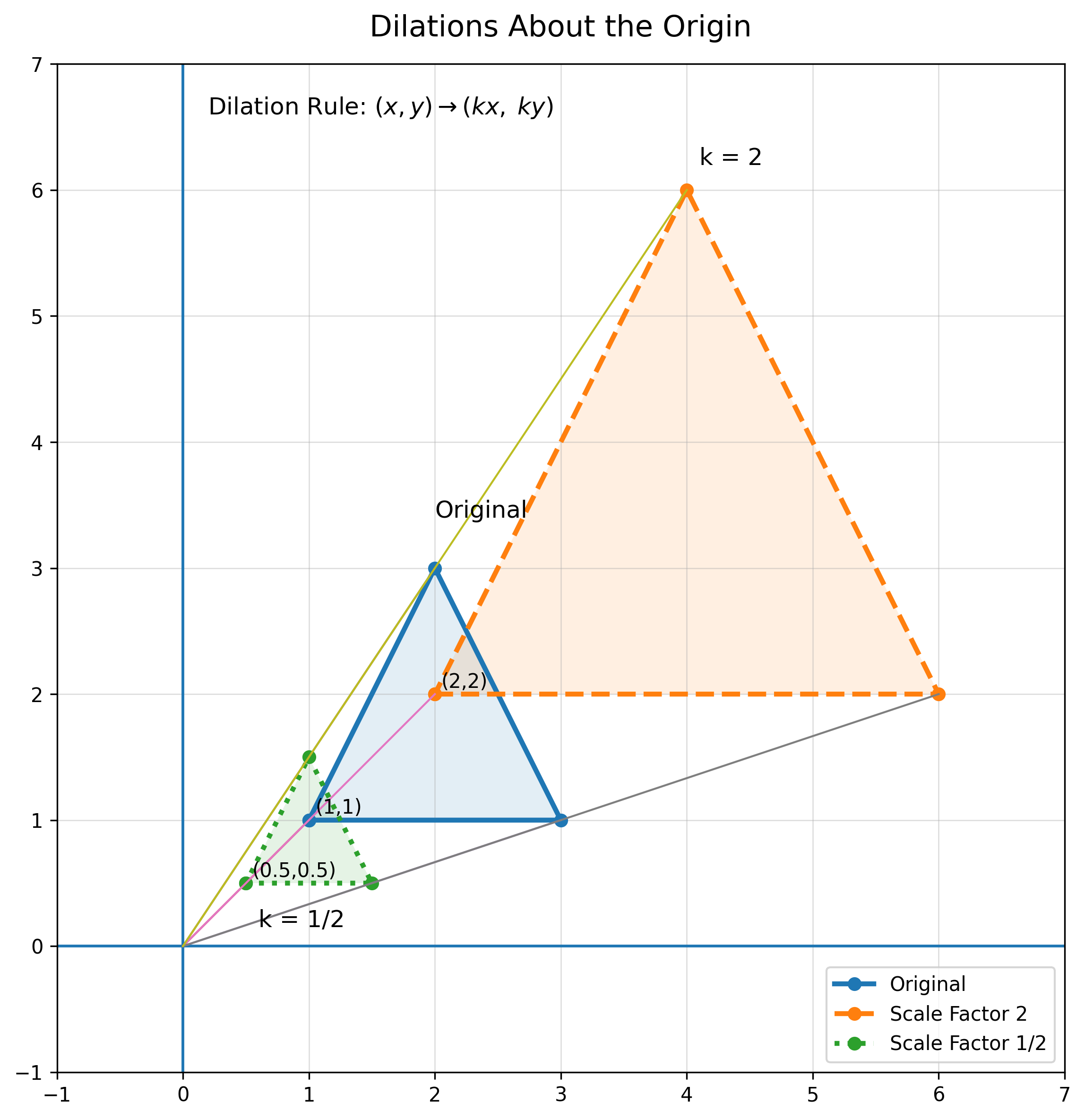
4. Dilations
A dilation changes the size of a figure.
Coordinate rule:
\[ (x,y)\rightarrow(kx,\;ky) \]
where \(k\) is the scale factor.
If:
\[ k>1 \]
the figure enlarges.
If:
\[ 0<k<1 \]
the figure shrinks.
Example:
Apply scale factor
\[ k=2 \]
to
\[ (3,4). \]
Result:
\[ (6,8). \]
Symmetry
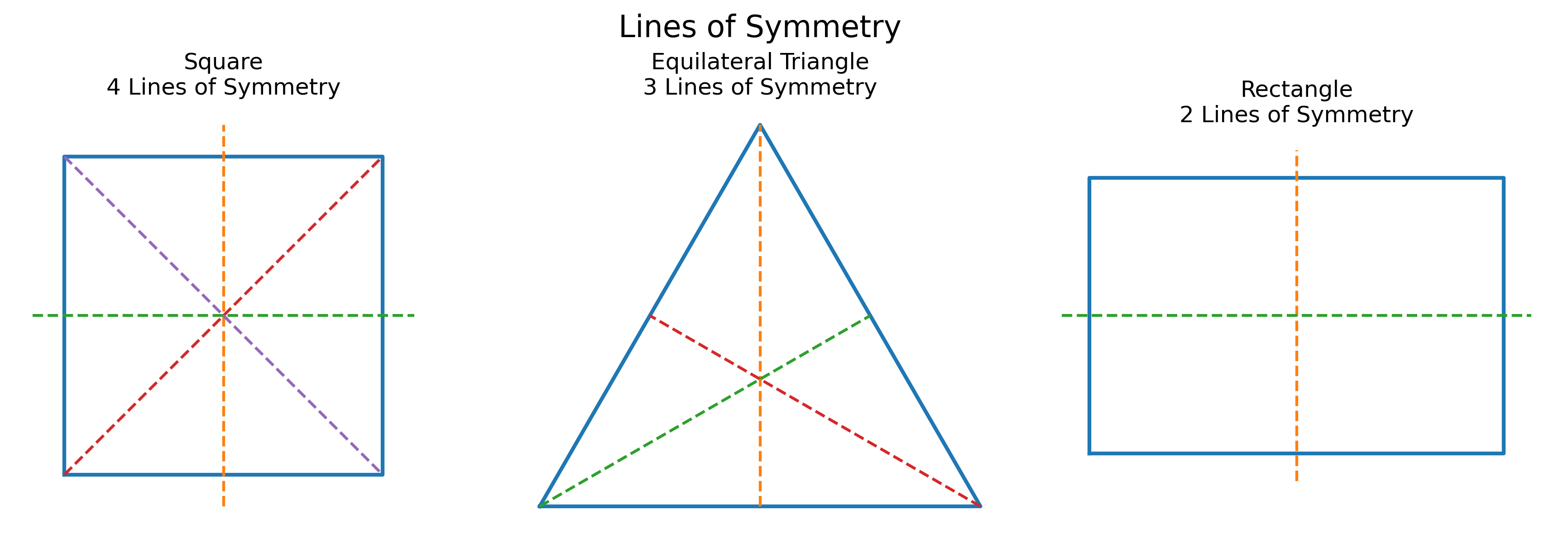
A figure has symmetry if it can be reflected across a line and still appear unchanged.
Examples:
| Figure | Lines of Symmetry |
|---|---|
| Equilateral Triangle | 3 |
| Square | 4 |
| Rectangle | 2 |
| Isosceles Triangle | 1 |
| Circle | Infinitely Many |
Identifying Transformations from Graphs
Many questions show two figures and ask which transformation occurred.
Look for these clues:
Translation
- Same orientation
- Same size
- Figure simply moved
Reflection
- Figure appears flipped
- Mirror image across a line
Rotation
- Figure turned around a point
- Size remains unchanged
Dilation
- Shape remains similar
- Size changes
Strategies
- Memorize the rotation rules.
- Memorize reflection rules across the x-axis and y-axis.
- Draw a quick coordinate plane if needed.
- For transformation problems, check whether the figure:
- moved,
- flipped,
- rotated,
- or resized.
- When working with coordinates, apply the transformation rule directly.
Worked Examples
Example 1 — Translation
Translate
\[ (-2,5) \]
using
\[ (x,y)\rightarrow(x+4,\;y-3). \]
Compute:
\[ x=-2+4=2 \]
\[ y=5-3=2 \]
Answer:
\[ (2,2) \]
Example 2 — Reflection Across the y-Axis
Reflect
\[ (6,-1) \]
across the y-axis.
Use:
\[ (x,y)\rightarrow(-x,y) \]
Answer:
\[ (-6,-1) \]
Example 3 — 180° Rotation
Rotate
\[ (-4,7) \]
180° about the origin.
Use:
\[ (x,y)\rightarrow(-x,-y) \]
Answer:
\[ (4,-7) \]
Example 4 — Dilation
Apply scale factor
\[ k=3 \]
to
\[ (2,-1). \]
Compute:
\[ (3\cdot2,\;3\cdot(-1)) \]
Answer:
\[ (6,-3) \]
Example 5 — Identify the Transformation
A triangle is moved 5 units right and 2 units down without changing size or orientation.
This is a:
Translation
because only the position changed.
Common Mistakes
- Mixing up reflections across the x-axis and y-axis.
- Forgetting rotation rules.
- Rotating clockwise when the problem specifies counterclockwise.
- Confusing reflections with rotations.
- Forgetting to multiply both coordinates during a dilation.
- Assuming every transformation changes size.
Practice Problems
- Translate \((3,4)\) using
\[ (x,y)\rightarrow(x-2,\;y+5). \]
Reflect \((5,-3)\) across the x-axis.
Reflect \((-4,2)\) across the y-axis.
Rotate \((2,7)\) by 90° counterclockwise.
Rotate \((3,-8)\) by 180°.
Rotate \((6,1)\) by 270° counterclockwise.
Dilate \((2,5)\) by scale factor 2.
Dilate \((8,-4)\) by scale factor \(\frac12\).
How many lines of symmetry does a square have?
A figure is flipped across a line. What transformation occurred?
1.
\[ (3-2,\;4+5) \]
Answer:
\[ (1,9) \]
2.
\[ (x,y)\rightarrow(x,-y) \]
Answer:
\[ (5,3) \]
3.
\[ (x,y)\rightarrow(-x,y) \]
Answer:
\[ (4,2) \]
4.
\[ (x,y)\rightarrow(-y,x) \]
Answer:
\[ (-7,2) \]
5.
\[ (x,y)\rightarrow(-x,-y) \]
Answer:
\[ (-3,8) \]
6.
\[ (x,y)\rightarrow(y,-x) \]
Answer:
\[ (1,-6) \]
7.
\[ (2\cdot2,\;5\cdot2) \]
Answer:
\[ (4,10) \]
8.
\[ \left(8\cdot\frac12,\;-4\cdot\frac12\right) \]
Answer:
\[ (4,-2) \]
9.
4 lines of symmetry.
10.
Reflection.
Summary
- Translations slide figures.
- Reflections create mirror images.
- Rotations turn figures around a point.
- Dilations change size using a scale factor.
- Symmetry describes mirror-image balance.
- Problems often ask you to identify transformations from diagrams or coordinate rules.
- Translation → move.
- Reflection → flip.
- Rotation → turn.
- Dilation → resize.
- 90° CCW: \((x,y)\rightarrow(-y,x)\).
- 180°: \((x,y)\rightarrow(-x,-y)\).
- 270° CCW: \((x,y)\rightarrow(y,-x)\).
- Reflection across x-axis: \((x,-y)\).
- Reflection across y-axis: \((-x,y)\).