Periodic Functions
By the end of this lesson, you’ll be able to:
- Understand what makes a function periodic.
- Identify the basic graphs of sine, cosine, and tangent functions.
- Determine amplitude, period, and midline for sinusoidal functions.
- Recognize transformations of trigonometric graphs.
- Interpret periodic behavior in real-world contexts.
Key Ideas
A periodic function repeats its values in a regular pattern.
For a periodic function: \[ f(x+P)=f(x) \]
where \(P\) is the period.
The most common periodic functions are:
- sine: \(\sin(x)\)
- cosine: \(\cos(x)\)
- tangent: \(\tan(x)\)
These functions repeat indefinitely.
Sine and Cosine
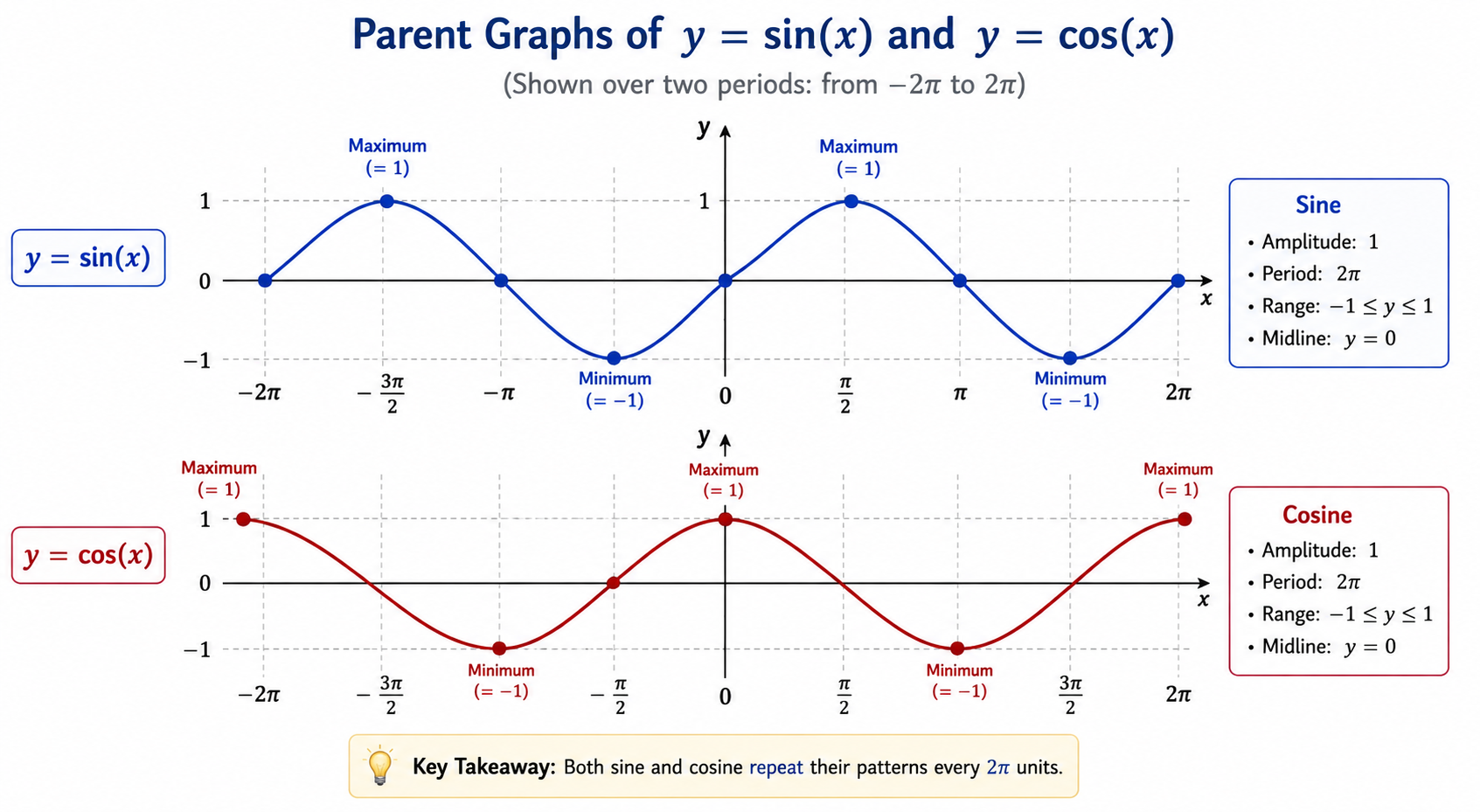
Basic sine function: \[ y=\sin(x) \]
Basic cosine function: \[ y=\cos(x) \]
Key features:
- Period: \[ 2\pi \]
- Range: \[ -1 \le y \le 1 \]
- Amplitude: \[ 1 \]
Tangent Function
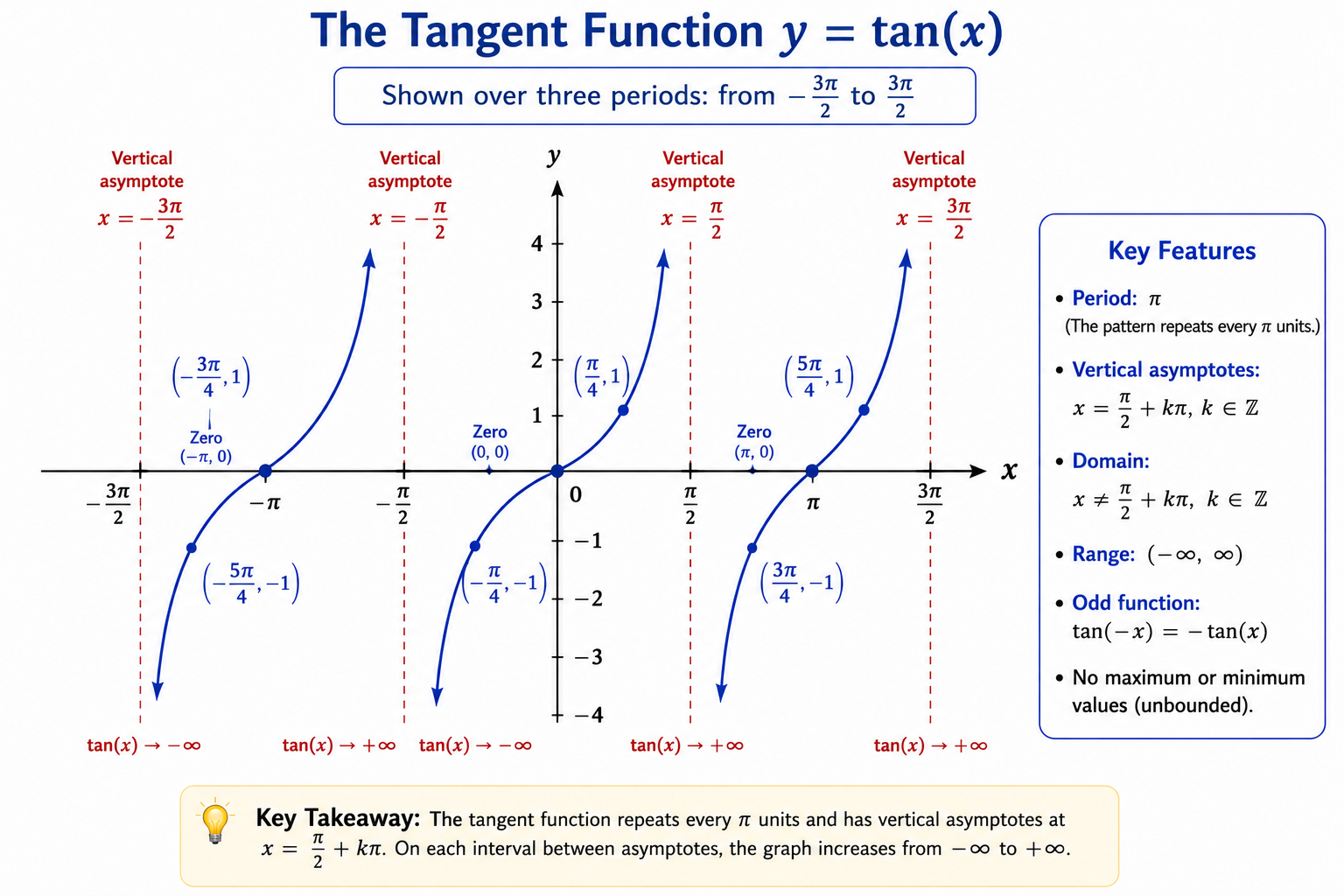
Basic tangent function: \[ y=\tan(x) \]
Key features:
- Period: \[ \pi \]
- Undefined at: \[ x=\frac{\pi}{2}+k\pi \]
- Has vertical asymptotes.
General Sinusoidal Form
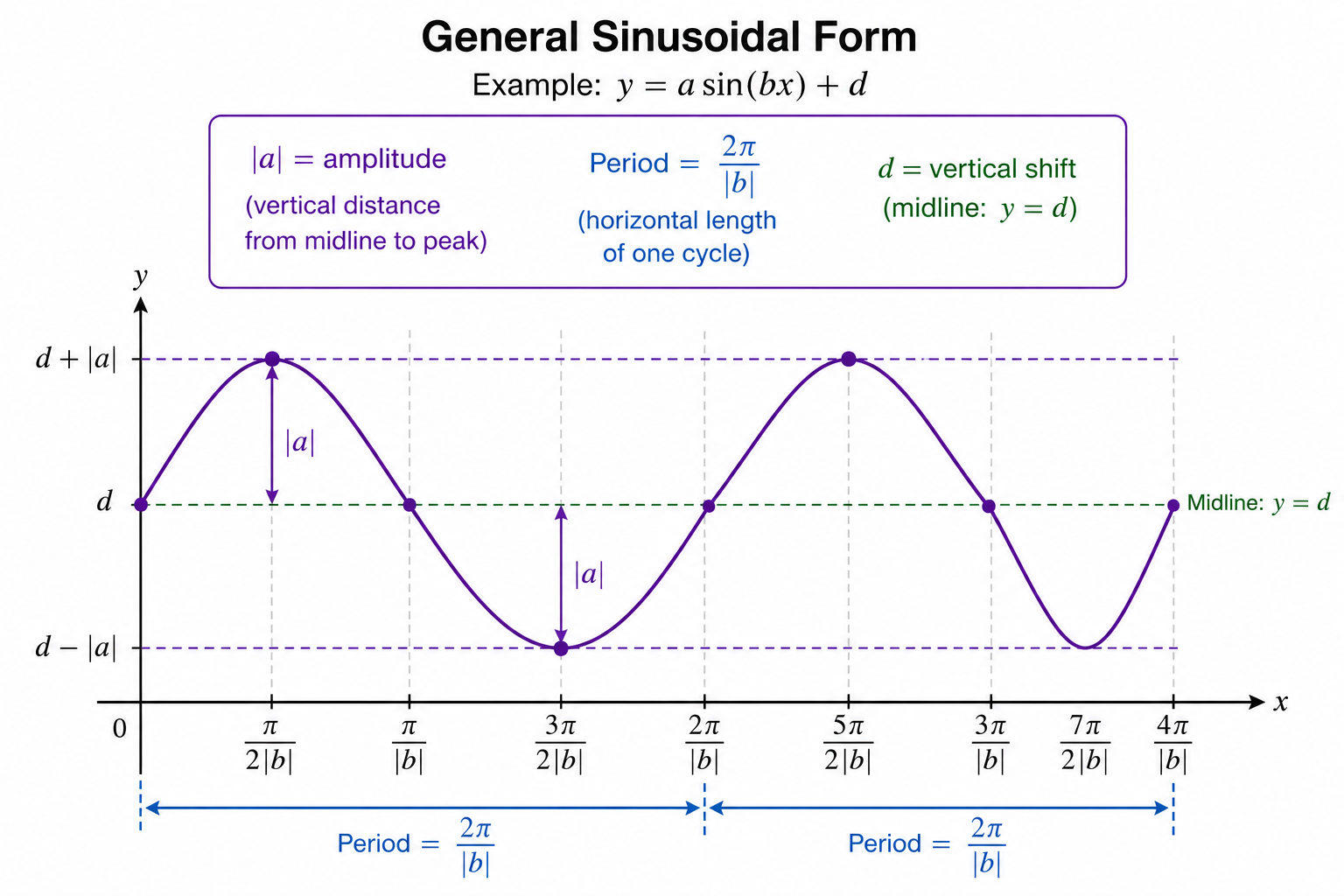
A transformed sine or cosine function can be written as: \[ y=a\sin(bx)+d \]
or \[ y=a\cos(bx)+d \]
where:
- \(|a|\) = amplitude
- Period: \[ \frac{2\pi}{|b|} \]
- \(d\) = vertical shift / midline
Common Problem Types
Identifying Period
For: \[ y=\sin(3x) \]
Period: \[ \frac{2\pi}{3} \]
because: \[ \frac{2\pi}{|3|} = \frac{2\pi}{3} \]
Finding Amplitude
For: \[ y=-4\cos(x) \]
Amplitude: \[ 4 \]
The negative sign reflects the graph but does not affect amplitude.
Identifying Vertical Shift
For: \[ y=\sin(x)+2 \]
The graph is shifted upward by 2 units.
Midline: \[ y=2 \]
Graph Interpretation
Problems may ask you to identify:
- maximum value
- minimum value
- period
- amplitude
- midline
- x-values where repeating occurs
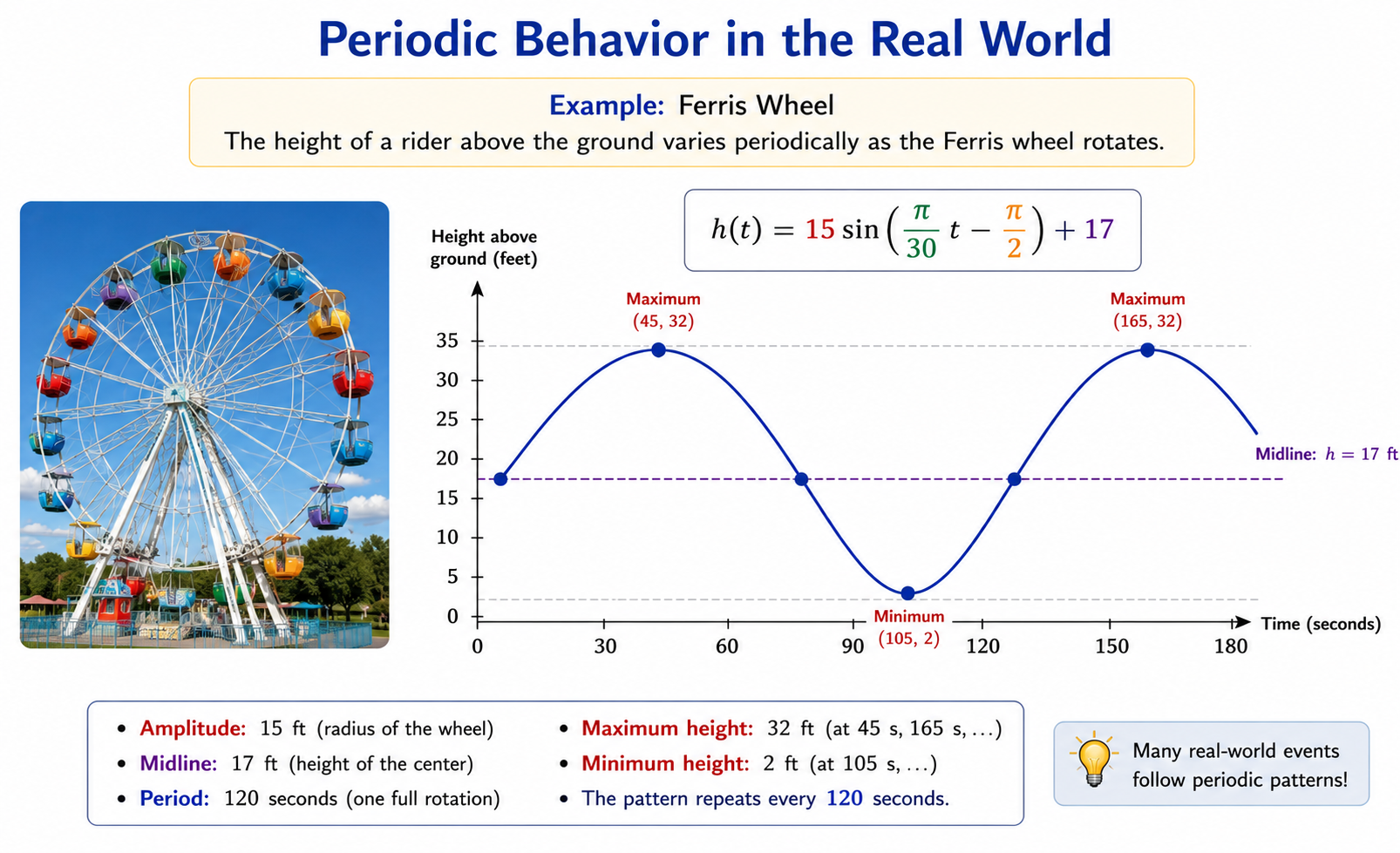
Real-World Periodic Modeling
Periodic functions model:
- sound waves
- tides
- seasons
- Ferris wheel motion
- daylight hours
Strategies
- Memorize the parent graph shapes of sine, cosine, and tangent.
- Amplitude is always the absolute value of the coefficient in front.
- Period changes when the input is multiplied by a constant.
- Tangent behaves differently because it has asymptotes and no amplitude.
- Sketch one full cycle first, then repeat.
Worked Examples
Example 1 — Find the Period
Find the period of: \[ y=\cos(5x) \]
Use: \[ \frac{2\pi}{|b|} \]
Here: \[ b=5 \]
So: \[ \text{Period}= \frac{2\pi}{5} \]
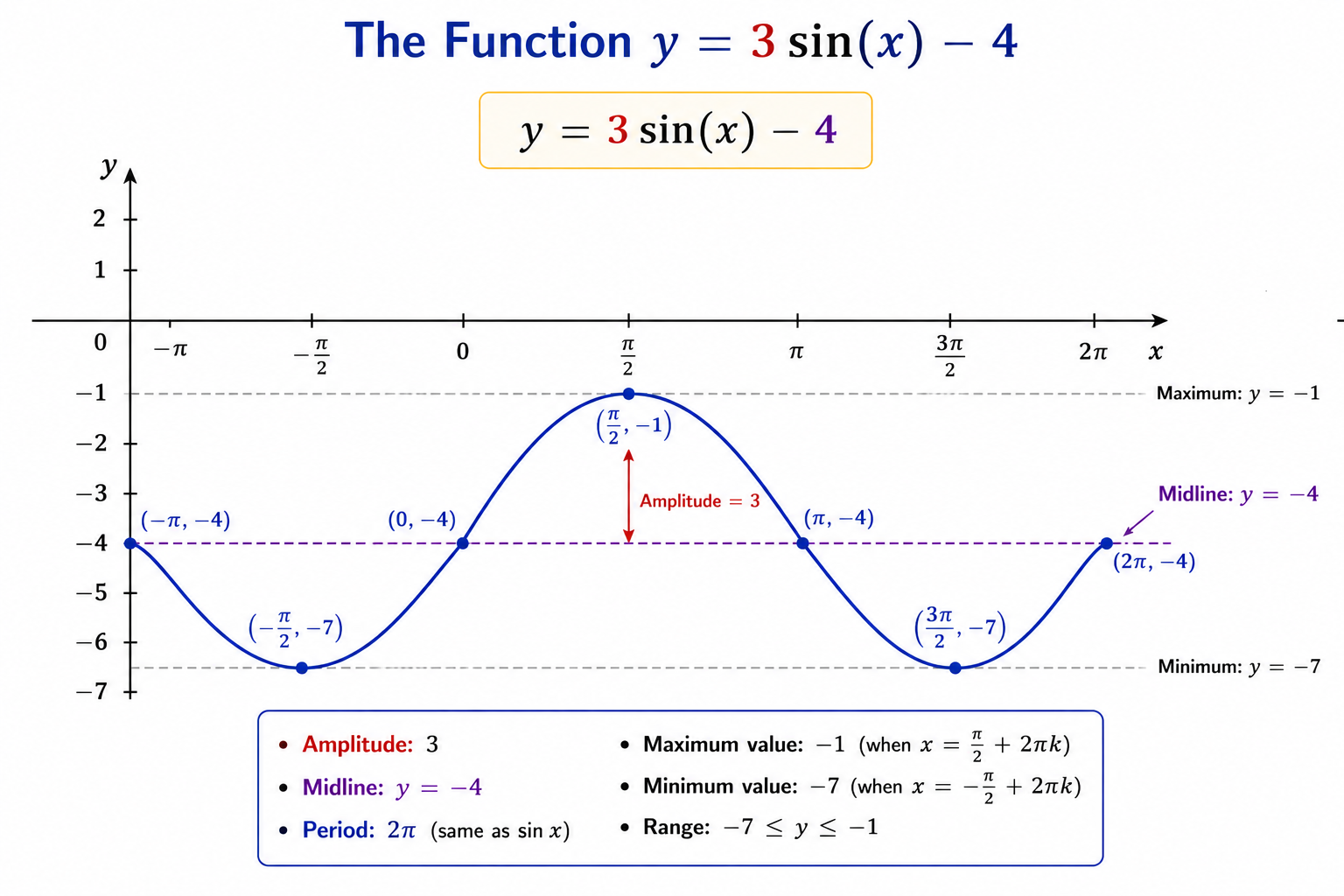
Example 2 — Find Amplitude and Midline
Find the amplitude and midline of: \[ y=3\sin(x)-4 \]
Amplitude: \[ 3 \]
Midline: \[ y=-4 \]
The graph oscillates around \(y=-4\).
Example 3 — Tangent Period
Find the period of: \[ y=\tan(2x) \]
For tangent: \[ \text{Period}= \frac{\pi}{|b|} \]
Since \(b=2\): \[ \text{Period}= \frac{\pi}{2} \]
Example 4 — Maximum and Minimum Values
Find the maximum and minimum values of: \[ y=2\cos(x)+1 \]
Cosine ranges from: \[ -1 \text{ to } 1 \]
Multiply by 2: \[ -2 \text{ to } 2 \]
Shift up by 1: \[ -1 \text{ to } 3 \]
Minimum: \[ -1 \]
Maximum: \[ 3 \]
- Forgetting that tangent’s period is \(\pi\), not \(2\pi\).
- Ignoring absolute value when finding amplitude.
- Mixing up horizontal and vertical shifts.
- Forgetting that tangent has asymptotes.
- Confusing the coefficient outside the function with the coefficient inside the function.
Practice Problems
Find the amplitude and period of: \[ y=5\sin(2x) \]
Find the period of: \[ y=\cos\left(\frac{x}{3}\right) \]
Determine the midline of: \[ y=-2\sin(x)+7 \]
Find the maximum and minimum values of: \[ y=4\cos(x)-1 \]
Find the period of: \[ y=\tan(4x) \]
1.
Amplitude: \[ 5 \]
Period: \[ \frac{2\pi}{2}=\pi \]
2.
Here: \[ b=\frac13 \]
So: \[ \text{Period}= \frac{2\pi}{1/3} = 6\pi \]
3.
Midline: \[ y=7 \]
4.
Cosine ranges from: \[ -1 \text{ to } 1 \]
Multiply by 4: \[ -4 \text{ to } 4 \]
Shift down 1: \[ -5 \text{ to } 3 \]
Minimum: \[ -5 \]
Maximum: \[ 3 \]
5.
For tangent: \[ \text{Period}= \frac{\pi}{4} \]
Summary
- Periodic functions repeat values in regular intervals.
- Sine and cosine have period: \[ 2\pi \]
- Tangent has period: \[ \pi \]
- Amplitude measures vertical stretch.
- Midline shows the vertical center of oscillation.
- Periodic functions are widely used in modeling repeating phenomena.
- Sine and cosine repeat every \(2\pi\).
- Tangent repeats every \(\pi\).
- Amplitude = absolute value of front coefficient.
- Period changes based on the coefficient inside the function.
- Tangent has asymptotes; sine and cosine do not.