Polar Coordinates
By the end of this lesson, you’ll be able to:
- Understand the meaning of polar coordinates.
- Convert between polar and rectangular (Cartesian) coordinates.
- Plot points given in polar form.
- Recognize equivalent polar representations of the same point.
- Solve common problems involving polar coordinates.
Key Ideas
In the rectangular coordinate system, a point is written as
\[ (x,y) \]
where \(x\) measures horizontal distance and \(y\) measures vertical distance.
In the polar coordinate system, a point is written as
\[ (r,\theta) \]
where:
- \(r\) = distance from the origin
- \(\theta\) = angle measured from the positive \(x\)-axis
Instead of describing a point by moving left/right and up/down, polar coordinates describe a point by:
- Moving outward from the origin a distance of \(r\).
- Rotating through an angle of \(\theta\).
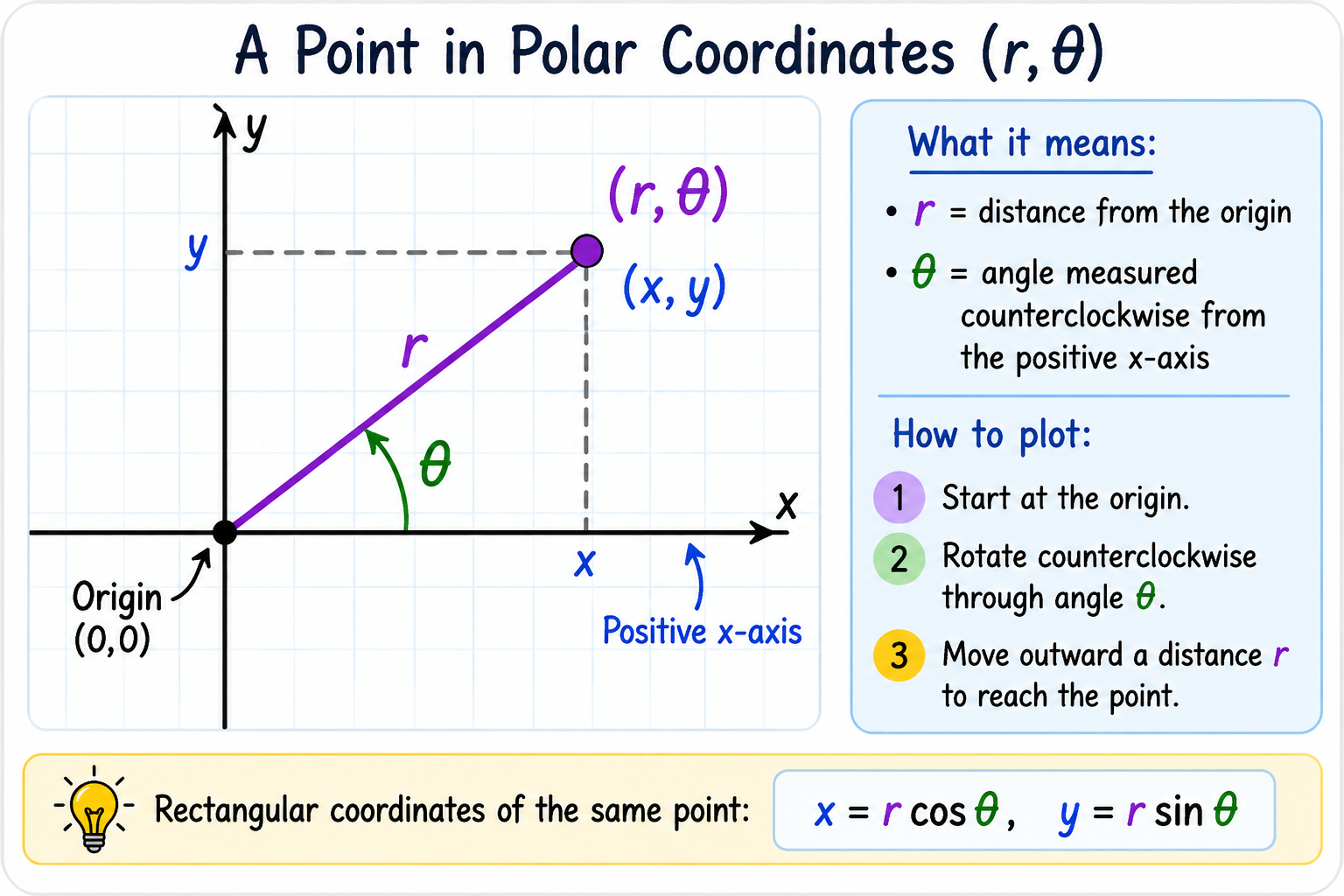
A point with
\[ (r,\theta)=(5,60^\circ) \]
means:
- Start at the origin.
- Rotate \(60^\circ\) counterclockwise.
- Move 5 units outward.
Common Problem Types
1. Plotting Polar Points
Given:
\[ (4,45^\circ) \]
Move 4 units from the origin along the ray that forms a \(45^\circ\) angle with the positive \(x\)-axis.
2. Converting Polar to Rectangular Coordinates
Use:
\[ x=r\cos\theta \]
\[ y=r\sin\theta \]
Example:
\[ (r,\theta)=(10,30^\circ) \]
Then
\[ x=10\cos30^\circ =10\left(\frac{\sqrt3}{2}\right) =5\sqrt3 \]
and
\[ y=10\sin30^\circ =10\left(\frac12\right) =5. \]
So the rectangular coordinates are
\[ (5\sqrt3,5). \]
3. Converting Rectangular to Polar Coordinates
Use:
\[ r=\sqrt{x^2+y^2} \]
and
\[ \tan\theta=\frac{y}{x}. \]
Example:
\[ (3,4) \]
Distance from origin:
\[ r=\sqrt{3^2+4^2} =\sqrt{25} =5. \]
Angle:
\[ \tan\theta=\frac43. \]
Thus
\[ \theta\approx53.1^\circ. \]
Polar coordinates:
\[ (5,53.1^\circ). \]
4. Equivalent Polar Coordinates
A point can have multiple polar representations.
For example,
\[ (3,45^\circ) \]
represents the same point as
\[ (3,405^\circ) \]
because
\[ 405^\circ=45^\circ+360^\circ. \]
It also represents the same point as
\[ (-3,225^\circ). \]
A negative radius means move in the opposite direction.
Strategies
- Sketch a quick coordinate plane when working with polar coordinates.
- Memorize common benchmark angles:
- \(30^\circ\)
- \(45^\circ\)
- \(60^\circ\)
- \(90^\circ\)
- When converting to rectangular coordinates, use: \[ x=r\cos\theta,\qquad y=r\sin\theta \]
- When converting to polar coordinates, find \(r\) first using the Pythagorean Theorem.
- Always check the quadrant when determining \(\theta\).
Worked Examples
Example 1
Convert
\[ (8,60^\circ) \]
to rectangular coordinates.
Using
\[ x=r\cos\theta \]
and
\[ y=r\sin\theta, \]
we get
\[ x=8\left(\frac12\right)=4 \]
and
\[ y=8\left(\frac{\sqrt3}{2}\right)=4\sqrt3. \]
Answer:
\[ (4,\;4\sqrt3). \]
Example 2
Convert
\[ (-5,12) \]
to polar coordinates.
First,
\[ r=\sqrt{(-5)^2+12^2} =\sqrt{25+144} =\sqrt{169} =13. \]
Next,
\[ \tan\theta=\frac{12}{-5}. \]
Since the point lies in Quadrant II,
\[ \theta\approx112.6^\circ. \]
Answer:
\[ (13,\;112.6^\circ). \]
- Confusing \(r\) (distance) with \(\theta\) (angle).
- Forgetting that angles are measured from the positive \(x\)-axis.
- Using \(\sin\) and \(\cos\) incorrectly when converting coordinates.
- Choosing the wrong quadrant when finding \(\theta\).
- Forgetting that multiple polar representations can describe the same point.
Practice Problems
- Convert \((6,0^\circ)\) to rectangular coordinates.
- Convert \((10,90^\circ)\) to rectangular coordinates.
- Convert \((4,45^\circ)\) to rectangular coordinates.
- Convert \((-8,15)\) to polar coordinates.
- Give another polar representation of \((5,120^\circ)\).
1.
\[ x=6\cos0^\circ=6 \]
\[ y=6\sin0^\circ=0 \]
Answer:
\[ (6,0) \]
2.
\[ x=10\cos90^\circ=0 \]
\[ y=10\sin90^\circ=10 \]
Answer:
\[ (0,10) \]
3.
\[ x=4\cos45^\circ=2\sqrt2 \]
\[ y=4\sin45^\circ=2\sqrt2 \]
Answer:
\[ (2\sqrt2,\;2\sqrt2) \]
4.
\[ r=\sqrt{(-8)^2+15^2} =\sqrt{289} =17 \]
\[ \tan\theta=\frac{15}{-8} \]
The point is in Quadrant II, so
\[ \theta\approx118.1^\circ. \]
Answer:
\[ (17,\;118.1^\circ) \]
5.
Add \(360^\circ\):
\[ (5,480^\circ) \]
is an equivalent representation.
Summary
- Polar coordinates locate points using distance and angle: \[ (r,\theta) \]
- Convert polar to rectangular using: \[ x=r\cos\theta,\qquad y=r\sin\theta \]
- Convert rectangular to polar using: \[ r=\sqrt{x^2+y^2},\qquad \tan\theta=\frac{y}{x} \]
- Multiple polar coordinate pairs can represent the same point.
- Always check the correct quadrant when determining the angle.
- Think: distance first, angle second.
- \(r\) is always the distance from the origin.
- Use cosine for \(x\) and sine for \(y\).
- Find \(r\) with the Pythagorean Theorem.
- Watch the quadrant when finding \(\theta\).
- Adding or subtracting \(360^\circ\) gives an equivalent polar coordinate.