Function Transformations
By the end of this lesson, you’ll be able to:
- Describe how graphs shift, reflect, stretch, and compress.
- Apply transformation rules directly to function formulas.
- Identify multiple transformations within a single function.
- Match transformed graphs to their parent (base) functions.
Key Ideas
Transformations tell us how a graph moves or changes shape relative to its parent function \(f(x)\).
A parent function is the simplest version of a function family.
Common parent functions include:
| Parent Function | Graph Shape |
|---|---|
| \(y=x\) | Line |
| \(y=x^2\) | Parabola |
| \(y=|x|\) | V-shape |
| \(y=\sqrt{x}\) | Square root curve |
| \(y=x^3\) | Cubic curve |
| \(y=b^x\) | Exponential curve |
Transformations change the graph without changing the basic family.
| Transformation | Rule | Effect |
|---|---|---|
| Vertical shift up | \(f(x)+k\) | Up \(k\) units |
| Vertical shift down | \(f(x)-k\) | Down \(k\) units |
| Horizontal shift right | \(f(x-h)\) | Right \(h\) units |
| Horizontal shift left | \(f(x+h)\) | Left \(h\) units |
| Reflect over \(x\)-axis | \(-f(x)\) | Flip vertically |
| Reflect over \(y\)-axis | \(f(-x)\) | Flip horizontally |
| Vertical stretch | \(af(x),\ |a|>1\) | Narrower / steeper |
| Vertical compression | \(af(x),\ 0<|a|<1\) | Wider / flatter |
| Horizontal compression | \(f(bx),\ |b|>1\) | Narrower |
| Horizontal stretch | \(f(bx),\ 0<|b|<1\) | Wider |
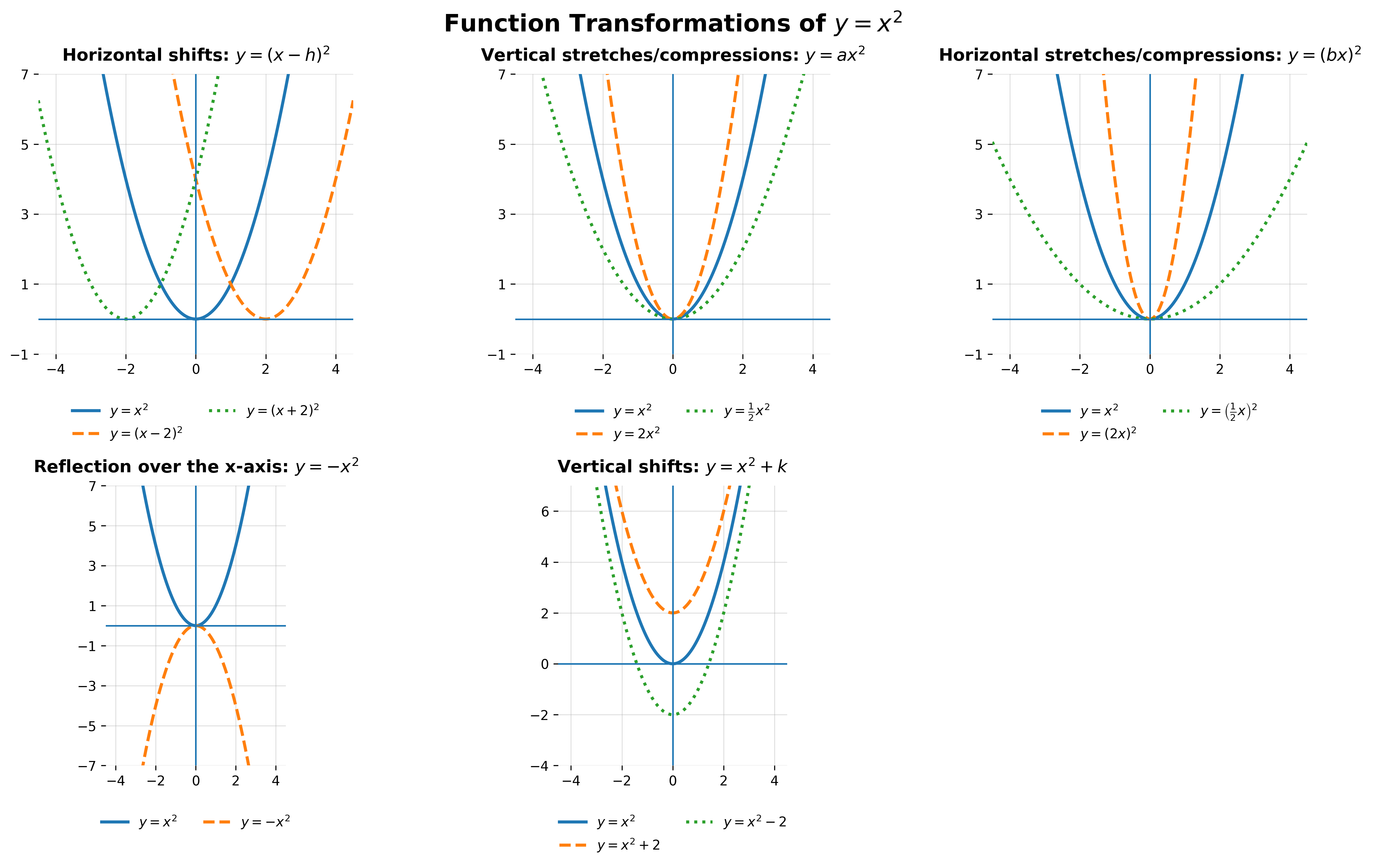
The most important idea:
- Changes outside the function affect the graph vertically.
- Changes inside the function affect the graph horizontally.
For example:
\[ y=f(x)+4 \]
moves the graph up 4 units.
But
\[ y=f(x+4) \]
moves the graph left 4 units.
Common Problem Types
1. Vertical Shifts
A number added or subtracted outside the function shifts the graph up or down.
Example:
\[ y=x^2+5 \]
This shifts the graph of \(y=x^2\) up 5 units.
Example:
\[ y=|x|-3 \]
This shifts the graph of \(y=|x|\) down 3 units.
2. Horizontal Shifts
A number added or subtracted inside the function shifts the graph left or right.
Example:
\[ y=(x-4)^2 \]
This shifts the graph of \(y=x^2\) right 4 units.
Example:
\[ y=\sqrt{x+2} \]
This shifts the graph of \(y=\sqrt{x}\) left 2 units.
Horizontal shifts feel backward:
- \(f(x-h)\) moves right \(h\) units.
- \(f(x+h)\) moves left \(h\) units.
3. Reflections
A negative sign reflects a graph.
If the negative is outside the function, the graph reflects across the \(x\)-axis.
Example:
\[ y=-x^2 \]
This reflects the graph of \(y=x^2\) across the \(x\)-axis.
If the negative is inside the function, the graph reflects across the \(y\)-axis.
Example:
\[ y=f(-x) \]
This reflects the graph of \(y=f(x)\) across the \(y\)-axis.
4. Stretches and Compressions
A coefficient changes the steepness or width of a graph.
Example:
\[ y=3x^2 \]
This is a vertical stretch by a factor of 3.
Example:
\[ y=\frac12x^2 \]
This is a vertical compression by a factor of \(\frac12\).
For many questions, vertical stretches and compressions are more common than horizontal stretches and compressions.
5. Combined Transformations
Many problems combine several transformations in one equation.
Example:
\[ y=-2(x-3)^2+5 \]
Start with the parent function:
\[ y=x^2 \]
Then identify each transformation:
- \((x-3)\) shifts the graph right 3 units.
- The coefficient \(-2\) reflects the graph across the \(x\)-axis.
- The coefficient \(2\) vertically stretches the graph by a factor of 2.
- The \(+5\) shifts the graph up 5 units.
So the graph is:
- shifted right 3 units
- shifted up 5 units
- reflected across the \(x\)-axis
- vertically stretched by a factor of 2
Strategies
- First identify the parent function.
- Look inside parentheses for horizontal changes.
- Look outside the function for vertical changes.
- A negative outside the function reflects across the \(x\)-axis.
- A negative inside the function reflects across the \(y\)-axis.
- Coefficients greater than 1 create stretches.
- Coefficients between 0 and 1 create compressions.
- For combined transformations, list each change separately.
A useful checklist:
- What is the parent function?
- Is there a horizontal shift?
- Is there a vertical shift?
- Is there a reflection?
- Is there a stretch or compression?
Worked Examples
Example 1 — Vertical Shift
Describe the transformation:
\[ g(x)=x^2+3 \]
The parent function is:
\[ y=x^2 \]
The \(+3\) is outside the function, so the graph shifts up 3 units.
Answer: Up 3 units.
Example 2 — Horizontal Shift
Describe the transformation:
\[ y=(x-4)^2 \]
The parent function is:
\[ y=x^2 \]
The expression \((x-4)\) shifts the graph right 4 units.
Answer: Right 4 units.
Example 3 — Reflection Across the \(x\)-Axis
Describe the transformation:
\[ h(x)=-\sqrt{x} \]
The parent function is:
\[ y=\sqrt{x} \]
The negative sign outside the function reflects the graph across the \(x\)-axis.
Answer: Reflection across the \(x\)-axis.
Example 4 — Combined Transformations
Describe the transformations of:
\[ y=-3(x+2)^2-4 \]
The parent function is:
\[ y=x^2 \]
Now identify each transformation:
- \((x+2)\) shifts the graph left 2 units.
- The negative sign outside reflects the graph across the \(x\)-axis.
- The coefficient \(3\) vertically stretches the graph by a factor of 3.
- The \(-4\) shifts the graph down 4 units.
Answer:
- left 2 units
- down 4 units
- reflected across the \(x\)-axis
- vertically stretched by a factor of 3
Example 5 — Absolute Value Combined Transformations
Describe the transformations of:
\[ y=-|x-1|+2 \]
The parent function is:
\[ y=|x| \]
Now identify each transformation:
- \((x-1)\) shifts the graph right 1 unit.
- The negative sign outside reflects the graph across the \(x\)-axis.
- The \(+2\) shifts the graph up 2 units.
Answer:
- right 1 unit
- up 2 units
- reflected across the \(x\)-axis
Example 6 — Square Root Combined Transformations
Describe the transformations of:
\[ y=4\sqrt{x+1} \]
The parent function is:
\[ y=\sqrt{x} \]
Now identify each transformation:
- \((x+1)\) shifts the graph left 1 unit.
- The coefficient \(4\) vertically stretches the graph by a factor of 4.
Answer:
- left 1 unit
- vertically stretched by a factor of 4
Common Mistakes
- Confusing horizontal and vertical shifts.
- Forgetting that \(f(x-h)\) moves right, not left.
- Mixing up reflections over the \(x\)-axis and \(y\)-axis.
- Missing a stretch or compression when multiple transformations are present.
- Identifying only one transformation when the equation contains several.
- Forgetting to compare the transformed graph to the parent function.
Practice Problems
- Describe the shift: \(y=x^2-5\).
- Describe the transformation: \(y=-|x|\).
- Describe the transformation: \(y=\sqrt{x+2}\).
- Does \(y=3f(x)\) stretch, compress, or shift?
- What does \(y=f(-x)\) do to the graph?
- Describe all transformations of:
\[ y=-2(x-4)^2+1 \]
- Describe all transformations of:
\[ y=\frac12(x+3)^2-6 \]
- Describe all transformations of:
\[ y=-|x-5|-2 \]
- Describe all transformations of:
\[ y=4\sqrt{x+1} \]
- Describe all transformations of:
\[ y=-(x+6)^2+8 \]
1.
\[ y=x^2-5 \]
The \(-5\) shifts the graph down 5 units.
Answer: Down 5 units.
2.
\[ y=-|x| \]
The negative sign outside reflects the graph across the \(x\)-axis.
Answer: Reflection across the \(x\)-axis.
3.
\[ y=\sqrt{x+2} \]
The \(+2\) inside shifts the graph left 2 units.
Answer: Left 2 units.
4.
\[ y=3f(x) \]
The coefficient 3 outside the function creates a vertical stretch.
Answer: Vertical stretch by factor 3.
5.
\[ y=f(-x) \]
The negative sign inside reflects the graph across the \(y\)-axis.
Answer: Reflection across the \(y\)-axis.
6.
\[ y=-2(x-4)^2+1 \]
Transformations:
- right 4 units
- up 1 unit
- reflection across the \(x\)-axis
- vertical stretch by factor 2
7.
\[ y=\frac12(x+3)^2-6 \]
Transformations:
- left 3 units
- down 6 units
- vertical compression by factor \(\frac12\)
8.
\[ y=-|x-5|-2 \]
Transformations:
- right 5 units
- down 2 units
- reflection across the \(x\)-axis
9.
\[ y=4\sqrt{x+1} \]
Transformations:
- left 1 unit
- vertical stretch by factor 4
10.
\[ y=-(x+6)^2+8 \]
Transformations:
- left 6 units
- up 8 units
- reflection across the \(x\)-axis
Summary
- Transformations describe how a graph changes from its parent function.
- Vertical changes occur outside the function.
- Horizontal changes occur inside the function.
- Shifts move graphs without changing their shape.
- Reflections flip graphs across an axis.
- Stretches and compressions change steepness or width.
- Combined transformations include multiple changes in the same equation.
- Questions often ask you to identify several transformations at once.
- Inside → horizontal.
- Outside → vertical.
- \(f(x-h)\) moves right.
- \(f(x+h)\) moves left.
- Negative outside → reflect over the \(x\)-axis.
- Negative inside → reflect over the \(y\)-axis.
- Larger outside coefficient → vertical stretch.
- Fraction outside coefficient → vertical compression.
- Identify transformations one at a time.