Parallel Lines with Transversals
By the end of this lesson, you’ll be able to:
- Identify angle pairs formed when a transversal crosses parallel lines.
- Recognize corresponding, alternate interior, alternate exterior, and same-side interior angles.
- Use angle relationships to find unknown angle measures.
- Use vertical angles and linear pairs together with parallel-line relationships.
Key Ideas
A transversal is a line that crosses two or more other lines.
When a transversal crosses parallel lines, it creates predictable relationships among the eight angles formed.
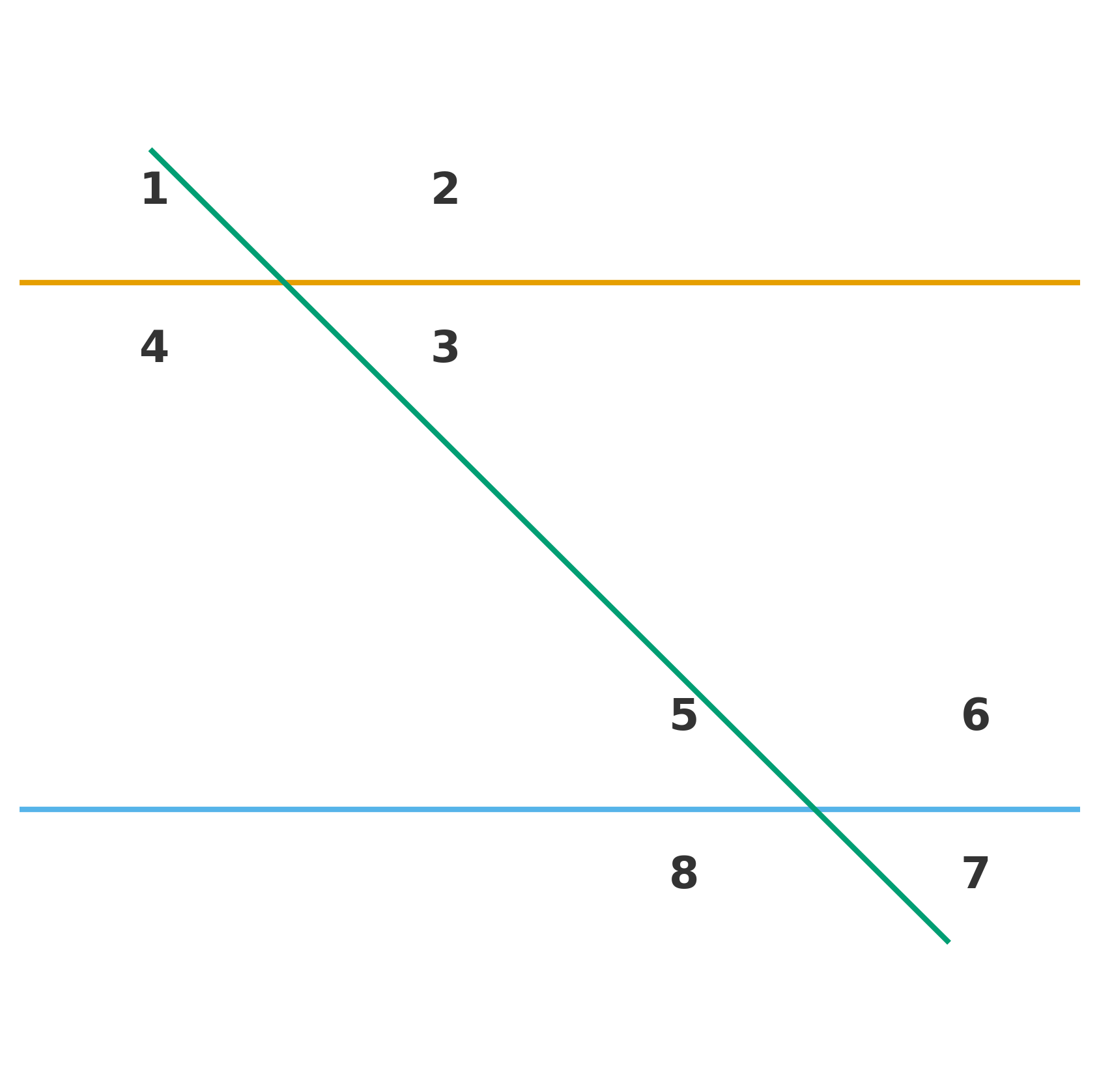
In the figure:
- Angles 1, 2, 7, and 8 are exterior angles because they lie outside the two parallel lines.
- Angles 3, 4, 5, and 6 are interior angles because they lie between the two parallel lines.
The position of the angles tells us which relationship to use.
Corresponding Angles
Corresponding angles occupy the same relative position at the two intersections.
In the figure:
- \(\angle 1\) and \(\angle 5\)
- \(\angle 2\) and \(\angle 6\)
- \(\angle 3\) and \(\angle 7\)
- \(\angle 4\) and \(\angle 8\)
When the lines are parallel, corresponding angles are equal.
For example, if
\[ m\angle 1=70^\circ \]
then
\[ m\angle 5=70^\circ. \]
Alternate Interior Angles
Alternate interior angles lie:
- between the parallel lines, and
- on opposite sides of the transversal.
In the figure:
- \(\angle 3\) and \(\angle 5\)
- \(\angle 4\) and \(\angle 6\)
When the lines are parallel, alternate interior angles are equal.
For example, if
\[ m\angle 3=110^\circ, \]
then
\[ m\angle 5=110^\circ. \]
Alternate Exterior Angles
Alternate exterior angles lie:
- outside the parallel lines, and
- on opposite sides of the transversal.
In the figure:
- \(\angle 1\) and \(\angle 7\)
- \(\angle 2\) and \(\angle 8\)
When the lines are parallel, alternate exterior angles are equal.
Same-Side Interior Angles
Same-side interior angles, also called consecutive interior angles, lie:
- between the parallel lines, and
- on the same side of the transversal.
In the figure:
- \(\angle 4\) and \(\angle 5\)
- \(\angle 3\) and \(\angle 6\)
These angles are supplementary, meaning they add to \(180^\circ\).
For example, if
\[ m\angle 3=120^\circ, \]
then
\[ m\angle 6=180^\circ-120^\circ=60^\circ. \]
Don’t Forget Vertical Angles and Linear Pairs
The numbered diagram also contains angle relationships that do not depend on the lines being parallel.
Vertical angles are opposite each other at an intersection and are equal.
For example:
\[ \angle 1=\angle 3 \]
and
\[ \angle 5=\angle 7. \]
Linear pairs are adjacent angles that form a straight line, so they add to \(180^\circ\).
For example:
\[ m\angle 1+m\angle 2=180^\circ. \]
These relationships are often useful when a problem does not give you the exact angle pair you need.
Table of Angle Relationships
| Angle Pair Type | Examples From Figure | Relationship |
|---|---|---|
| Corresponding | \(\angle1,\angle5\) | Equal |
| Alternate Interior | \(\angle3,\angle5\) | Equal |
| Alternate Exterior | \(\angle1,\angle7\) | Equal |
| Same-Side Interior | \(\angle3,\angle6\) | Sum to \(180^\circ\) |
| Vertical | \(\angle1,\angle3\) | Equal |
| Linear Pair | \(\angle1,\angle2\) | Sum to \(180^\circ\) |
Common Problem Types
1. Recognizing an Angle Pair
First decide where the angles are located.
Ask:
- Are they inside or outside the parallel lines?
- Are they on the same side or opposite sides of the transversal?
- Do they occupy the same relative position at each intersection?
For example, \(\angle3\) and \(\angle5\) are inside the parallel lines and on opposite sides of the transversal.
Therefore, they are alternate interior angles.
2. Using Equal Angle Relationships
Corresponding, alternate interior, and alternate exterior angles are equal when the lines are parallel.
For example, if
\[ m\angle2=75^\circ, \]
then its corresponding angle \(\angle6\) also measures
\[ 75^\circ. \]
3. Using Supplementary Angle Relationships
Same-side interior angles add to \(180^\circ\).
For example, \(\angle3\) and \(\angle6\) are same-side interior angles.
If
\[ m\angle3=125^\circ, \]
then
\[ m\angle6=180^\circ-125^\circ=55^\circ. \]
4. Finding Several Angles From One Given Angle
One known angle can often determine all eight angles.
Suppose
\[ m\angle1=65^\circ. \]
Then:
- \(\angle3=65^\circ\) because vertical angles are equal.
- \(\angle5=65^\circ\) because corresponding angles are equal.
- \(\angle7=65^\circ\) because alternate exterior angles are equal.
- \(\angle2=115^\circ\) because \(\angle1\) and \(\angle2\) form a linear pair.
The remaining angles \(\angle4\), \(\angle6\), and \(\angle8\) are also \(115^\circ\).
So the entire diagram contains only two angle measures:
\[ 65^\circ \quad \text{and} \quad 115^\circ. \]
5. Identifying Non-Parallel Cases
The special corresponding and alternate-angle rules require parallel lines.
If the two lines are not parallel, you cannot automatically conclude that corresponding or alternate angles are equal.
Vertical-angle and linear-pair relationships, however, still hold because they do not require parallel lines.
Strategies
- Use the diagram. Mark the given angle before doing any calculations.
- First decide whether the angles are interior or exterior.
- Then check whether they are on the same side or opposite sides of the transversal.
- If the relationship says equal, copy the angle measure.
- If the relationship says supplementary, subtract from \(180^\circ\).
- Use vertical angles and linear pairs when they provide a quicker route.
Worked Examples
Example 1 — Corresponding Angles
In the figure, suppose
\[ m\angle1=65^\circ. \]
Find \(m\angle5\).
Step 1: Identify the relationship.
\(\angle1\) and \(\angle5\) occupy the same relative position at the two intersections, so they are corresponding angles.
Step 2: Use the parallel-line rule.
Corresponding angles are equal:
\[ m\angle5=m\angle1. \]
Therefore,
\[ \boxed{m\angle5=65^\circ} \]
Example 2 — Same-Side Interior Angles
In the figure, suppose
\[ m\angle3=130^\circ. \]
Find \(m\angle6\).
Step 1: Identify the relationship.
\(\angle3\) and \(\angle6\) are both between the parallel lines and on the same side of the transversal.
Therefore, they are same-side interior angles.
Step 2: Use the supplementary relationship.
Same-side interior angles add to \(180^\circ\):
\[ m\angle3+m\angle6=180^\circ. \]
Substitute \(130^\circ\):
\[ 130^\circ+m\angle6=180^\circ. \]
Subtract:
\[ m\angle6=50^\circ. \]
Therefore,
\[ \boxed{m\angle6=50^\circ} \]
Example 3 — Using More Than One Relationship
Suppose
\[ m\angle4=72^\circ. \]
Find \(m\angle7\).
\(\angle4\) and \(\angle8\) are corresponding angles, so
\[ m\angle8=72^\circ. \]
At the lower intersection, \(\angle7\) and \(\angle8\) form a linear pair:
\[ m\angle7+m\angle8=180^\circ. \]
Therefore,
\[ m\angle7=180^\circ-72^\circ=108^\circ. \]
So,
\[ \boxed{m\angle7=108^\circ} \]
- Confusing same-side with opposite-side angle pairs.
- Forgetting that same-side interior angles are supplementary, not equal.
- Calling two angles alternate interior when one of them is outside the parallel lines.
- Forgetting to check that the lines are parallel before using corresponding or alternate-angle rules.
- Overlooking vertical angles or linear pairs that may give a faster solution.
Practice Problems
Use the numbered figure above.
If \(m\angle1=50^\circ\), find \(m\angle5\).
If \(m\angle3=120^\circ\), find \(m\angle5\).
If \(m\angle3=120^\circ\), find \(m\angle6\).
If \(m\angle2=105^\circ\), find \(m\angle8\).
If \(m\angle4=70^\circ\), find \(m\angle7\).
Which numbered angles are alternate exterior angles with \(\angle1\)?
Which numbered angle is the same-side interior partner of \(\angle4\)?
1. \(\angle1\) and \(\angle5\) are corresponding:
\[ \boxed{50^\circ} \]
2. \(\angle3\) and \(\angle5\) are alternate interior:
\[ \boxed{120^\circ} \]
3. \(\angle3\) and \(\angle6\) are same-side interior:
\[ 180^\circ-120^\circ=60^\circ \]
\[ \boxed{60^\circ} \]
4. \(\angle2\) and \(\angle8\) are alternate exterior:
\[ \boxed{105^\circ} \]
5. \(\angle4\) and \(\angle8\) are corresponding, so
\[ m\angle8=70^\circ. \]
\(\angle7\) and \(\angle8\) form a linear pair:
\[ m\angle7=180^\circ-70^\circ=110^\circ. \]
\[ \boxed{110^\circ} \]
6. \(\angle1\) and \(\angle7\) are alternate exterior angles.
\[ \boxed{\angle7} \]
7. \(\angle4\) and \(\angle5\) are same-side interior angles.
\[ \boxed{\angle5} \]
Summary
When parallel lines are crossed by a transversal:
- Corresponding angles are equal.
- Alternate interior angles are equal.
- Alternate exterior angles are equal.
- Same-side interior angles add to \(180^\circ\).
- Vertical angles are equal.
- Linear pairs add to \(180^\circ\).
The key is not to memorize angle numbers. Instead, learn to recognize the position of the angles in the diagram.
- Same position → corresponding → equal
- Inside + opposite sides → alternate interior → equal
- Outside + opposite sides → alternate exterior → equal
- Inside + same side → same-side interior → add to \(180^\circ\)
- Directly opposite at one intersection → vertical → equal