Polygons & Angle Sums
By the end of this lesson, you’ll be able to:
- Identify and classify polygons.
- Compute the sum of interior angles of any polygon.
- Find the measure of each interior angle in a regular polygon.
- Use the exterior angle sum and find each exterior angle of a regular polygon.
- Compute the number of diagonals in a polygon.
- Solve angle problems involving polygons.
Key Ideas
A polygon is a closed figure made entirely of straight line segments.
Polygons are often named by their number of sides:
- Triangle → 3 sides
- Quadrilateral → 4 sides
- Pentagon → 5 sides
- Hexagon → 6 sides
- Octagon → 8 sides
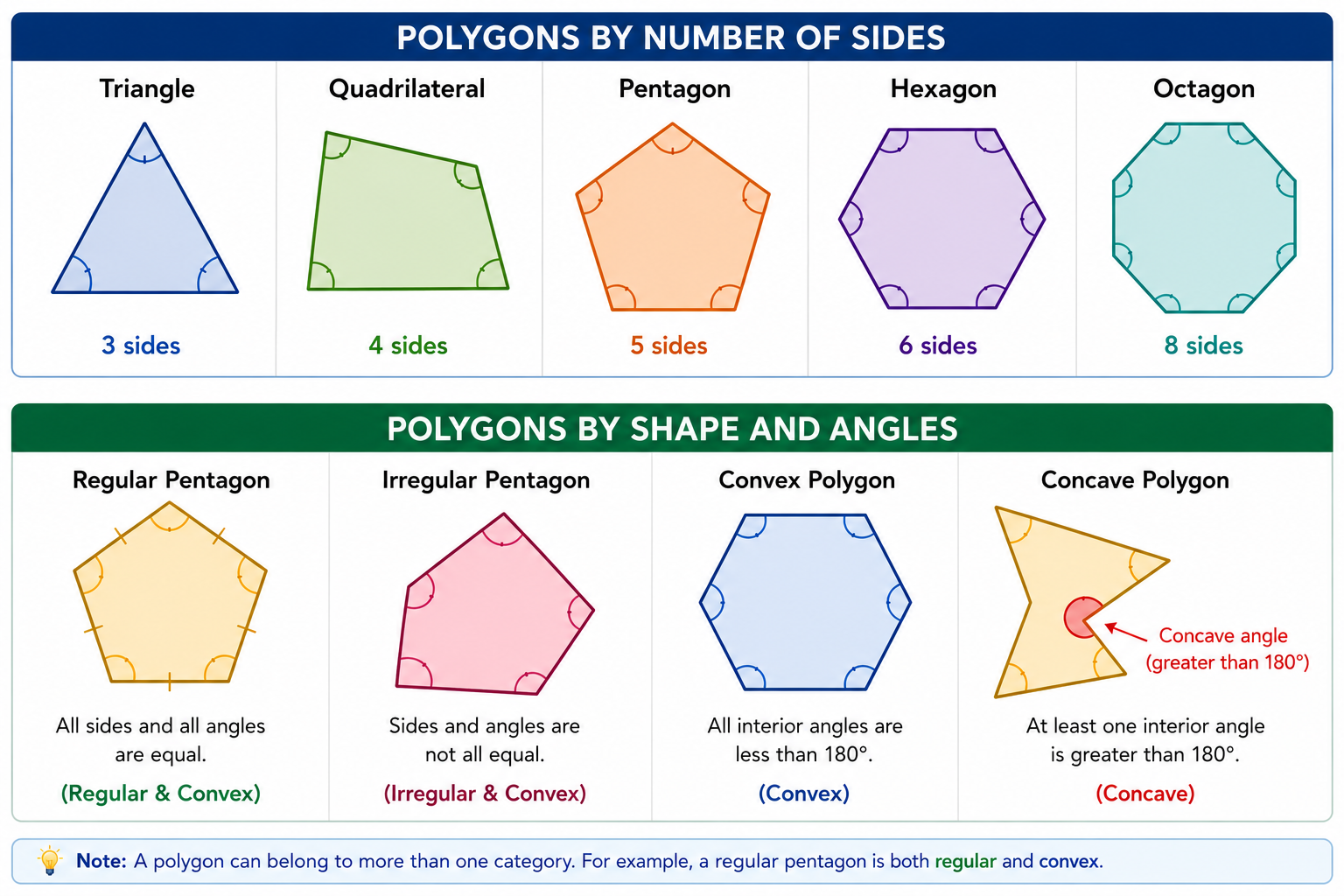
Polygons can also be classified by their sides, angles, and shape:
- Regular: all sides and all interior angles are equal
- Irregular: sides or angles are not all equal
- Convex: all interior angles are less than \(180^\circ\)
- Concave: at least one interior angle is greater than \(180^\circ\)
A polygon can belong to more than one category. For example, a regular pentagon is both regular and convex.
In a concave polygon, the inward-pointing vertex creates a reflex interior angle, meaning the interior angle is greater than \(180^\circ\).
1. Interior Angle Sum
For any polygon with \(n\) sides:
\[ \text{Sum of interior angles} = (n - 2)\cdot 180^\circ \]
This formula works for both convex and concave polygons.
The reason is that an \(n\)-sided polygon can be divided into
\[ n-2 \]
triangles, and each triangle has an angle sum of \(180^\circ\).
For example:
- Triangle: \(1\) triangle → \(180^\circ\)
- Quadrilateral: \(2\) triangles → \(360^\circ\)
- Pentagon: \(3\) triangles → \(540^\circ\)
- Hexagon: \(4\) triangles → \(720^\circ\)
Example
For an octagon, \(n=8\):
\[ (8-2)\cdot180^\circ \]
\[ 6\cdot180^\circ=1080^\circ \]
So the sum of the interior angles is
\[ \boxed{1080^\circ} \]
2. Interior Angle of a Regular Polygon
For a regular polygon, all interior angles are equal.
First find the total interior-angle sum:
\[ (n-2)180^\circ \]
Then divide by the number of angles, which is also the number of sides:
\[ \text{Each interior angle} = \frac{(n-2)180^\circ}{n} \]
Example
Find each interior angle of a regular pentagon.
Here,
\[ n=5 \]
so
\[ \frac{(5-2)180^\circ}{5} = \frac{540^\circ}{5} = 108^\circ \]
Therefore,
\[ \boxed{108^\circ} \]
You may divide the total angle sum by \(n\) only when the polygon is regular.
In an irregular polygon, the interior angles do not all have the same measure.
3. Exterior Angles
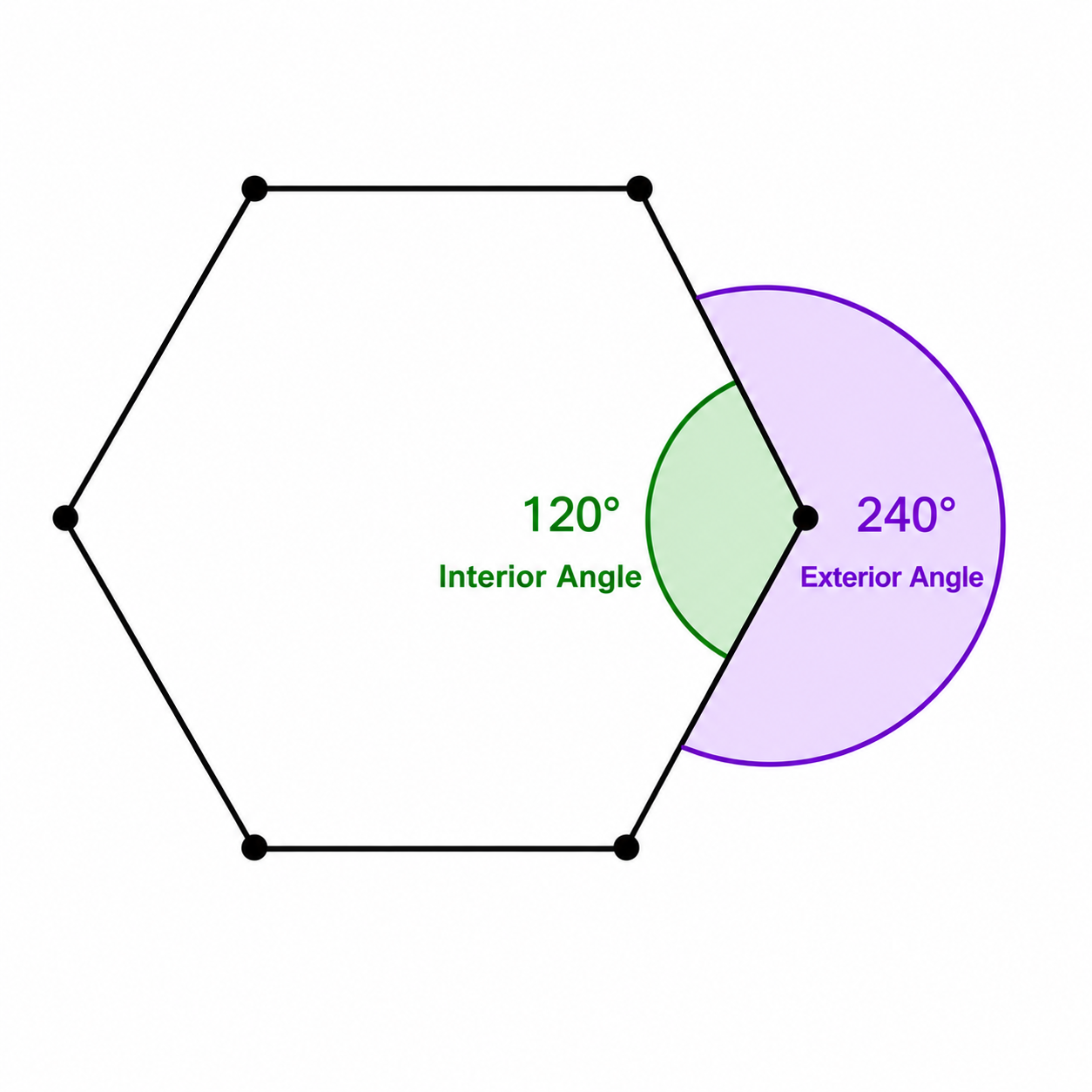
An exterior angle is formed by extending one side of a polygon.
At a vertex, an interior angle and its adjacent exterior angle form a straight line, so:
\[ \text{interior angle}+\text{exterior angle}=180^\circ \]
Exterior Angle Sum Rule
For any convex polygon, one exterior angle at each vertex sums to
\[ \boxed{360^\circ} \]
This is true no matter how many sides the polygon has.
Exterior Angle of a Regular Polygon
In a regular polygon, all exterior angles are equal.
Therefore:
\[ \text{Each exterior angle} = \frac{360^\circ}{n} \]
Example
Find each exterior angle of a regular 12-gon.
\[ \frac{360^\circ}{12}=30^\circ \]
So each exterior angle is
\[ \boxed{30^\circ} \]
4. Finding the Number of Sides From an Angle
Sometimes a problem gives an angle measure and asks for the number of sides.
For a regular polygon, the exterior-angle formula is often the fastest method:
\[ \text{Exterior angle}=\frac{360^\circ}{n} \]
So:
\[ n=\frac{360^\circ}{\text{exterior angle}} \]
Example
A regular polygon has exterior angles of \(24^\circ\).
Find the number of sides.
\[ n=\frac{360}{24} \]
\[ n=15 \]
So the polygon is a
\[ \boxed{15\text{-gon}} \]
Using an Interior Angle
If the interior angle is given, use
\[ \text{interior angle} = \frac{(n-2)180^\circ}{n} \]
For example, suppose each interior angle is \(135^\circ\):
\[ 135=\frac{(n-2)180}{n} \]
Multiply both sides by \(n\):
\[ 135n=180n-360 \]
Subtract \(135n\):
\[ 45n=360 \]
Therefore,
\[ n=8 \]
So the polygon is a regular octagon.
If a regular polygon has interior angle \(135^\circ\), its exterior angle is
\[ 180^\circ-135^\circ=45^\circ \]
Then:
\[ n=\frac{360^\circ}{45^\circ}=8 \]
This is usually faster.
5. Number of Diagonals
A diagonal is a segment connecting two non-adjacent vertices of a polygon.
From any one vertex of an \(n\)-sided polygon, you can draw diagonals to
\[ n-3 \]
other vertices.
That gives
\[ n(n-3) \]
connections if you count from every vertex.
But each diagonal gets counted twice, so divide by \(2\):
\[ \text{Number of diagonals} = \frac{n(n-3)}{2} \]
Example
How many diagonals are in a heptagon?
A heptagon has
\[ n=7 \]
So:
\[ \frac{7(7-3)}{2} = \frac{7(4)}{2} = \frac{28}{2} = 14 \]
Therefore,
\[ \boxed{14} \]
Common Problem Types
1. Find the Sum of Interior Angles
Find the sum of interior angles of a 12-sided polygon.
Use:
\[ (n-2)180^\circ \]
Substitute \(n=12\):
\[ (12-2)180^\circ = 10\cdot180^\circ = 1800^\circ \]
So:
\[ \boxed{1800^\circ} \]
2. Find Each Interior Angle of a Regular Polygon
Find each interior angle of a regular decagon.
A decagon has
\[ n=10 \]
So:
\[ \frac{(10-2)180^\circ}{10} = \frac{1440^\circ}{10} = 144^\circ \]
Therefore:
\[ \boxed{144^\circ} \]
3. Find Each Exterior Angle of a Regular Polygon
Find each exterior angle of a regular 18-gon.
\[ \frac{360^\circ}{18} = 20^\circ \]
Therefore:
\[ \boxed{20^\circ} \]
4. Find the Number of Sides From an Interior Angle
A regular polygon has interior angles of \(160^\circ\).
First find the exterior angle:
\[ 180^\circ-160^\circ=20^\circ \]
Then:
\[ n=\frac{360^\circ}{20^\circ} \]
\[ n=18 \]
Therefore:
\[ \boxed{18\text{ sides}} \]
5. Find a Missing Interior Angle
The interior angles of a pentagon are
\[ 100^\circ,\ 120^\circ,\ 90^\circ,\ 110^\circ,\ x \]
Find \(x\).
A pentagon has an interior-angle sum of
\[ (5-2)180^\circ=540^\circ \]
Add the known angles:
\[ 100+120+90+110=420 \]
So:
\[ 420+x=540 \]
\[ x=120 \]
Therefore:
\[ \boxed{120^\circ} \]
This type of problem works for both regular and irregular polygons.
Strategies
- First identify the number of sides, \(n\).
- For an interior-angle sum, use:
\[ (n-2)180^\circ \]
- For each interior angle of a regular polygon, divide the sum by \(n\).
- For each exterior angle of a regular polygon, use:
\[ \frac{360^\circ}{n} \]
- If you are given a regular polygon’s interior angle, subtract from \(180^\circ\) to find the exterior angle first.
- Use the diagonal formula only when the problem asks for connections between non-adjacent vertices.
- In a concave polygon, remember that the inward-pointing vertex has a reflex interior angle greater than \(180^\circ\).
Worked Examples
Example 1 — Interior Angle Sum
What is the sum of the interior angles of a 15-sided polygon?
Use:
\[ (n-2)180^\circ \]
Substitute \(n=15\):
\[ (15-2)180^\circ \]
\[ 13\cdot180^\circ \]
\[ 2340^\circ \]
Therefore:
\[ \boxed{2340^\circ} \]
Example 2 — Number of Sides From an Exterior Angle
A regular polygon has exterior angles of \(24^\circ\).
How many sides does it have?
For a regular polygon:
\[ n=\frac{360^\circ}{\text{exterior angle}} \]
So:
\[ n=\frac{360}{24}=15 \]
Therefore:
\[ \boxed{15\text{-gon}} \]
Example 3 — Number of Diagonals
How many diagonals does a 20-gon have?
Use:
\[ \frac{n(n-3)}{2} \]
Substitute \(n=20\):
\[ \frac{20(20-3)}{2} \]
\[ \frac{20(17)}{2} \]
\[ 10(17)=170 \]
Therefore:
\[ \boxed{170} \]
- Using \(n\cdot180^\circ\) instead of \((n-2)180^\circ\) for the interior-angle sum.
- Dividing by \(n\) when the polygon is irregular.
- Forgetting that regular polygons have equal sides and equal angles.
- Mixing up interior and exterior angles.
- Forgetting that adjacent interior and exterior angles form a straight line and sum to \(180^\circ\).
- Confusing diagonals with sides.
- At an inward-pointing vertex of a concave polygon, choosing the small angle instead of the reflex interior angle.
Practice Problems
Find the sum of the interior angles of a 9-gon.
Find each interior angle of a regular 12-gon.
Find each exterior angle of a regular 30-gon.
A regular polygon has interior angles of \(160^\circ\). How many sides does it have?
How many diagonals are in a decagon?
The interior angles of a hexagon are
\[ 120^\circ,\ 130^\circ,\ 100^\circ,\ 140^\circ,\ 110^\circ,\ x \]
Find \(x\).
1.
\[ (9-2)180^\circ = 7\cdot180^\circ = \boxed{1260^\circ} \]
2.
\[ \frac{(12-2)180^\circ}{12} = \frac{1800^\circ}{12} = \boxed{150^\circ} \]
3.
\[ \frac{360^\circ}{30} = \boxed{12^\circ} \]
4.
Find the exterior angle first:
\[ 180^\circ-160^\circ=20^\circ \]
Then:
\[ n=\frac{360^\circ}{20^\circ}=18 \]
\[ \boxed{18} \]
5.
\[ \frac{10(10-3)}{2} = \frac{10(7)}{2} = \boxed{35} \]
6.
A hexagon has interior-angle sum:
\[ (6-2)180^\circ = 720^\circ \]
Add the known angles:
\[ 120+130+100+140+110=600 \]
So:
\[ 600+x=720 \]
\[ x=120 \]
\[ \boxed{120^\circ} \]
Summary
- Interior-angle sum:
\[ (n-2)180^\circ \]
- Each interior angle of a regular polygon:
\[ \frac{(n-2)180^\circ}{n} \]
- Exterior-angle sum of a convex polygon:
\[ 360^\circ \]
- Each exterior angle of a regular polygon:
\[ \frac{360^\circ}{n} \]
- Number of diagonals:
\[ \frac{n(n-3)}{2} \]
- Convex polygons have all interior angles less than \(180^\circ\).
- Concave polygons have at least one reflex interior angle greater than \(180^\circ\).
- The interior-angle sum formula works for both convex and concave polygons.
- Interior-angle sum? → use \((n-2)180^\circ\)
- Regular interior angle? → divide by \(n\)
- Regular exterior angle? → use \(360^\circ/n\)
- Given a regular interior angle? → subtract from \(180^\circ\) first
- Diagonals? → use \(n(n-3)/2\)
- Concave polygon? → look for an inward-pointing vertex and a reflex interior angle