Compound Probability
By the end of this lesson, you’ll be able to:
- Calculate probabilities involving “AND” and “OR” events.
- Distinguish between independent and dependent events.
- Distinguish between mutually exclusive and overlapping events.
- Use the complement rule to solve “at least one” problems efficiently.
- Apply compound probability rules to coins, dice, cards, spinners, and other situations.
Key Ideas
A compound event combines two or more events.
Common probability questions involve words such as:
- and
- or
- both
- either
- at least one
- none
The correct method depends on how the events are related.
“AND” Events
For an AND event, both events must occur.
In general:
\[ \boxed{ P(A\text{ and }B) = P(A)\cdot P(B\mid A) } \]
The notation:
\[ P(B\mid A) \]
means the probability that \(B\) occurs given that \(A\) has already occurred.
If \(A\) and \(B\) are independent, then the occurrence of \(A\) does not change the probability of \(B\).
In that case:
\[ P(B\mid A)=P(B) \]
so:
\[ \boxed{ P(A\text{ and }B) = P(A)\cdot P(B) } \]
Independent Events
Two events are independent if the outcome of one does not affect the probability of the other.
Examples include:
- flipping a coin twice
- rolling a die twice
- spinning a spinner, resetting it, and spinning again
- drawing a card, replacing it, and drawing again
Example:
What is the probability of getting heads on two consecutive fair coin flips?
The first flip does not affect the second.
Therefore:
\[ P(H\text{ and }H) = \frac12\cdot\frac12 = \boxed{\frac14} \]
Dependent Events
Two events are dependent if the first event changes the probability of the second.
A common example is drawing objects without replacement.
Suppose two cards are drawn from a standard 52-card deck without replacement.
If the first card is an ace, there are now:
\[ 51 \]
cards remaining and only:
\[ 3 \]
aces remaining.
Therefore:
\[ P(\text{two aces}) = \frac{4}{52}\cdot\frac{3}{51} \]
The second probability changed because the first card was not replaced.
“OR” Events
For an OR event, at least one of the events occurs.
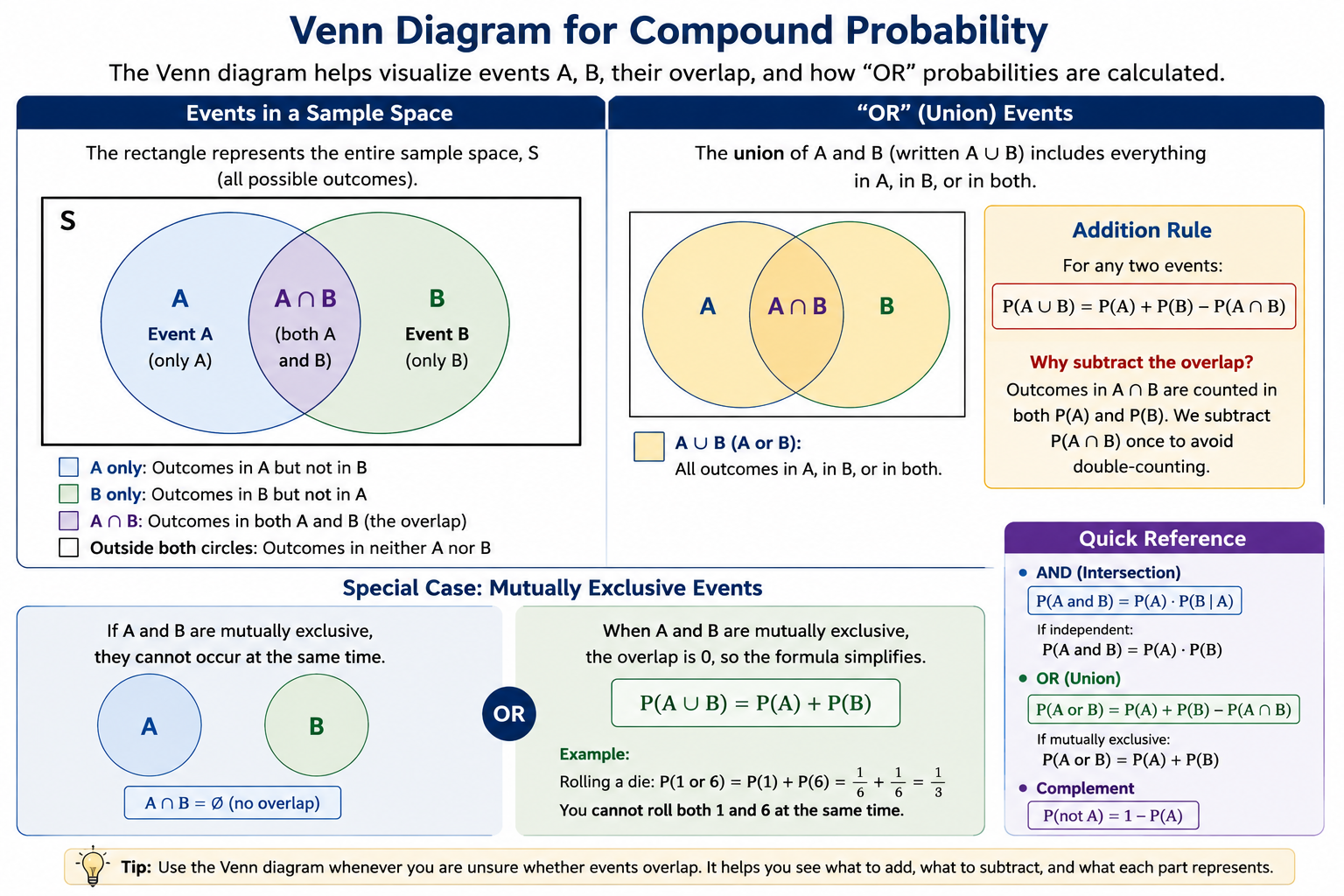
The general addition rule is:
\[ \boxed{ P(A\text{ or }B) = P(A)+P(B)-P(A\cap B) } \]
The intersection:
\[ A\cap B \]
represents outcomes that belong to both events.
We subtract the intersection because otherwise those outcomes would be counted twice.
Mutually Exclusive Events
Events are mutually exclusive if they cannot occur at the same time.
Then:
\[ P(A\cap B)=0 \]
so the addition rule becomes:
\[ \boxed{ P(A\text{ or }B) = P(A)+P(B) } \]
For example, on one roll of a die, you cannot roll both a 1 and a 6.
Therefore:
\[ P(1\text{ or }6) = \frac16+\frac16 = \boxed{\frac13} \]
Overlapping Events
Events are not mutually exclusive if they can occur at the same time.
In that case, subtract the overlap:
\[ \boxed{ P(A\text{ or }B) = P(A)+P(B)-P(A\cap B) } \]
For example, consider drawing one card from a standard deck.
Let:
- \(A\) = drawing a heart
- \(B\) = drawing a face card
There are:
\[ 13 \]
hearts and:
\[ 12 \]
face cards.
But 3 cards are both hearts and face cards:
\[ J\heartsuit,\quad Q\heartsuit,\quad K\heartsuit \]
Therefore:
\[ P(\text{heart or face card}) = \frac{13}{52} + \frac{12}{52} - \frac{3}{52} \]
\[ P(\text{heart or face card}) = \frac{22}{52} = \boxed{\frac{11}{26}} \]
Without subtracting the 3 heart face cards, they would be counted twice.
Using Complements
The complement rule is:
\[ \boxed{ P(\text{not }A)=1-P(A) } \]
This becomes especially useful in compound probability problems involving phrases such as:
- at least one
- one or more
- not all
- none
“At Least One”
Instead of counting every possible way to get at least one success, it is often easier to calculate:
\[ \boxed{ P(\text{at least one}) = 1-P(\text{none}) } \]
For example, suppose a fair coin is flipped 3 times.
Rather than separately counting:
- exactly 1 head
- exactly 2 heads
- exactly 3 heads
find the probability of no heads.
No heads means all three flips are tails:
\[ P(TTT) = \frac12\cdot\frac12\cdot\frac12 = \frac18 \]
Therefore:
\[ P(\text{at least one head}) = 1-\frac18 = \boxed{\frac78} \]
When you see “at least one,” consider finding the probability of none first.
\[ P(\text{at least one}) = 1-P(\text{none}) \]
Common Problem Types
1. “AND” With Independent Events
When the events are independent, multiply their probabilities.
2. “AND” With Dependent Events
If the first event changes the second probability, update the second fraction.
This often happens in “without replacement” problems.
3. “OR” With Mutually Exclusive Events
If the events cannot occur together, add their probabilities.
4. “OR” With Overlapping Events
If the events can occur together, subtract the overlap.
Use:
\[ P(A\text{ or }B) = P(A)+P(B)-P(A\text{ and }B) \]
5. “At Least One” Problems
Use the complement when it is easier to calculate the probability of none.
6. Repeated Independent Events
When the same independent event occurs repeatedly, powers can simplify the calculation.
Suppose an event has probability:
\[ P(A)=p \]
and you want it to occur on all \(n\) independent trials.
Then:
\[ \boxed{ P(\text{A on every trial})=p^n } \]
Strategies
For “AND”
Ask:
Does the first event affect the probability of the second?
If no → independent.
Multiply the unchanged probabilities.
If yes → dependent.
Update the second probability before multiplying.
For “OR”
Ask:
Can both events happen at the same time?
If no → mutually exclusive.
Add:
\[ P(A)+P(B) \]
If yes → overlapping.
Use:
\[ P(A)+P(B)-P(A\cap B) \]
For “At Least One”
Consider the complement:
\[ \boxed{ P(\text{at least one}) = 1-P(\text{none}) } \]
General Strategy
- Identify whether the question involves AND, OR, or a complement.
- For AND problems, check whether events are independent or dependent.
- For OR problems, check whether events overlap.
- Pay close attention to with replacement versus without replacement.
- Use a Venn diagram when overlap is difficult to visualize.
- Write the sample space for small experiments such as two dice or two coins.
- Check that the final probability is between 0 and 1.
Worked Examples
Example 1 — Two Dice
Two fair six-sided dice are rolled.
What is the probability that their sum is 7?
Each die has 6 possible outcomes, so there are:
\[ 6\cdot6=36 \]
equally likely ordered outcomes.
The outcomes that sum to 7 are:
\[ (1,6),\ (2,5),\ (3,4),\ (4,3),\ (5,2),\ (6,1) \]
There are 6 favorable outcomes.
Therefore:
\[ P(\text{sum of }7) = \frac{6}{36} = \boxed{\frac16} \]
Example 2 — Cards Without Replacement
Two cards are drawn from a standard deck without replacement.
What is the probability that both are aces?
There are 4 aces among 52 cards.
For the first card:
\[ P(\text{first ace}) = \frac{4}{52} \]
If the first card is an ace, there are now 3 aces among 51 remaining cards.
So:
\[ P(\text{second ace}\mid\text{first ace}) = \frac{3}{51} \]
Multiply:
\[ P(\text{both aces}) = \frac{4}{52}\cdot\frac{3}{51} = \boxed{\frac{1}{221}} \]
Example 3 — Cards With Replacement
Suppose the first card is returned to the deck before the second card is drawn.
What is the probability of drawing two aces?
Because the first card is replaced, the deck returns to 52 cards with 4 aces.
Therefore:
\[ P(\text{both aces}) = \frac{4}{52}\cdot\frac{4}{52} \]
\[ P(\text{both aces}) = \frac{1}{13}\cdot\frac{1}{13} = \boxed{\frac{1}{169}} \]
Replacement makes the two draws independent.
Example 4 — Overlapping “OR”
A standard die is rolled.
What is the probability of rolling a number greater than 3 or an even number?
Let:
\[ A=\{4,5,6\} \]
and:
\[ B=\{2,4,6\} \]
The overlap is:
\[ A\cap B=\{4,6\} \]
Use the addition rule:
\[ P(A\text{ or }B) = \frac36+\frac36-\frac26 \]
\[ P(A\text{ or }B) = \boxed{\frac46=\frac23} \]
Example 5 — At Least One Success
A fair coin is flipped 4 times.
What is the probability of getting at least one head?
The complement is getting no heads, which means all four flips are tails.
\[ P(\text{no heads}) = \left(\frac12\right)^4 = \frac{1}{16} \]
Therefore:
\[ P(\text{at least one head}) = 1-\frac{1}{16} = \boxed{\frac{15}{16}} \]
- Assuming “AND” always means multiplying unchanged probabilities.
- Forgetting that probabilities change when sampling without replacement.
- Adding probabilities in an “OR” problem without checking for overlap.
- Forgetting to subtract the intersection when events overlap.
- Confusing independent with mutually exclusive.
- Treating events as independent just because they involve two separate steps.
- Forgetting that replacement usually restores the original probabilities.
- Counting “at least one” case by case when the complement is much easier.
- Forgetting that the final probability must be between 0 and 1.
Practice Problems
Two fair coins are flipped. What is the probability of getting two heads?
A standard die is rolled. What is the probability of rolling an even number or a prime number?
Two cards are drawn from a standard deck without replacement. What is the probability that both are red?
Two fair coins are flipped. What is the probability of getting at least one head?
A bag contains 4 red marbles and 6 blue marbles. Two marbles are selected without replacement. What is the probability that both are blue?
A standard die is rolled. What is the probability of rolling a number less than 3 or greater than 4?
A fair coin is flipped 3 times. What is the probability of getting at least one tail?
1. The two coin flips are independent.
For each flip:
\[ P(H)=\frac12 \]
Therefore:
\[ P(HH) = \frac12\cdot\frac12 = \boxed{\frac14} \]
2. The even numbers are:
\[ \{2,4,6\} \]
The prime numbers are:
\[ \{2,3,5\} \]
The overlap is:
\[ \{2\} \]
Use the addition rule:
\[ P(\text{even or prime}) = \frac36+\frac36-\frac16 = \boxed{\frac56} \]
3. There are 26 red cards among 52 cards.
The probability that the first card is red is:
\[ \frac{26}{52} \]
Without replacement, 25 red cards remain among 51 total cards.
Therefore:
\[ P(\text{both red}) = \frac{26}{52}\cdot\frac{25}{51} \]
Simplify:
\[ P(\text{both red}) = \frac12\cdot\frac{25}{51} = \boxed{\frac{25}{102}} \]
4. Use the complement.
“At least one head” is the complement of “no heads.”
No heads means two tails:
\[ P(TT) = \frac12\cdot\frac12 = \frac14 \]
Therefore:
\[ P(\text{at least one head}) = 1-\frac14 = \boxed{\frac34} \]
5. There are 6 blue marbles among 10 total marbles.
For the first selection:
\[ P(\text{first blue}) = \frac{6}{10} \]
Without replacement, 5 blue marbles remain among 9 total marbles.
Therefore:
\[ P(\text{both blue}) = \frac{6}{10}\cdot\frac59 \]
Simplify:
\[ P(\text{both blue}) = \frac{30}{90} = \boxed{\frac13} \]
6. Numbers less than 3 are:
\[ \{1,2\} \]
Numbers greater than 4 are:
\[ \{5,6\} \]
These events are mutually exclusive.
There are 4 favorable outcomes out of 6.
Therefore:
\[ P(\text{less than 3 or greater than 4}) = \frac46 = \boxed{\frac23} \]
7. Use the complement.
“At least one tail” is the complement of getting no tails.
No tails means all three flips are heads.
\[ P(HHH) = \left(\frac12\right)^3 = \frac18 \]
Therefore:
\[ P(\text{at least one tail}) = 1-\frac18 = \boxed{\frac78} \]
Summary
Compound probability problems often involve AND, OR, or complements.
For independent events:
\[ \boxed{ P(A\text{ and }B)=P(A)P(B) } \]
For dependent events:
\[ \boxed{ P(A\text{ and }B)=P(A)P(B\mid A) } \]
For any two events:
\[ \boxed{ P(A\text{ or }B) = P(A)+P(B)-P(A\cap B) } \]
If the events are mutually exclusive:
\[ \boxed{ P(A\text{ or }B)=P(A)+P(B) } \]
For “at least one”:
\[ \boxed{ P(\text{at least one}) = 1-P(\text{none}) } \]
- AND → think multiplication, but check whether probabilities change.
- OR → think addition, but check for overlap.
- Without replacement → probabilities usually change.
- With replacement → probabilities are usually restored.
- At least one → try \(1-P(\text{none})\).
- Mutually exclusive means the events cannot happen together.
- Independent means one event does not change the probability of the other.
- Always check that your final probability is between 0 and 1.