Pythagorean Triples & Special Right Triangles
By the end of this lesson, you’ll be able to:
- Recognize common Pythagorean triples.
- Scale Pythagorean triples to find missing side lengths.
- Use the side relationships of 45-45-90 and 30-60-90 triangles.
- Work forward or backward from a known side in a special right triangle.
- Choose when a triple or special-triangle relationship is faster than the Pythagorean Theorem.
Key Ideas
Some right triangles have predictable side-length patterns. Recognizing these patterns can save time compared with using the Pythagorean Theorem from scratch.
Common Pythagorean Triples
A Pythagorean triple is a set of three whole-number side lengths that satisfies:
\[ a^2+b^2=c^2 \]
where \(c\) is the hypotenuse.
Common triples worth recognizing include:
- \(3-4-5\)
- \(5-12-13\)
- \(7-24-25\)
Any multiple of a Pythagorean triple is also a Pythagorean triple.
For example, multiplying the \(3-4-5\) triple by 2 gives:
\[ 6-8-10 \]
and multiplying it by 3 gives:
\[ 9-12-15 \]
Special Right Triangles
Two right triangles appear frequently because their angles create predictable side ratios.
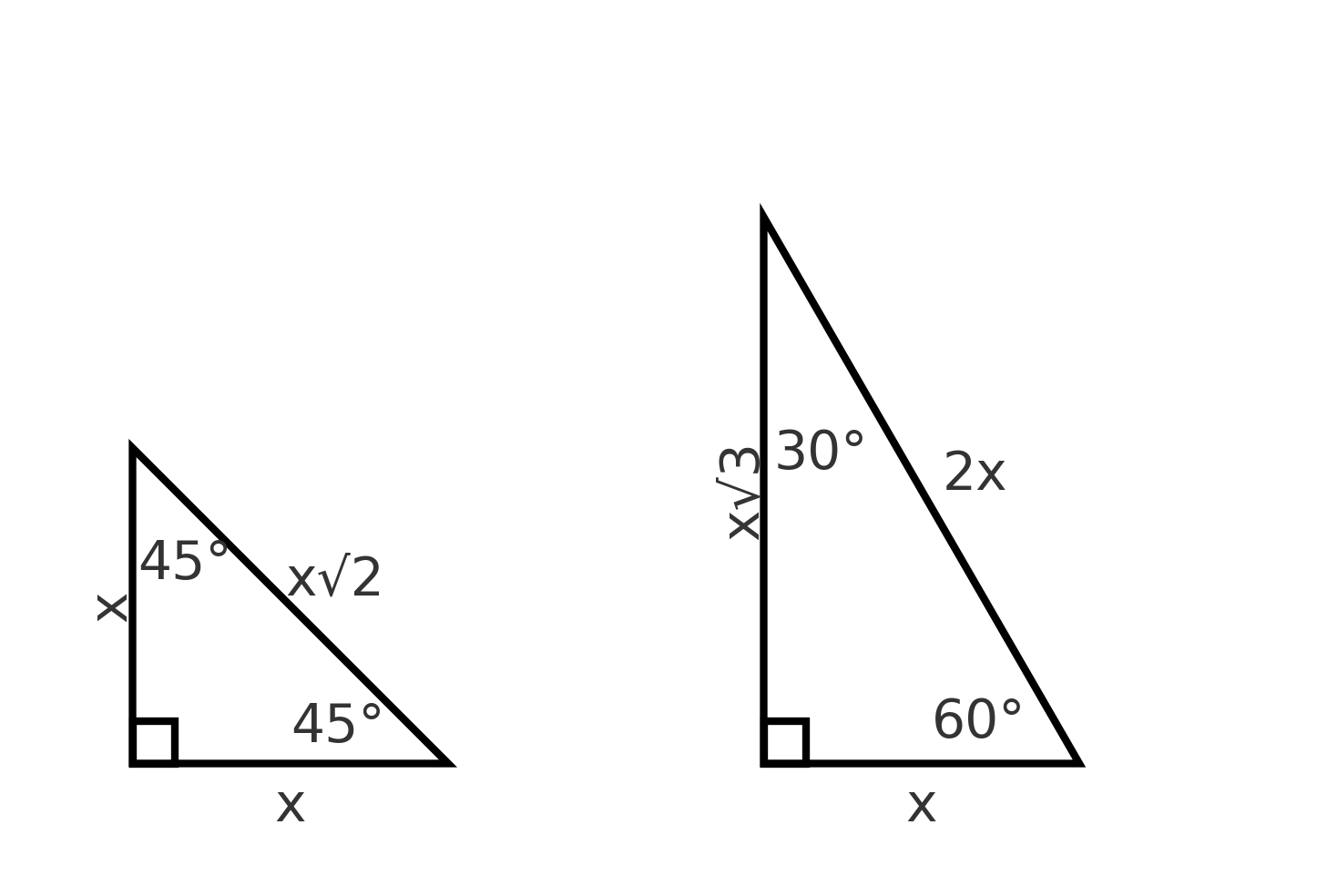
45-45-90 Triangle
A 45-45-90 triangle has two equal angles, so its two legs are also equal.
The side lengths follow:
\[ x,\;x,\;x\sqrt2 \]
where:
- \(x\) = one leg
- \(x\) = the other leg
- \(x\sqrt2\) = the hypotenuse
So the hypotenuse is always \(\sqrt2\) times either leg.
30-60-90 Triangle
A 30-60-90 triangle has side lengths:
\[ x,\;x\sqrt3,\;2x \]
The side lengths correspond to the angles they are opposite:
- \(x\) = short leg, opposite \(30^\circ\)
- \(x\sqrt3\) = long leg, opposite \(60^\circ\)
- \(2x\) = hypotenuse, opposite \(90^\circ\)
Common Problem Types
1. Recognizing Pythagorean Triples
Before using the Pythagorean Theorem, check whether the side lengths match a familiar triple.
For example, suppose a right triangle has legs of 9 and 12.
Notice:
\[ 9=3(3) \]
and
\[ 12=3(4) \]
These are the first two sides of a \(3-4-5\) triangle scaled by 3:
\[ 3-4-5 \]
becomes:
\[ 9-12-15 \]
So the hypotenuse is 15.
2. Scaling Pythagorean Triples
When a known triple is scaled, every side must be multiplied by the same factor.
For example, suppose a right triangle has legs 15 and 20.
Since:
\[ 15=3(5) \]
and
\[ 20=4(5) \]
the triangle follows the \(3-4-5\) pattern scaled by 5.
Scale the hypotenuse by the same factor:
\[ 5(5)=25 \]
So the side lengths are:
\[ 15,\;20,\;25 \]
3. Using a 45-45-90 Triangle
A 45-45-90 triangle follows:
\[ x:x:x\sqrt2 \]
If a leg is known, multiply it by \(\sqrt2\) to find the hypotenuse.
For example, if a leg is 6:
\[ \text{hypotenuse}=6\sqrt2 \]
If the hypotenuse is given, work backward from:
\[ x\sqrt2=\text{hypotenuse} \]
to find the legs.
4. Using a 30-60-90 Triangle
A 30-60-90 triangle follows:
\[ x:x\sqrt3:2x \]
The short leg, \(x\), is especially useful because the other two sides can be found directly from it.
For example, if the short leg is 4:
\[ \text{long leg}=4\sqrt3 \]
and:
\[ \text{hypotenuse}=2(4)=8 \]
Remember that the side lengths are tied to their opposite angles:
\[ 30^\circ \rightarrow x \]
\[ 60^\circ \rightarrow x\sqrt3 \]
\[ 90^\circ \rightarrow 2x \]
5. Working Backward in Special Right Triangles
The given side will not always be \(x\).
For a 45-45-90 triangle, if the hypotenuse is given:
\[ x\sqrt2=\text{hypotenuse} \]
Solve for \(x\) to find each leg.
For a 30-60-90 triangle, you might instead be given:
\[ x\sqrt3=\text{long leg} \]
or:
\[ 2x=\text{hypotenuse} \]
Use the given side to find \(x\) first. Then use \(x\) to find any remaining sides.
Strategies
- Look for multiples of common Pythagorean triples before using the Pythagorean Theorem.
- When scaling a triple, multiply all three sides by the same factor.
- For a 45-45-90 triangle, remember that the two legs are equal.
- For a 30-60-90 triangle, identify the side opposite \(30^\circ\) first. This is the short leg, \(x\).
- The side opposite \(60^\circ\) is the long leg, \(x\sqrt3\).
- The side opposite \(90^\circ\) is always the hypotenuse.
- If the given side is not \(x\), work backward to find \(x\) first.
- Keep exact answers such as \(5\sqrt2\) or \(7\sqrt3\) unless a decimal approximation is requested.
Worked Examples
Example 1 — Recognizing a Pythagorean Triple
A right triangle has legs of length 9 and 12. Find the hypotenuse.
Notice that:
\[ 9=3(3) \]
and:
\[ 12=3(4) \]
So the two legs match a \(3-4-5\) triangle scaled by 3:
\[ 3-4-5 \]
\[ \downarrow \times 3 \]
\[ 9-12-15 \]
Therefore, the hypotenuse is:
\[ \boxed{15} \]
Recognizing the triple lets us find the answer without calculating \(9^2+12^2\).
Example 2 — 45-45-90 Triangle
A 45-45-90 triangle has a leg of length 10. Find the hypotenuse.
The side ratio is:
\[ x:x:x\sqrt2 \]
Since the given leg is 10:
\[ x=10 \]
The hypotenuse is \(x\sqrt2\), so:
\[ 10\sqrt2 \]
Therefore:
\[ \boxed{10\sqrt2} \]
Example 3 — 30-60-90 Triangle
A 30-60-90 triangle has a short leg of length 5. Find the long leg and hypotenuse.
The side ratio is:
\[ x:x\sqrt3:2x \]
The short leg is \(x\), so:
\[ x=5 \]
The long leg is:
\[ x\sqrt3=5\sqrt3 \]
The hypotenuse is:
\[ 2x=2(5)=10 \]
Therefore:
\[ \boxed{\text{long leg}=5\sqrt3} \]
and:
\[ \boxed{\text{hypotenuse}=10} \]
Example 4 — Working Backward From the Hypotenuse
A 45-45-90 triangle has a hypotenuse of 12. Find the length of each leg.
The side ratio is:
\[ x:x:x\sqrt2 \]
The hypotenuse corresponds to \(x\sqrt2\), so:
\[ x\sqrt2=12 \]
Solve for \(x\):
\[ x=\frac{12}{\sqrt2} \]
Rationalize the denominator:
\[ x=\frac{12\sqrt2}{2} \]
\[ x=6\sqrt2 \]
Since both legs are equal:
\[ \boxed{\text{each leg}=6\sqrt2} \]
- Mixing up the short and long legs in a 30-60-90 triangle.
- Forgetting that the short leg is opposite the \(30^\circ\) angle.
- Using \(x\sqrt3\) as the hypotenuse in a 30-60-90 triangle—the hypotenuse is \(2x\).
- Forgetting that both legs are equal in a 45-45-90 triangle.
- Forgetting to scale all three sides of a Pythagorean triple by the same factor.
- Assuming every right triangle is a 45-45-90 or 30-60-90 triangle.
- Converting radical answers to decimals when an exact answer is expected.
Practice Problems
A \(3-4-5\) right triangle is scaled by a factor of 7. Find all three side lengths.
A 45-45-90 triangle has a hypotenuse of 8. Find the length of each leg.
A 30-60-90 triangle has a long leg of \(9\sqrt3\). Find the short leg and hypotenuse.
A 30-60-90 triangle has a hypotenuse of 14. Find the short leg and long leg.
1. Start with the \(3-4-5\) triple:
\[ 3,\;4,\;5 \]
Scale every side by 7:
\[ 3(7)=21 \]
\[ 4(7)=28 \]
\[ 5(7)=35 \]
Therefore, the three side lengths are:
\[ \boxed{21,\;28,\;35} \]
2. A 45-45-90 triangle has side ratio:
\[ x:x:x\sqrt2 \]
The hypotenuse is 8, so:
\[ x\sqrt2=8 \]
Solve for \(x\):
\[ x=\frac{8}{\sqrt2} \]
Rationalize the denominator:
\[ x=\frac{8\sqrt2}{2} \]
\[ x=4\sqrt2 \]
Since the two legs are equal:
\[ \boxed{\text{each leg}=4\sqrt2} \]
3. A 30-60-90 triangle has side ratio:
\[ x:x\sqrt3:2x \]
The long leg corresponds to \(x\sqrt3\).
We are given:
\[ x\sqrt3=9\sqrt3 \]
Therefore:
\[ x=9 \]
So the short leg is:
\[ \boxed{9} \]
The hypotenuse is:
\[ 2x=2(9)=18 \]
Therefore:
\[ \boxed{\text{hypotenuse}=18} \]
4. In a 30-60-90 triangle:
\[ x:x\sqrt3:2x \]
The hypotenuse is \(2x\). Since the hypotenuse is 14:
\[ 2x=14 \]
Divide by 2:
\[ x=7 \]
So the short leg is:
\[ \boxed{7} \]
The long leg is \(x\sqrt3\):
\[ 7\sqrt3 \]
Therefore:
\[ \boxed{\text{long leg}=7\sqrt3} \]
Summary
- Common Pythagorean triples include:
\[ 3-4-5,\qquad 5-12-13,\qquad 7-24-25 \]
Multiples of Pythagorean triples are also triples.
A 45-45-90 triangle follows:
\[ x:x:x\sqrt2 \]
- A 30-60-90 triangle follows:
\[ x:x\sqrt3:2x \]
- In a 30-60-90 triangle:
\[ 30^\circ \rightarrow x,\qquad 60^\circ \rightarrow x\sqrt3,\qquad 90^\circ \rightarrow 2x \]
- If the given side is not \(x\), work backward to find \(x\) first.
- 45-45-90: equal angles → equal legs.
- 30-60-90: the short leg is always opposite \(30^\circ\).
- The hypotenuse is always opposite the \(90^\circ\) angle.
- Look for hidden multiples of common Pythagorean triples.
- Keep radical answers exact unless a decimal is requested.