Radian Measure
By the end of this lesson, you’ll be able to:
- Interpret radian measure using arc length and radius.
- Convert angles between degrees and radians.
- Recognize common degree–radian equivalents.
- Use radians to calculate arc length and sector area.
- Solve for missing angles using radian-based formulas.
Key Ideas
What Is a Radian?
A radian is a way to measure angles using the radius of a circle.
One radian is the central angle that intercepts an arc whose length is equal to the radius.
In other words, if:
\[ s=r \]
then:
\[ \theta=1\text{ radian} \]
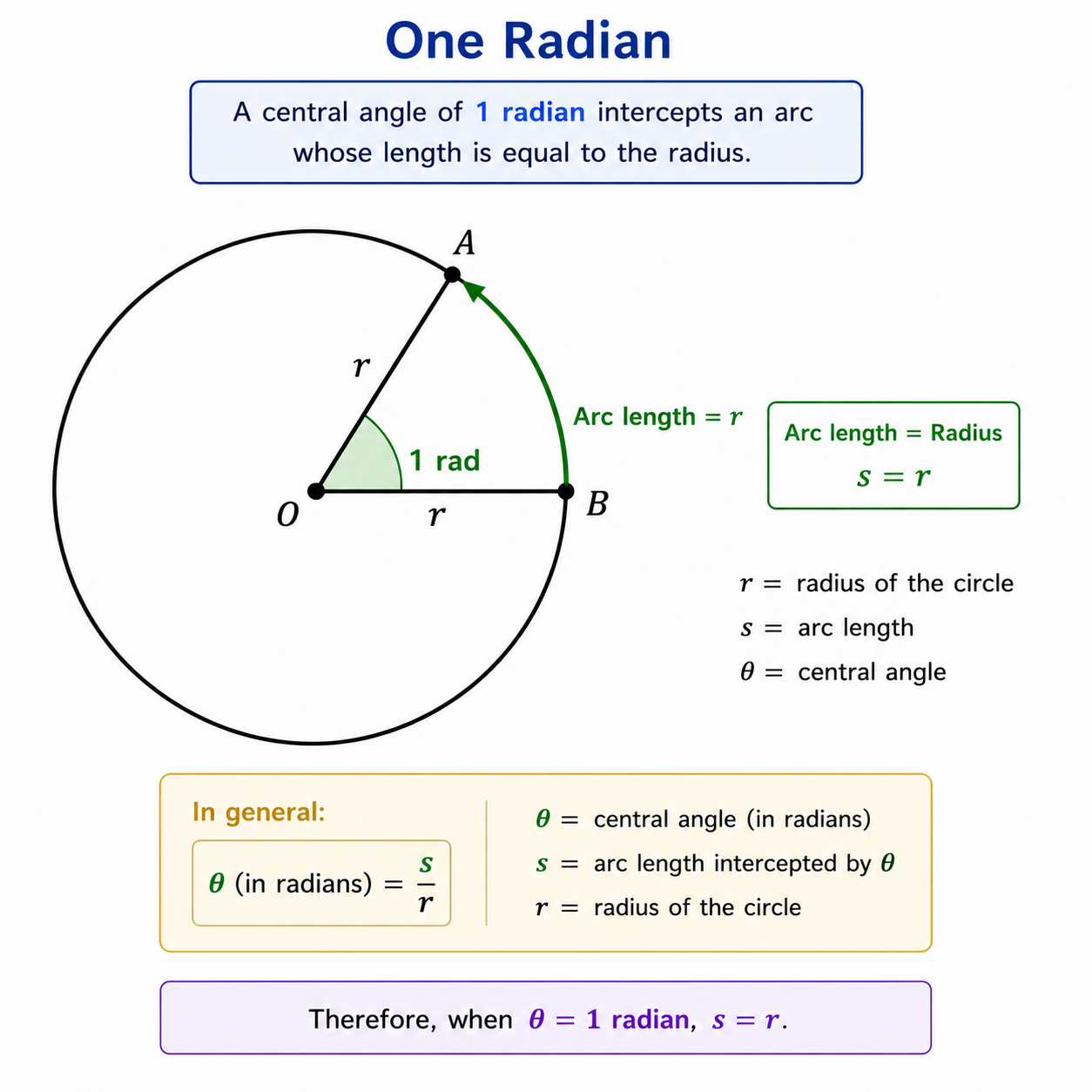
More generally, radian measure compares the arc length \(s\) with the radius \(r\):
\[ \boxed{\theta=\frac{s}{r}} \]
So if an arc is twice as long as the radius:
\[ s=2r \]
then:
\[ \theta=2\text{ radians} \]
This relationship also explains the arc-length formula:
\[ \theta=\frac{s}{r} \]
Multiply both sides by \(r\):
\[ \boxed{s=r\theta} \]
Degrees and Radians
Degrees and radians are two different units for measuring the same angle.
A half-circle measures:
\[ 180^\circ \]
or:
\[ \pi\text{ radians} \]
Therefore:
\[ \boxed{180^\circ=\pi\text{ rad}} \]
A full circle measures:
\[ 360^\circ=2\pi\text{ rad} \]
This relationship allows us to convert between the two units.
Degrees to Radians
Multiply by:
\[ \frac{\pi}{180^\circ} \]
So:
\[ \boxed{ \text{radians} = \text{degrees}\cdot\frac{\pi}{180^\circ} } \]
Radians to Degrees
Multiply by:
\[ \frac{180^\circ}{\pi} \]
So:
\[ \boxed{ \text{degrees} = \text{radians}\cdot\frac{180^\circ}{\pi} } \]
Common Degree–Radian Equivalents
These common angles are useful to recognize:
| Degrees | Radians |
|---|---|
| \(0^\circ\) | \(0\) |
| \(30^\circ\) | \(\frac{\pi}{6}\) |
| \(45^\circ\) | \(\frac{\pi}{4}\) |
| \(60^\circ\) | \(\frac{\pi}{3}\) |
| \(90^\circ\) | \(\frac{\pi}{2}\) |
| \(180^\circ\) | \(\pi\) |
| \(270^\circ\) | \(\frac{3\pi}{2}\) |
| \(360^\circ\) | \(2\pi\) |
You do not always need to memorize every value if you remember:
\[ 180^\circ=\pi \]
Radian-Based Circle Formulas
When \(\theta\) is measured in radians, circle formulas become especially simple.
Arc Length
\[ \boxed{s=r\theta} \]
where:
- \(s\) = arc length
- \(r\) = radius
- \(\theta\) = central angle in radians
Sector Area
\[ \boxed{ A_{\text{sector}} = \frac12r^2\theta } \]
where \(\theta\) must again be measured in radians.
The formulas
\[ s=r\theta \]
and:
\[ A_{\text{sector}}=\frac12r^2\theta \]
require \(\theta\) to be measured in radians, not degrees.
If the angle is given in degrees, convert it to radians first.
Common Problem Types
1. Converting Degrees to Radians
Multiply by:
\[ \frac{\pi}{180^\circ} \]
2. Converting Radians to Degrees
Multiply by:
\[ \frac{180^\circ}{\pi} \]
3. Finding Arc Length
When the angle is in radians, use:
\[ s=r\theta \]
4. Finding Sector Area
When the central angle is in radians, use:
\[ A_{\text{sector}} = \frac12r^2\theta \]
5. Finding an Angle From Arc Length
The formula:
\[ s=r\theta \]
can also be used backward.
If the problem asks for degrees:
\[ \frac{\pi}{2}=90^\circ \]
Strategies
- First check whether the angle is measured in degrees or radians.
- Remember the key conversion:
\[ 180^\circ=\pi\text{ rad} \]
- Degrees → radians: multiply by:
\[ \frac{\pi}{180^\circ} \]
- Radians → degrees: multiply by:
\[ \frac{180^\circ}{\pi} \]
- Simplify fractions before multiplying when possible.
- Keep exact radian answers in terms of \(\pi\) unless a decimal is requested.
- Use \(s=r\theta\) only when \(\theta\) is in radians.
- Use \(\frac12r^2\theta\) only when \(\theta\) is in radians.
- Remember that radian measure itself comes from:
\[ \theta=\frac{s}{r} \]
Worked Examples
Example 1 — Degrees to Radians
Convert \(150^\circ\) to radians.
Multiply by:
\[ \frac{\pi}{180^\circ} \]
\[ 150^\circ\cdot\frac{\pi}{180^\circ} \]
Cancel the degree units:
\[ \frac{150\pi}{180} \]
Simplify:
\[ \frac{150}{180}=\frac56 \]
Therefore:
\[ \boxed{\frac{5\pi}{6}} \]
Example 2 — Radians to Degrees
Convert:
\[ \frac{5\pi}{3} \]
to degrees.
Multiply by:
\[ \frac{180^\circ}{\pi} \]
\[ \frac{5\pi}{3}\cdot\frac{180^\circ}{\pi} \]
Cancel \(\pi\):
\[ \frac{5(180^\circ)}{3} \]
\[ =5(60^\circ) \]
\[ =300^\circ \]
Therefore:
\[ \boxed{300^\circ} \]
Example 3 — Arc Length
Find the arc length when:
\[ r=8 \]
and:
\[ \theta=\frac{\pi}{4} \]
The angle is already in radians, so use:
\[ s=r\theta \]
Substitute:
\[ s=8\left(\frac{\pi}{4}\right) \]
Simplify:
\[ s=2\pi \]
Therefore:
\[ \boxed{2\pi} \]
Example 4 — Sector Area
Find the sector area when:
\[ r=6 \]
and:
\[ \theta=\frac{\pi}{2} \]
Use:
\[ A_{\text{sector}} = \frac12r^2\theta \]
Substitute:
\[ A_{\text{sector}} = \frac12(6^2)\left(\frac{\pi}{2}\right) \]
\[ = \frac12(36)\left(\frac{\pi}{2}\right) \]
\[ =18\left(\frac{\pi}{2}\right) \]
\[ =9\pi \]
Therefore:
\[ \boxed{9\pi\text{ square units}} \]
Example 5 — Degrees Given in a Radian Formula
A circle has radius 9 and a central angle of \(60^\circ\). Find the arc length using \(s=r\theta\).
The formula requires radians, so first convert:
\[ 60^\circ\cdot\frac{\pi}{180^\circ} = \frac{\pi}{3} \]
Now use:
\[ s=r\theta \]
\[ s=9\left(\frac{\pi}{3}\right) \]
\[ s=3\pi \]
Therefore:
\[ \boxed{3\pi} \]
- Using a degree value directly in \(s=r\theta\).
- Using a degree value directly in \(\frac12r^2\theta\).
- Multiplying by the wrong conversion factor.
- Forgetting \(\pi\) when converting degrees to radians.
- Leaving \(\pi\) in the denominator when converting radians to degrees instead of simplifying.
- Confusing arc length with angle measure.
- Converting an exact answer involving \(\pi\) to a decimal when no approximation is requested.
Practice Problems
Convert \(60^\circ\) to radians.
Convert \(\frac{2\pi}{3}\) radians to degrees.
Find the arc length if:
\[ r=10,\qquad \theta=\frac{\pi}{3} \]
- Find the sector area if:
\[ r=6,\qquad \theta=\frac{\pi}{2} \]
- An arc has length \(4\pi\) in a circle with radius 8. Find the central angle in radians.
1. Convert degrees to radians by multiplying by:
\[ \frac{\pi}{180^\circ} \]
\[ 60^\circ\cdot\frac{\pi}{180^\circ} \]
Simplify:
\[ \frac{60\pi}{180} = \frac{\pi}{3} \]
Therefore:
\[ \boxed{\frac{\pi}{3}} \]
2. Convert radians to degrees by multiplying by:
\[ \frac{180^\circ}{\pi} \]
\[ \frac{2\pi}{3}\cdot\frac{180^\circ}{\pi} \]
Cancel \(\pi\):
\[ \frac{2(180^\circ)}{3} \]
\[ =120^\circ \]
Therefore:
\[ \boxed{120^\circ} \]
3. The angle is already in radians, so use:
\[ s=r\theta \]
Substitute:
\[ s=10\left(\frac{\pi}{3}\right) \]
Therefore:
\[ \boxed{s=\frac{10\pi}{3}} \]
4. Use:
\[ A_{\text{sector}} = \frac12r^2\theta \]
Substitute:
\[ A_{\text{sector}} = \frac12(6^2)\left(\frac{\pi}{2}\right) \]
\[ = \frac12(36)\left(\frac{\pi}{2}\right) \]
\[ =9\pi \]
Therefore:
\[ \boxed{9\pi\text{ square units}} \]
5. Use:
\[ s=r\theta \]
Substitute:
\[ 4\pi=8\theta \]
Divide by 8:
\[ \theta=\frac{4\pi}{8} \]
Simplify:
\[ \theta=\frac{\pi}{2} \]
Therefore:
\[ \boxed{\theta=\frac{\pi}{2}} \]
Summary
- One radian is the angle that intercepts an arc equal in length to the radius.
- Radian measure can be defined by:
\[ \theta=\frac{s}{r} \]
- The key degree–radian relationship is:
\[ 180^\circ=\pi\text{ rad} \]
- Degrees → radians:
\[ \times\frac{\pi}{180^\circ} \]
- Radians → degrees:
\[ \times\frac{180^\circ}{\pi} \]
- When \(\theta\) is in radians:
\[ s=r\theta \]
and:
\[ A_{\text{sector}} = \frac12r^2\theta \]
- \(180^\circ=\pi\) radians is the conversion to remember.
- Degrees → radians: multiply by \(\pi\), divide by 180.
- Radians → degrees: multiply by 180, divide by \(\pi\).
- Before using \(s=r\theta\), check that \(\theta\) is in radians.
- Before using \(\frac12r^2\theta\), check that \(\theta\) is in radians.
- Keep exact answers in terms of \(\pi\) unless a decimal is requested.