Triangle Area
- Compute triangle area using multiple formulas.
- Identify base and height correctly.
- Use area relationships in coordinate geometry.
Key Ideas
Main Formula
\[ A = \frac{1}{2}bh \]
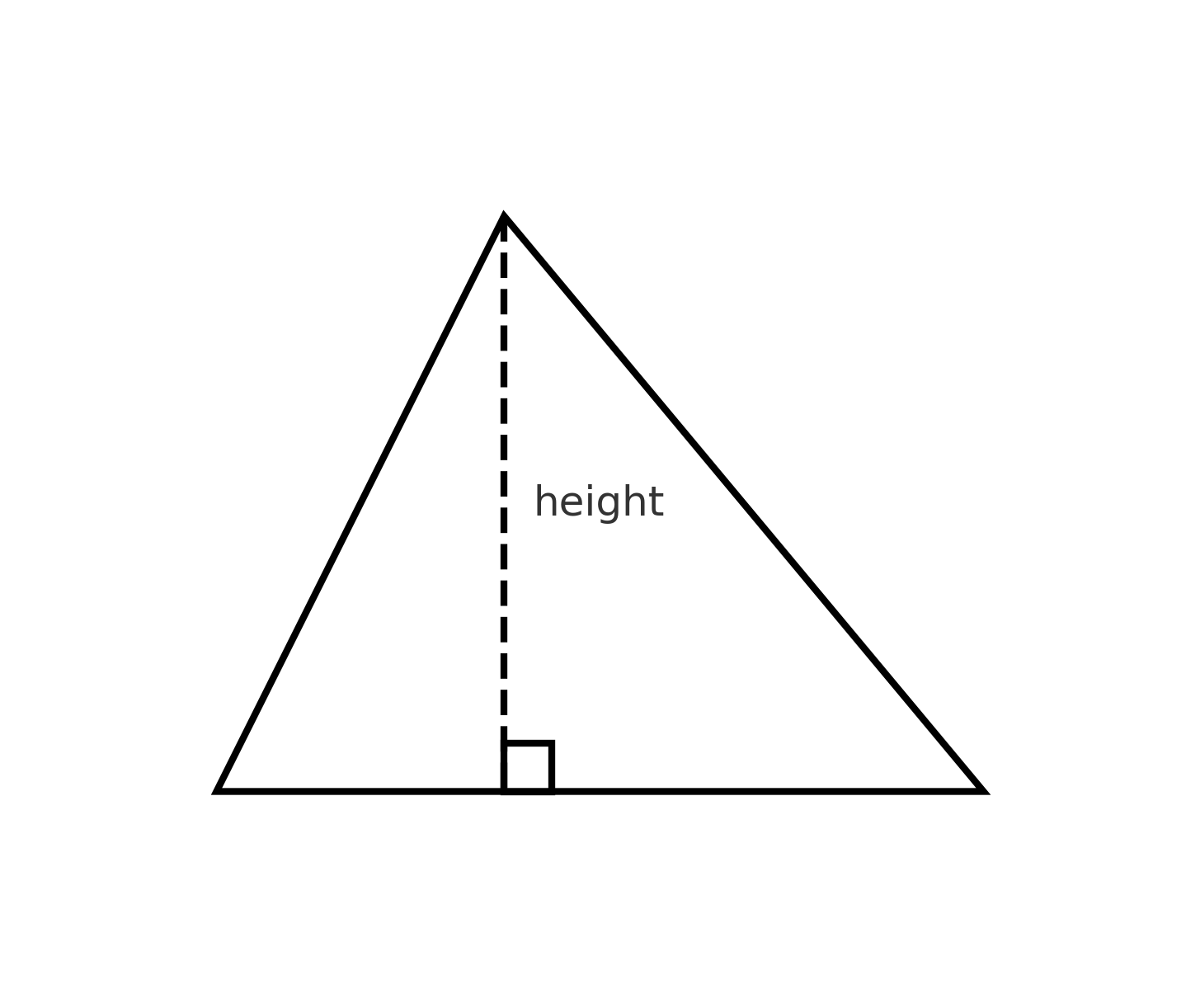
- Base and height must be perpendicular.
Special Cases
Right triangles: the two perpendicular legs can be used as the base and height.
Coordinate geometry: horizontal and vertical distances can often be used to find the base and height.
Non-right triangles: an altitude may need to be drawn to identify the perpendicular height.
Heron’s Formula (optional): if all three side lengths are known but the height is not, you can find the area using:
\[ A = \sqrt{s(s-a)(s-b)(s-c)} \]
where \(a\), \(b\), and \(c\) are the three side lengths and \(s\) is the semiperimeter (half the perimeter):
\[ s = \frac{a+b+c}{2} \]
First calculate \(s\), then substitute \(s\), \(a\), \(b\), and \(c\) into Heron’s formula.
Common Problem Types
1. Right Triangle Area
In a right triangle, the two legs that form the \(90^\circ\) angle are already perpendicular. This means they can be used directly as the base and height.
If the legs have lengths \(a\) and \(b\):
\[ A=\frac12 ab \]
For example, if the legs are 6 and 9:
\[ A=\frac12(6)(9)=27 \]
2. Non-Right Triangle With an Altitude
For a triangle that is not a right triangle, the height may not be one of the sides.
Look for an altitude: a perpendicular segment drawn from a vertex to the opposite side (or its extension).
Once the perpendicular height is known, use:
\[ A=\frac12 bh \]
Remember: the base and height must be perpendicular, but the height does not have to be a side of the triangle.
3. Using Coordinates
For triangles on the coordinate plane, look for horizontal and vertical sides.
- For a horizontal segment, subtract the \(x\)-coordinates to find its length.
- For a vertical segment, subtract the \(y\)-coordinates to find its length.
Horizontal and vertical segments are perpendicular, so they can often be used as the base and height.
4. Using Area to Find a Missing Measurement
Sometimes the area and either the base or height are given.
Start with:
\[ A=\frac12 bh \]
Substitute the known values, then solve for the missing variable.
For example, if \(A=30\) and \(b=10\):
\[ 30=\frac12(10)h \]
\[ 30=5h \]
\[ h=6 \]
Strategies
- Identify a base and its corresponding perpendicular height.
- Do not assume that any two sides can be used as \(b\) and \(h\).
- For right triangles, the two legs are automatically perpendicular.
- For coordinate problems, use differences in \(x\) or \(y\) to find horizontal and vertical distances.
- If the area is given, substitute it into \(A=\frac12 bh\) and solve for the missing measurement.
- If all three sides are known but no height is given, Heron’s formula may be useful.
Worked Examples
Example 1 — Basic Area
A triangle has a base of 10 units and a perpendicular height of 6 units. Find its area.
Start with the triangle area formula:
\[ A=\frac12 bh \]
Substitute \(b=10\) and \(h=6\):
\[ A=\frac12(10)(6) \]
Multiply:
\[ A=30 \]
Therefore, the area is:
\[ \boxed{30\text{ square units}} \]
Example 2 — Coordinate Geometry
Points \(A(1,2)\), \(B(1,7)\), and \(C(6,2)\) form a triangle. Find its area.
First identify two perpendicular sides.
\(A\) and \(B\) have the same \(x\)-coordinate, so \(\overline{AB}\) is vertical. Its length is:
\[ 7-2=5 \]
\(A\) and \(C\) have the same \(y\)-coordinate, so \(\overline{AC}\) is horizontal. Its length is:
\[ 6-1=5 \]
A horizontal segment and a vertical segment are perpendicular, so the triangle is a right triangle with base 5 and height 5.
Use:
\[ A=\frac12 bh \]
\[ A=\frac12(5)(5) \]
\[ A=12.5 \]
Therefore:
\[ \boxed{12.5\text{ square units}} \]
Example 3 — Non-Right Triangle With an Altitude
A non-right triangle has a base of 14 units. A perpendicular altitude from the opposite vertex to the base has length 8 units. Find the area.
Even though the triangle is not a right triangle, the altitude gives us the perpendicular height:
\[ b=14,\qquad h=8 \]
Use:
\[ A=\frac12 bh \]
Substitute:
\[ A=\frac12(14)(8) \]
\[ A=56 \]
Therefore:
\[ \boxed{56\text{ square units}} \]
- Using incorrect height (not perpendicular).
- Using side lengths without verifying right triangle.
- Forgetting the 1/2 factor.
Practice Problems
A triangle has a base of 12 units and a perpendicular height of 4 units. Find its area.
A right triangle has legs of length 5 units and 8 units. Find its area.
A triangle has vertices \(A(0,0)\), \(B(6,0)\), and \(C(6,4)\). Find its area.
A triangle has an area of 24 square units and a base of 8 units. Find its perpendicular height.
1. The base is 12 and the perpendicular height is 4.
Use the triangle area formula:
\[ A=\frac12 bh \]
Substitute:
\[ A=\frac12(12)(4) \]
\[ A=\boxed{24} \]
2. In a right triangle, the two legs are perpendicular, so they can be used as the base and height.
\[ A=\frac12(5)(8) \]
\[ A=\boxed{20} \]
3. From \(A(0,0)\) to \(B(6,0)\), the horizontal distance is 6.
From \(B(6,0)\) to \(C(6,4)\), the vertical distance is 4.
These segments are perpendicular, so:
\[ A=\frac12(6)(4) \]
\[ A=\boxed{12} \]
4. We know the area is 24 and the base is 8.
Start with:
\[ A=\frac12 bh \]
Substitute the known values:
\[ 24=\frac12(8)h \]
Simplify:
\[ 24=4h \]
Divide both sides by 4:
\[ h=\boxed{6} \]
Summary
- Area formula: \(A=\frac12 bh\).
- Height must be perpendicular.
- Right triangles simplify area greatly.
- Draw altitudes for non-right triangles.
- In coordinates, use horizontal/vertical distances.