Triangle Basics
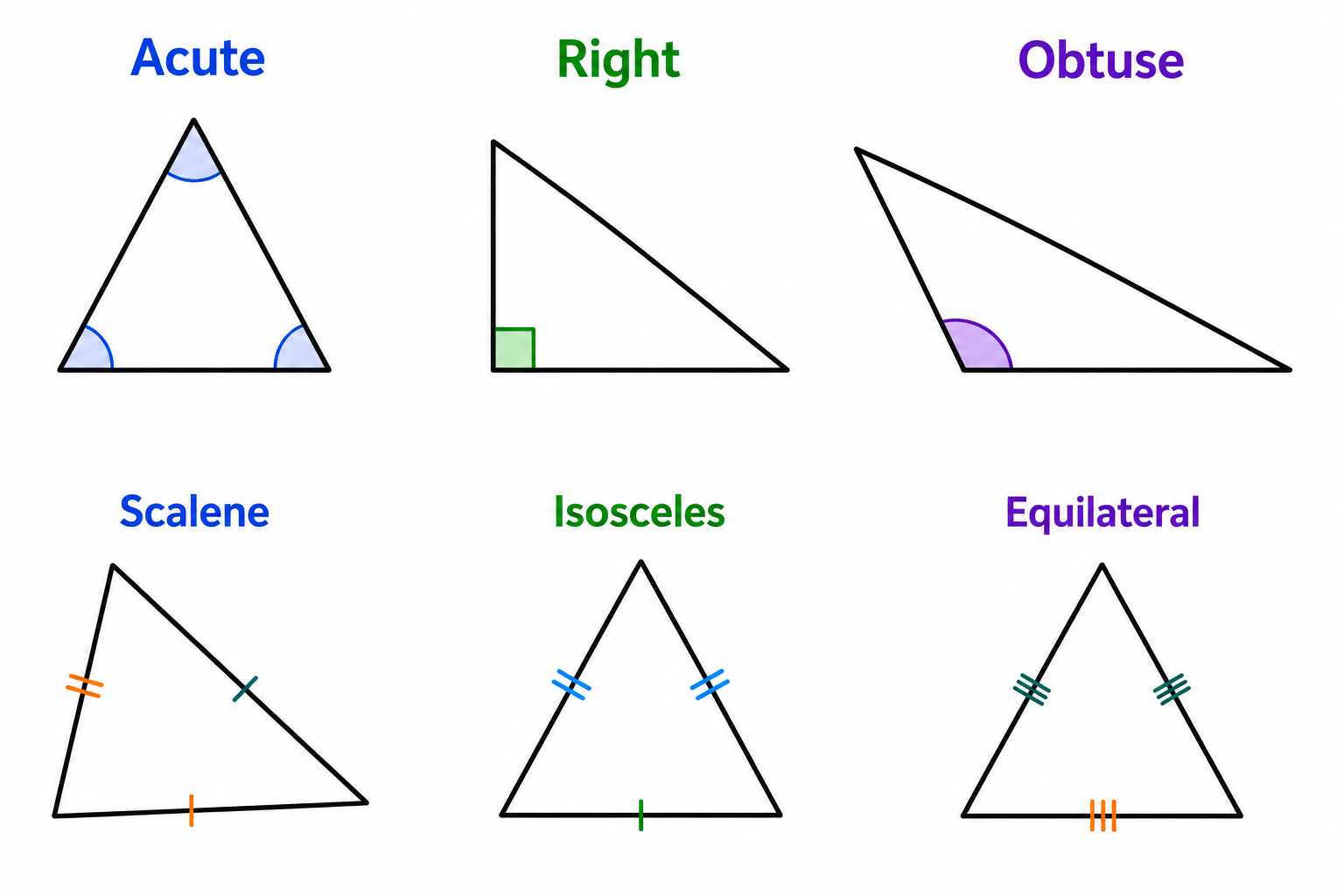
- Classify triangles by angles (acute, right, obtuse) and by sides (scalene, isosceles, equilateral).
- Use the Triangle Angle Sum Theorem.
- Identify key terminology: vertices, interior angles, sides.
- Understand properties of special triangles.
Key Ideas
- A triangle has 3 sides, 3 angles, and the sum of its angles is: \[ 180^\circ \]
- Classifications:
By Angles
- Acute: all angles < 90°
- Right: one angle = 90°
- Obtuse: one angle > 90°
By Sides
- Scalene: all sides different
- Isosceles: two sides equal → base angles equal
- Equilateral: all sides equal → all angles 60°
Common Problem Types
Using Angle Sum
Find missing angle using
\[A + B + C = 180^\circ.\]
Classifying by Angles
Given angle measures → determine type.
Classifying by Sides
Given all side lengths → determine type.
Isosceles Base-Angle Properties
Equal sides → equal base angles.
Checking for Valid Triangles
Triangle Inequality:
\[
a + b > c, \; b + c > a, \; a + c > b.
\]
Strategies
- Draw and label triangles before solving.
- Check whether the triangle is isosceles — base angles often match.
- Use the angle sum as the first step in finding missing angles.
Worked Examples
Example 1 — Angle Sum
Angles are 50° and 65°. Find the third angle. \[ 180 - (50 + 65) = 65^\circ \]
Example 2 — Classifying by Sides
Side lengths: 5, 5, 8 → isosceles.
- Forgetting angle sum = 180°.
- Assuming sides are equal without checking.
- Mixing isosceles with equilateral classifications.
- Violating the triangle inequality.
Practice Problems
Triangle has angles 40°, 70°, and \(x\)°. Find \(x\).
Sides: 6, 7, 10 → classify by sides.
Sides: 7, 7, 7 → classify fully.
Angles: 30°, 30°, 120° → classify by angles.
1. The angles of a triangle add to \(180^\circ\).
First add the known angles:
\[ 40^\circ + 70^\circ = 110^\circ \]
Then subtract from \(180^\circ\):
\[ x = 180^\circ - 110^\circ = \boxed{70^\circ} \]
2. The side lengths are 6, 7, and 10.
All three sides have different lengths, so the triangle is:
\[ \boxed{\text{Scalene}} \]
3. The side lengths are 7, 7, and 7.
All three sides are equal, so the triangle is equilateral. An equilateral triangle also has three equal angles.
Since the angles sum to \(180^\circ\):
\[ 180^\circ \div 3 = 60^\circ \]
So the triangle has angles \(60^\circ\), \(60^\circ\), and \(60^\circ\) and is:
\[ \boxed{\text{Equilateral and acute}} \]
4. The angles are \(30^\circ\), \(30^\circ\), and \(120^\circ\).
Because one angle is greater than \(90^\circ\), the triangle is:
\[ \boxed{\text{Obtuse}} \]
Summary
- All triangle angles sum to 180°.
- Classify by sides and angles separately.
- Isosceles → equal base angles; equilateral → 60° each.
- Always check triangle inequality.
- For isosceles, mark the equal sides immediately.
- Equilateral is always acute.