Trig Ratios (SOH–CAH–TOA)
By the end of this lesson, you’ll be able to:
- Define the sine, cosine, and tangent ratios in right triangles.
- Identify the opposite, adjacent, and hypotenuse relative to a chosen acute angle.
- Evaluate trig ratios from side lengths.
- Use SOH–CAH–TOA to solve for missing sides.
- Use inverse trig functions to solve for missing angles.
- Recognize when special right triangles give exact trig values.
Key Ideas
Trigonometric ratios connect the angles of a right triangle to the lengths of its sides.
For an acute angle \(\theta\):
Sine
\[ \boxed{ \sin\theta = \frac{\text{opposite}}{\text{hypotenuse}} } \]
Cosine
\[ \boxed{ \cos\theta = \frac{\text{adjacent}}{\text{hypotenuse}} } \]
Tangent
\[ \boxed{ \tan\theta = \frac{\text{opposite}}{\text{adjacent}} } \]
The memory aid is:
\[ \boxed{\text{SOH–CAH–TOA}} \]
which stands for:
- SOH → Sine = Opposite / Hypotenuse
- CAH → Cosine = Adjacent / Hypotenuse
- TOA → Tangent = Opposite / Adjacent
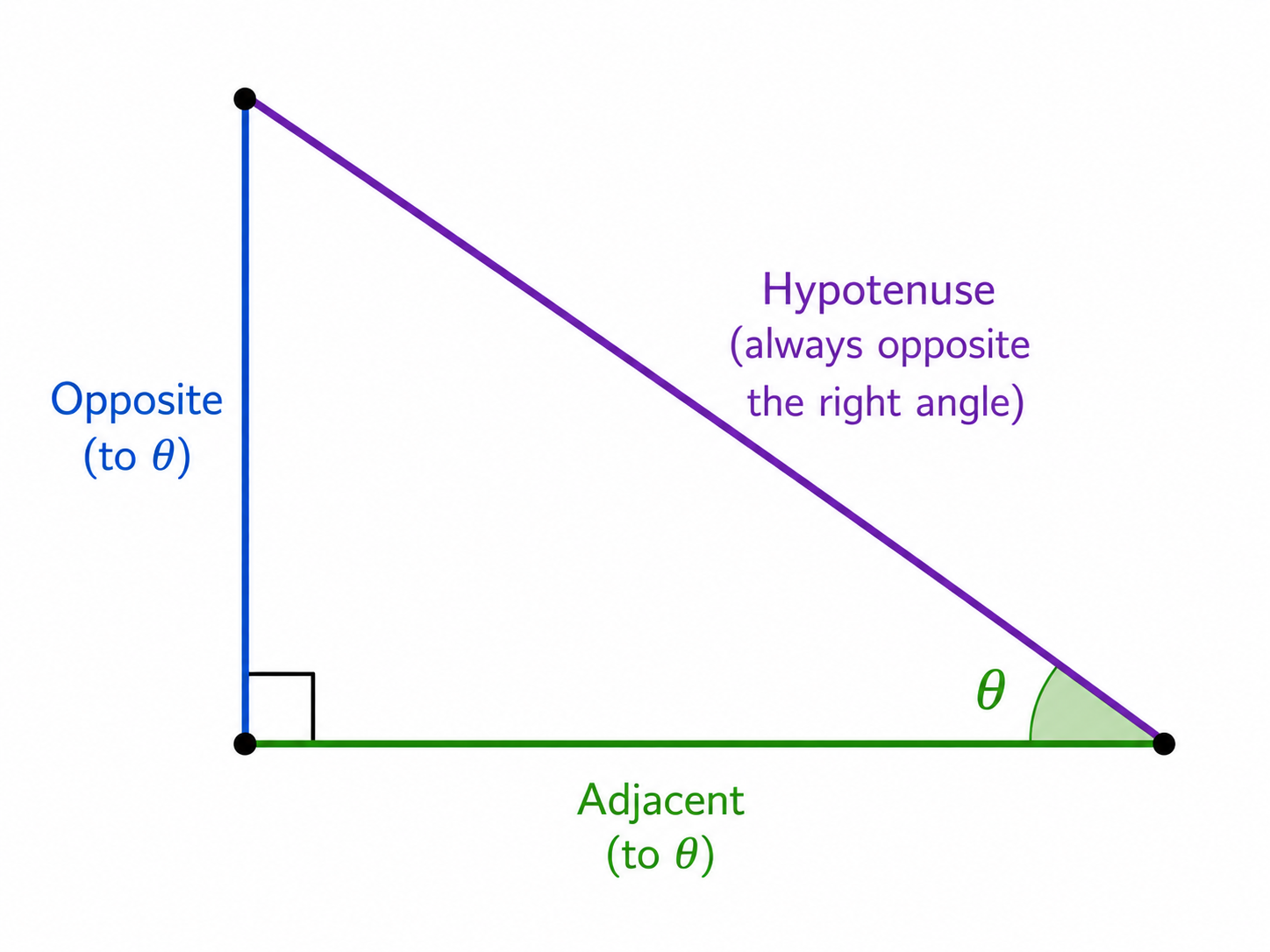
Opposite, Adjacent, and Hypotenuse
The hypotenuse is always the side opposite the right angle.
It is also the longest side of a right triangle.
The other two side names depend on the chosen acute angle \(\theta\):
- Opposite → directly across from \(\theta\)
- Adjacent → next to \(\theta\), but not the hypotenuse
- Hypotenuse → opposite the \(90^\circ\) angle
The hypotenuse stays the same no matter which acute angle you choose.
But the opposite and adjacent sides switch when the reference angle changes.
Always identify the reference angle first.
Common Problem Types
1. Identifying Opposite, Adjacent, and Hypotenuse
Start with the marked acute angle.
Then identify:
- the hypotenuse
- the side across from the angle
- the remaining side
For example, relative to \(\theta\):
\[ \text{opposite}=8 \]
\[ \text{adjacent}=15 \]
\[ \text{hypotenuse}=17 \]
Then:
\[ \sin\theta=\frac{8}{17} \]
\[ \cos\theta=\frac{15}{17} \]
\[ \tan\theta=\frac{8}{15} \]
2. Evaluating a Trig Ratio
If the opposite side is 3 and the hypotenuse is 5:
\[ \sin\theta = \frac{\text{opposite}}{\text{hypotenuse}} \]
so:
\[ \boxed{ \sin\theta=\frac35 } \]
No angle calculation is needed if the problem only asks for the ratio.
3. Solving for a Missing Side
Choose the trig ratio that contains:
- the side you know
- the side you want
For example, suppose:
- \(\theta=40^\circ\)
- adjacent side = 12
- opposite side = \(x\)
Since opposite and adjacent are involved, use tangent:
\[ \tan40^\circ=\frac{x}{12} \]
Multiply by 12:
\[ x=12\tan40^\circ \]
Then use a calculator if a decimal answer is requested.
4. Finding an Angle
If the side lengths are known but the angle is unknown, use an inverse trig function.
For example:
\[ \cos\theta=0.6 \]
Apply inverse cosine:
\[ \theta=\cos^{-1}(0.6) \]
Using a calculator:
\[ \theta\approx53.1^\circ \]
When solving geometry problems in degrees, make sure your calculator is in degree mode, not radian mode.
5. Using Special Right Triangles
Some angles have exact trig values that come from special right triangles.
For a \(45^\circ\)–\(45^\circ\)–\(90^\circ\) triangle:
\[ 1:1:\sqrt2 \]
so:
\[ \sin45^\circ = \cos45^\circ = \frac{\sqrt2}{2} \]
For a \(30^\circ\)–\(60^\circ\)–\(90^\circ\) triangle:
\[ 1:\sqrt3:2 \]
so:
\[ \sin30^\circ=\frac12 \]
\[ \cos30^\circ=\frac{\sqrt3}{2} \]
\[ \sin60^\circ=\frac{\sqrt3}{2} \]
\[ \cos60^\circ=\frac12 \]
These exact values can often be used without a calculator.
Strategies
- Confirm that the triangle is a right triangle.
- Identify the reference angle first.
- Label O, A, and H if helpful.
- Decide which two sides are involved.
- Choose the ratio containing those two sides:
- O and H → sine
- A and H → cosine
- O and A → tangent
- If solving for a side, write the trig equation before substituting.
- If solving for an angle, use the appropriate inverse trig function.
- Check that your calculator is in degree mode.
- Leave exact radical answers when appropriate.
- Round only at the end unless told otherwise.
Worked Examples
Example 1 — Evaluate a Trig Ratio
In a right triangle, the side opposite \(\theta\) has length 8 and the hypotenuse has length 17.
Find:
\[ \sin\theta \]
Use:
\[ \sin\theta = \frac{\text{opposite}}{\text{hypotenuse}} \]
Substitute:
\[ \sin\theta = \frac{8}{17} \]
Therefore:
\[ \boxed{ \sin\theta=\frac{8}{17} } \]
Example 2 — Find a Missing Side Using Cosine
Find \(x\) if:
\[ \cos30^\circ=\frac{x}{10} \]
Since:
\[ \cos30^\circ = \frac{\text{adjacent}}{\text{hypotenuse}} \]
\(x\) is the adjacent side and 10 is the hypotenuse.
Multiply both sides by 10:
\[ x=10\cos30^\circ \]
Use the exact value:
\[ \cos30^\circ=\frac{\sqrt3}{2} \]
So:
\[ x = 10\left(\frac{\sqrt3}{2}\right) \]
\[ x=5\sqrt3 \]
Therefore:
\[ \boxed{x=5\sqrt3} \]
Example 3 — Find a Missing Side Using Tangent
A right triangle has an angle of \(35^\circ\).
The adjacent side is 10 and the opposite side is \(x\).
Use tangent because it involves opposite and adjacent:
\[ \tan35^\circ=\frac{x}{10} \]
Multiply by 10:
\[ x=10\tan35^\circ \]
Using a calculator:
\[ x\approx7.0 \]
Therefore:
\[ \boxed{x\approx7.0} \]
Example 4 — Find an Angle
A right triangle has:
\[ \text{opposite}=6 \]
and:
\[ \text{adjacent}=8 \]
Find \(\theta\).
Use tangent:
\[ \tan\theta = \frac{6}{8} \]
Simplify:
\[ \tan\theta=\frac34 \]
Apply inverse tangent:
\[ \theta = \tan^{-1}\left(\frac34\right) \]
Using a calculator:
\[ \theta\approx36.9^\circ \]
Therefore:
\[ \boxed{\theta\approx36.9^\circ} \]
Example 5 — Ladder Problem
A 12-foot ladder leans against a wall and makes a \(60^\circ\) angle with the ground.
How high up the wall does the ladder reach?
The ladder is the hypotenuse.
The height is opposite the \(60^\circ\) angle.
Use sine:
\[ \sin60^\circ = \frac{h}{12} \]
Multiply by 12:
\[ h=12\sin60^\circ \]
Use:
\[ \sin60^\circ=\frac{\sqrt3}{2} \]
Then:
\[ h = 12\left(\frac{\sqrt3}{2}\right) \]
\[ h=6\sqrt3 \]
Therefore:
\[ \boxed{6\sqrt3\text{ ft}} \]
- Mixing up opposite and adjacent.
- Forgetting that opposite and adjacent depend on the reference angle.
- Using the wrong trig ratio.
- Treating the side next to the angle as adjacent when it is actually the hypotenuse.
- Using SOH–CAH–TOA on a triangle that is not a right triangle.
- Using regular sine, cosine, or tangent when solving for an angle instead of an inverse trig function.
- Leaving the calculator in radian mode when the answer should be in degrees.
- Rounding too early.
Practice Problems
- In a right triangle, relative to \(\theta\):
\[ \text{opposite}=4,\qquad \text{hypotenuse}=5 \]
Find:
\[ \sin\theta \]
- In a right triangle:
\[ \tan\theta=\frac34 \]
and the adjacent side is 12.
Find the opposite side.
- Solve for \(\theta\):
\[ \cos\theta=0.6 \]
Round to the nearest tenth of a degree.
- A 12-foot ladder leans against a wall at an angle of \(60^\circ\) with the ground.
How high up the wall does the ladder reach?
- A right triangle has a hypotenuse of 15 and an angle of \(40^\circ\).
Find the side opposite the \(40^\circ\) angle. Round to the nearest tenth.
1. Use sine:
\[ \sin\theta = \frac{\text{opposite}}{\text{hypotenuse}} \]
Substitute:
\[ \sin\theta = \frac45 \]
Therefore:
\[ \boxed{ \sin\theta=\frac45 } \]
2. Start with:
\[ \tan\theta = \frac{\text{opposite}}{\text{adjacent}} \]
We are given:
\[ \tan\theta=\frac34 \]
and:
\[ \text{adjacent}=12 \]
So:
\[ \frac{\text{opposite}}{12} = \frac34 \]
Multiply by 12:
\[ \text{opposite} = 12\left(\frac34\right) \]
\[ \text{opposite}=9 \]
Therefore:
\[ \boxed{9} \]
3. We are given:
\[ \cos\theta=0.6 \]
To solve for the angle, use inverse cosine:
\[ \theta=\cos^{-1}(0.6) \]
Using a calculator in degree mode:
\[ \theta\approx53.1^\circ \]
Therefore:
\[ \boxed{\theta\approx53.1^\circ} \]
4. The ladder is the hypotenuse:
\[ 12 \]
The height is opposite the \(60^\circ\) angle.
Use sine:
\[ \sin60^\circ = \frac{h}{12} \]
Multiply by 12:
\[ h=12\sin60^\circ \]
Since:
\[ \sin60^\circ=\frac{\sqrt3}{2} \]
we get:
\[ h = 12\left(\frac{\sqrt3}{2}\right) \]
\[ h=6\sqrt3 \]
Therefore:
\[ \boxed{6\sqrt3\text{ ft}} \]
5. The unknown side is opposite the \(40^\circ\) angle, and the hypotenuse is 15.
Use sine:
\[ \sin40^\circ = \frac{x}{15} \]
Multiply by 15:
\[ x=15\sin40^\circ \]
Using a calculator:
\[ x\approx9.6 \]
Therefore:
\[ \boxed{x\approx9.6} \]
Summary
- SOH–CAH–TOA gives the three basic right-triangle trig ratios:
\[ \sin\theta = \frac{\text{opposite}}{\text{hypotenuse}} \]
\[ \cos\theta = \frac{\text{adjacent}}{\text{hypotenuse}} \]
\[ \tan\theta = \frac{\text{opposite}}{\text{adjacent}} \]
- The hypotenuse is always opposite the right angle.
- Opposite and adjacent depend on the chosen reference angle.
- Choose the trig ratio containing the known and unknown sides.
- Use inverse trig functions to find angles.
- Special right triangles can provide exact trig values.
- Mark the reference angle first.
- Label the sides O, A, and H.
- O + H → sine
- A + H → cosine
- O + A → tangent
- Missing angle → use inverse trig
- Check degree mode
- Round only at the end