Ellipses
By the end of this lesson, you’ll be able to:
- Identify the center, vertices, co-vertices, major axis, minor axis, and foci of an ellipse.
- Write and interpret ellipses in standard form.
- Determine whether an ellipse has a horizontal or vertical major axis.
- Graph ellipses using their center and semi-axis lengths.
- Convert ellipse equations from general form to standard form.
- Connect algebraic parameters to geometric features.
Key Ideas
An ellipse is the set of all points for which the sum of the distances to two fixed points, called the foci, is constant.
An ellipse has two axes:
- Major axis — the longer axis
- Minor axis — the shorter axis
The axes cross at the center of the ellipse.
The endpoints of the major axis are called the vertices.
The endpoints of the minor axis are called the co-vertices.
The foci lie inside the ellipse along the major axis.
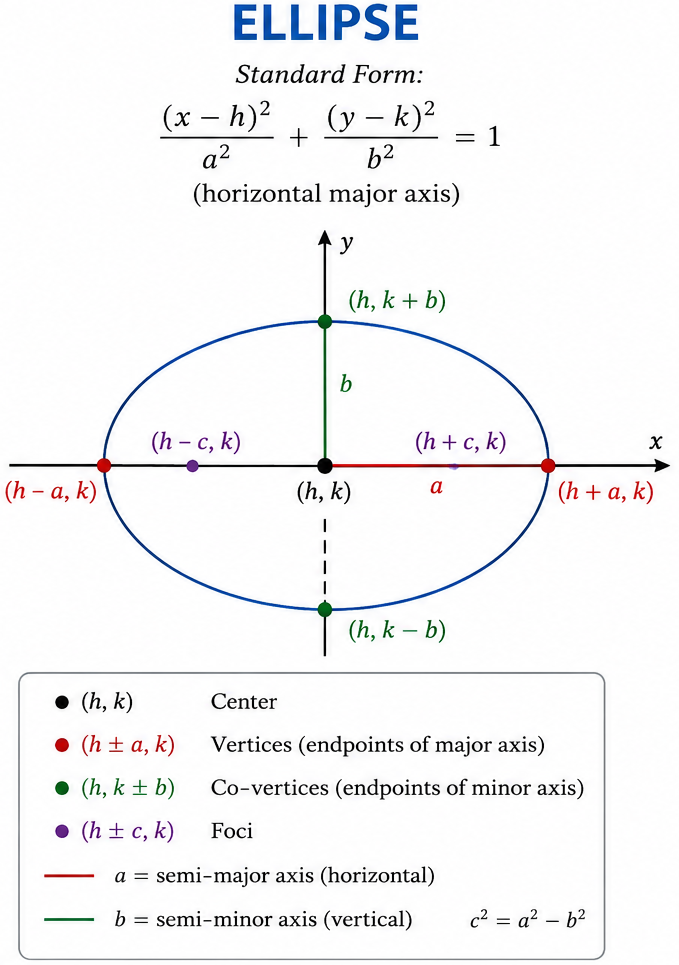
Standard Form — Horizontal Major Axis
If the major axis is horizontal:
\[ \boxed{ \frac{(x-h)^2}{a^2} + \frac{(y-k)^2}{b^2} = 1 } \]
where:
\[ a>b \]
The center is:
\[ (h,k) \]
The vertices are:
\[ (h\pm a,k) \]
The co-vertices are:
\[ (h,k\pm b) \]
Standard Form — Vertical Major Axis
If the major axis is vertical:
\[ \boxed{ \frac{(x-h)^2}{b^2} + \frac{(y-k)^2}{a^2} = 1 } \]
where again:
\[ a>b \]
The vertices are:
\[ (h,k\pm a) \]
The co-vertices are:
\[ (h\pm b,k) \]
Understanding \(a\) and \(b\)
The value \(a\) is always the semi-major axis, so it represents the distance from the center to a vertex along the longer direction.
The value \(b\) is always the semi-minor axis, so it represents the distance from the center to a co-vertex.
Therefore:
\[ a>b \]
The full major-axis length is:
\[ 2a \]
and the full minor-axis length is:
\[ 2b \]
Look for the larger denominator.
- Larger denominator under the \(x\)-term → horizontal major axis
- Larger denominator under the \(y\)-term → vertical major axis
Foci
The foci lie along the major axis.
Their distance \(c\) from the center is determined by:
\[ \boxed{ c^2=a^2-b^2 } \]
For a horizontal ellipse, the foci are:
\[ (h\pm c,k) \]
For a vertical ellipse, the foci are:
\[ (h,k\pm c) \]
Notice that:
\[ c<a \]
so the foci lie inside the ellipse.
Common Problem Types
1. Identifying the Center and Orientation
Compare the equation to standard form and read the center from \((x-h)^2\) and \((y-k)^2\).
The larger denominator determines the major axis:
- larger denominator under \(x\) → horizontal major axis
- larger denominator under \(y\) → vertical major axis
2. Finding Vertices and Co-Vertices
Take square roots of the denominators to find \(a\) and \(b\).
Move \(a\) units from the center along the major axis to find the vertices.
Move \(b\) units from the center along the minor axis to find the co-vertices.
3. Finding the Foci
Use the ellipse relationship:
\[ c^2=a^2-b^2 \]
The foci lie \(c\) units from the center along the major axis.
4. Writing an Equation From Geometric Information
Use the center, orientation, and axis lengths to choose the correct form:
\[ \frac{(x-h)^2}{a^2} + \frac{(y-k)^2}{b^2} = 1 \]
For a horizontal ellipse, \(a^2\) goes under the \(x\)-term.
For a vertical ellipse, \(a^2\) goes under the \(y\)-term.
5. Graphing an Ellipse
To graph an ellipse from standard form:
- Identify the center \((h,k)\).
- Determine which denominator is larger.
- Find \(a\) and \(b\) by taking square roots.
- Move \(a\) units from the center along the major axis to locate the vertices.
- Move \(b\) units from the center along the minor axis to locate the co-vertices.
- Sketch a smooth ellipse through those four points.
The foci can also be found using:
\[ c^2=a^2-b^2 \]
but they are not necessary just to sketch the basic ellipse.
6. Converting General Form to Standard Form
To convert it:
- Group the \(x\)-terms and \(y\)-terms.
- Factor out coefficients when needed.
- Complete the square for both variables.
- Move constants and simplify.
- Divide so the right side equals 1.
The final equation should have the form:
\[ \frac{(x-h)^2}{\text{number}} + \frac{(y-k)^2}{\text{number}} = 1 \]
7. Finding Missing Parameters
Sometimes the foci, vertices, or axis lengths are given instead of \(a\) and \(b\).
Use \(c^2=a^2-b^2\), rearranged as needed:
\[ a^2=b^2+c^2 \]
Strategies
- Identify the center first.
- Find the larger denominator to determine the direction of the major axis.
- Remember that \(a\) always represents the longer semi-axis.
- Take square roots of \(a^2\) and \(b^2\) before locating vertices and co-vertices.
- Horizontal major axis → vertices and foci move left/right.
- Vertical major axis → vertices and foci move up/down.
- Compute \(c\) only after identifying \(a\) and \(b\):
\[ c^2=a^2-b^2 \]
- When converting from general form: group → factor → complete the square → divide.
- Sketch the center, vertices, and co-vertices before drawing the ellipse.
Worked Examples
Example 1 — Identify All Key Features
Find the center, orientation, vertices, co-vertices, and foci of:
\[ \frac{(x-2)^2}{25} + \frac{(y+1)^2}{9} = 1 \]
The center is:
\[ \boxed{(2,-1)} \]
The larger denominator is 25 and appears under the \(x\)-term, so the major axis is horizontal.
We have:
\[ a^2=25 \Rightarrow a=5 \]
and:
\[ b^2=9 \Rightarrow b=3 \]
The vertices are 5 units left and right of the center:
\[ (2\pm5,-1) \]
so:
\[ \boxed{(-3,-1)\text{ and }(7,-1)} \]
The co-vertices are 3 units above and below the center:
\[ (2,-1\pm3) \]
so:
\[ \boxed{(2,-4)\text{ and }(2,2)} \]
Now find \(c\):
\[ c^2=a^2-b^2 \]
\[ c^2=25-9 \]
\[ c^2=16 \]
\[ c=4 \]
Since the major axis is horizontal, the foci are:
\[ (2\pm4,-1) \]
Therefore:
\[ \boxed{(-2,-1)\text{ and }(6,-1)} \]
Example 2 — Write the Equation
An ellipse has:
- center \((0,0)\)
- vertical major axis
- \(a=7\)
- \(b=4\)
Since the major axis is vertical, \(a^2\) goes under the \(y\)-term.
The standard form is:
\[ \frac{x^2}{b^2} + \frac{y^2}{a^2} = 1 \]
Substitute:
\[ a^2=49 \]
and:
\[ b^2=16 \]
Therefore:
\[ \boxed{ \frac{x^2}{16} + \frac{y^2}{49} = 1 } \]
Example 3 — Convert to Standard Form
Convert:
\[ 9x^2+4y^2-54x+16y+61=0 \]
to standard form.
Group the variable terms and move the constant:
\[ 9(x^2-6x)+4(y^2+4y)=-61 \]
Complete the square inside each group.
For the \(x\)-terms:
\[ x^2-6x=(x-3)^2-9 \]
For the \(y\)-terms:
\[ y^2+4y=(y+2)^2-4 \]
Substitute:
\[ 9[(x-3)^2-9] + 4[(y+2)^2-4] = -61 \]
Distribute:
\[ 9(x-3)^2-81 + 4(y+2)^2-16 = -61 \]
Combine the constants:
\[ 9(x-3)^2+4(y+2)^2=36 \]
Divide every term by 36:
\[ \frac{(x-3)^2}{4} + \frac{(y+2)^2}{9} = 1 \]
Therefore:
\[ \boxed{ \frac{(x-3)^2}{4} + \frac{(y+2)^2}{9} = 1 } \]
The center is:
\[ \boxed{(3,-2)} \]
The larger denominator is under the \(y\)-term, so the major axis is:
\[ \boxed{\text{vertical}} \]
Example 4 — Find an Equation From the Foci
A vertical ellipse has center \((0,0)\) and foci:
\[ (0,\pm5) \]
The semi-minor axis is:
\[ b=12 \]
Find the equation.
The foci tell us:
\[ c=5 \]
Use:
\[ c^2=a^2-b^2 \]
Substitute:
\[ 5^2=a^2-12^2 \]
\[ 25=a^2-144 \]
Add 144:
\[ a^2=169 \]
Because the ellipse is vertical, \(a^2\) goes under the \(y\)-term:
\[ \boxed{ \frac{x^2}{144} + \frac{y^2}{169} = 1 } \]
- Assuming \(a^2\) always goes under the \(x\)-term.
- Forgetting that \(a\) always represents the longer semi-axis.
- Using the smaller denominator to determine the major-axis direction.
- Mixing up vertices and co-vertices.
- Placing the foci along the minor axis instead of the major axis.
- Using \(c^2=a^2+b^2\) instead of:
\[ c^2=a^2-b^2 \]
- Reading the signs of the center incorrectly.
- Forgetting to divide the entire equation so the right side becomes 1.
- Using \(a^2\) and \(b^2\) as distances instead of taking their square roots.
Practice Problems
- Find the center, orientation, vertices, and foci of:
\[ \frac{(x+1)^2}{36} + \frac{(y-4)^2}{4} = 1 \]
Write the equation of an ellipse with center \((5,-3)\), horizontal major axis, \(a=6\), and \(b=2\).
Convert the ellipse:
\[ 4x^2+9y^2-16x+36y+16=0 \]
to standard form. Then identify its center and orientation.
- Identify whether the ellipse has a horizontal or vertical major axis:
\[ \frac{(x-2)^2}{9} + \frac{(y+3)^2}{49} = 1 \]
- A vertical ellipse has center \((0,0)\) and foci at \((0,\pm5)\). If \(b=12\), find its equation.
1. Start with:
\[ \frac{(x+1)^2}{36} + \frac{(y-4)^2}{4} = 1 \]
The center is:
\[ \boxed{(-1,4)} \]
The larger denominator is 36 and appears under the \(x\)-term, so the major axis is:
\[ \boxed{\text{horizontal}} \]
We have:
\[ a^2=36 \Rightarrow a=6 \]
and:
\[ b^2=4 \Rightarrow b=2 \]
The vertices are 6 units left and right of the center:
\[ (-1\pm6,4) \]
Therefore:
\[ \boxed{(-7,4)\text{ and }(5,4)} \]
To find the foci:
\[ c^2=a^2-b^2 \]
\[ c^2=36-4 \]
\[ c^2=32 \]
\[ c=4\sqrt2 \]
Since the major axis is horizontal:
\[ \boxed{ (-1-4\sqrt2,4) \text{ and } (-1+4\sqrt2,4) } \]
2. The center is:
\[ (5,-3) \]
and the major axis is horizontal.
Use:
\[ \frac{(x-h)^2}{a^2} + \frac{(y-k)^2}{b^2} = 1 \]
Since:
\[ a=6 \Rightarrow a^2=36 \]
and:
\[ b=2 \Rightarrow b^2=4 \]
the equation is:
\[ \boxed{ \frac{(x-5)^2}{36} + \frac{(y+3)^2}{4} = 1 } \]
3. Start with:
\[ 4x^2+9y^2-16x+36y+16=0 \]
Move the constant:
\[ 4x^2-16x+9y^2+36y=-16 \]
Group and factor:
\[ 4(x^2-4x)+9(y^2+4y)=-16 \]
Complete the square.
For the \(x\)-terms:
\[ x^2-4x=(x-2)^2-4 \]
For the \(y\)-terms:
\[ y^2+4y=(y+2)^2-4 \]
Substitute:
\[ 4[(x-2)^2-4] + 9[(y+2)^2-4] = -16 \]
Distribute:
\[ 4(x-2)^2-16 + 9(y+2)^2-36 = -16 \]
Add 52 to both sides:
\[ 4(x-2)^2+9(y+2)^2=36 \]
Divide by 36:
\[ \boxed{ \frac{(x-2)^2}{9} + \frac{(y+2)^2}{4} = 1 } \]
The center is:
\[ \boxed{(2,-2)} \]
The larger denominator is under the \(x\)-term, so the major axis is:
\[ \boxed{\text{horizontal}} \]
4. Compare the denominators:
\[ 9 \quad \text{and} \quad 49 \]
The larger denominator, 49, appears under the \(y\)-term.
Therefore, the ellipse has a:
\[ \boxed{\text{vertical major axis}} \]
5. The foci are:
\[ (0,\pm5) \]
so:
\[ c=5 \]
We are also given:
\[ b=12 \]
Use:
\[ c^2=a^2-b^2 \]
Rearrange:
\[ a^2=b^2+c^2 \]
Substitute:
\[ a^2=12^2+5^2 \]
\[ a^2=144+25 \]
\[ a^2=169 \]
Because the major axis is vertical, \(a^2\) goes under the \(y\)-term and \(b^2\) goes under the \(x\)-term.
Therefore:
\[ \boxed{ \frac{x^2}{144} + \frac{y^2}{169} = 1 } \]
Summary
- An ellipse has a major axis and a minor axis.
- The center is:
\[ (h,k) \]
- The larger denominator determines the major-axis direction.
- \(a\) is the semi-major axis and \(b\) is the semi-minor axis:
\[ a>b \]
- The full axis lengths are:
\[ \text{major axis}=2a \]
\[ \text{minor axis}=2b \]
- Vertices lie along the major axis.
- Co-vertices lie along the minor axis.
- Foci lie inside the ellipse along the major axis.
- Find the focal distance using:
\[ c^2=a^2-b^2 \]
- To convert from general form:
group → factor → complete the square → divide
- Larger denominator under \(x\) → horizontal.
- Larger denominator under \(y\) → vertical.
- \(a\) always belongs to the major axis.
- Vertices → move \(a\) units from the center.
- Co-vertices → move \(b\) units from the center.
- Foci → move \(c\) units along the major axis.
- Center signs come from \((x-h)\) and \((y-k)\), so watch the signs carefully.