Solving One-Step & Two-Step Equations
By the end of this lesson, you’ll be able to:
- Understand what it means to solve a linear equation.
- Solve one-step equations using inverse operations.
- Solve two-step equations with one additional operation.
- Check solutions by substitution to confirm correctness.
Key Ideas
A solution to an equation is a value that makes the equation true.
To solve an equation, we use inverse operations to isolate the variable on one side.
Common inverse pairs:
- addition ↔︎ subtraction
- multiplication ↔︎ division
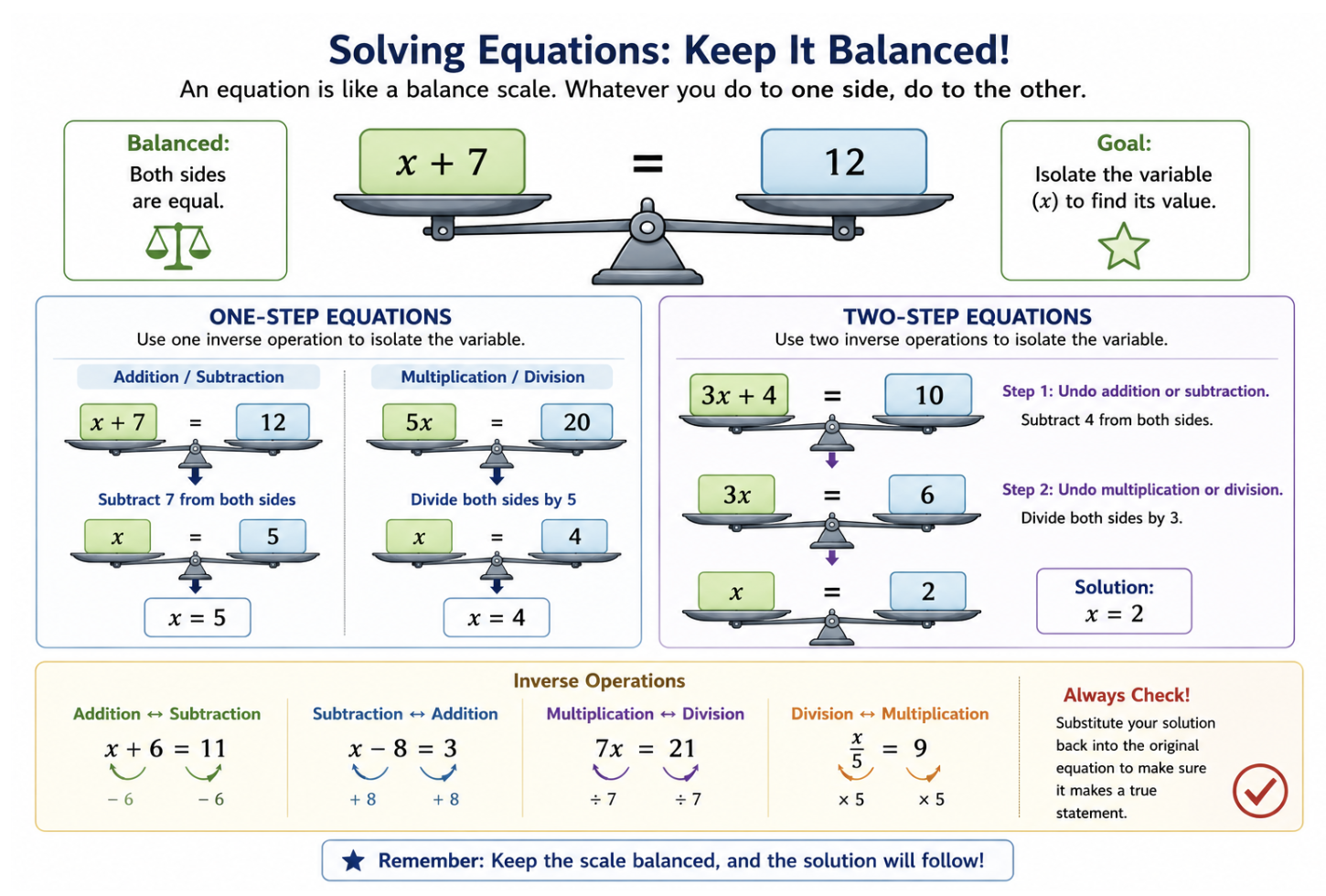
A key principle:
Whatever you do to one side of the equation, do to the other to keep it balanced.
Common Problem Types
1. One-Step: Addition/Subtraction
Solve:
\[
x + 7 = 12
\]
Subtract 7 from both sides:
\[
x = 5
\]
2. One-Step: Multiplication/Division
Solve:
\[
5x = 20
\]
Divide both sides by 5:
\[
x = 4
\]
3. Two-Step: \(ax + b = c\)
Solve:
\[
3x + 4 = 10
\]
Step 1: subtract 4 → \(3x = 6\)
Step 2: divide by 3 → \(x = 2\)
4. Negative Coefficients
Solve:
\[
-4x = 20
\]
Divide both sides by \(-4\):
\[
x = -5
\]
Strategies
- Use inverse operations to isolate the variable.
- Write work in neat vertical steps to stay organized.
- After solving, check your answer in the original equation.
- Keep a close eye on negative signs—errors often happen there.
Worked Examples
Example 1
Solve:
\[
x - 9 = 4
\]
Solution:
- Add 9: \(x = 13\)
- Check: \(13 - 9 = 4\) ✓
Answer: \(13\)
Example 2
Solve:
\[
\frac{x}{6} = -3
\]
Solution:
- Multiply both sides by 6: \(x = -18\)
- Check: \(-18/6 = -3\) ✓
Answer: \(-18\)
Example 3
Solve:
\[
2x - 5 = 9
\]
Solution:
- Add 5 → \(2x = 14\)
- Divide by 2 → \(x = 7\)
- Check: \(2(7) - 5 = 9\) ✓
Answer: \(7\)
- Doing a different operation to each side (breaking balance).
- Forgetting to apply operations to every term on a side.
- Losing track of negative signs when adding, subtracting, or dividing.
- Skipping the solution check and missing simple errors.
Practice Problems
- Solve: \(x + 6 = 11\)
- Solve: \(9x = 45\)
- Solve: \(x - 4 = -1\)
- Solve: \(\dfrac{x}{5} = 7\)
- Solve: \(3x + 2 = 11\)
- Solve: \(-4x = 28\)
1. \(x + 6 = 11\)
Subtract 6 → \(x = 5\)
2. \(9x = 45\)
Divide by 9 → \(x = 5\)
3. \(x - 4 = -1\)
Add 4 → \(x = 3\)
4. \(\dfrac{x}{5} = 7\)
Multiply by 5 → \(x = 35\)
5. \(3x + 2 = 11\)
Subtract 2 → \(3x = 9\)
Divide by 3 → \(x = 3\)
6. \(-4x = 28\)
Divide by \(-4\) → \(x = -7\)
Summary
- Solve equations using inverse operations to isolate the variable.
- Keep both sides of an equation balanced.
- Check solutions by substituting back into the original equation.
- Be careful with negative signs—they matter at every step.
- Undo addition/subtraction first, then undo multiplication/division.
- Keep an eye on negative coefficients—they flip signs when dividing.
- Use a balance-scale mindset: do the same thing to both sides.
- Checking your answer catches almost every small slip.