Equations with Variables on Both Sides
By the end of this lesson, you’ll be able to:
- Solve equations where the variable appears on both sides.
- Decide which side to collect variable terms on.
- Recognize when an equation has no solution or infinitely many solutions.
Key Ideas
When variables appear on both sides:
- Collect variable terms on one side.
- Collect constants on the other side.
- Solve the resulting simpler equation.
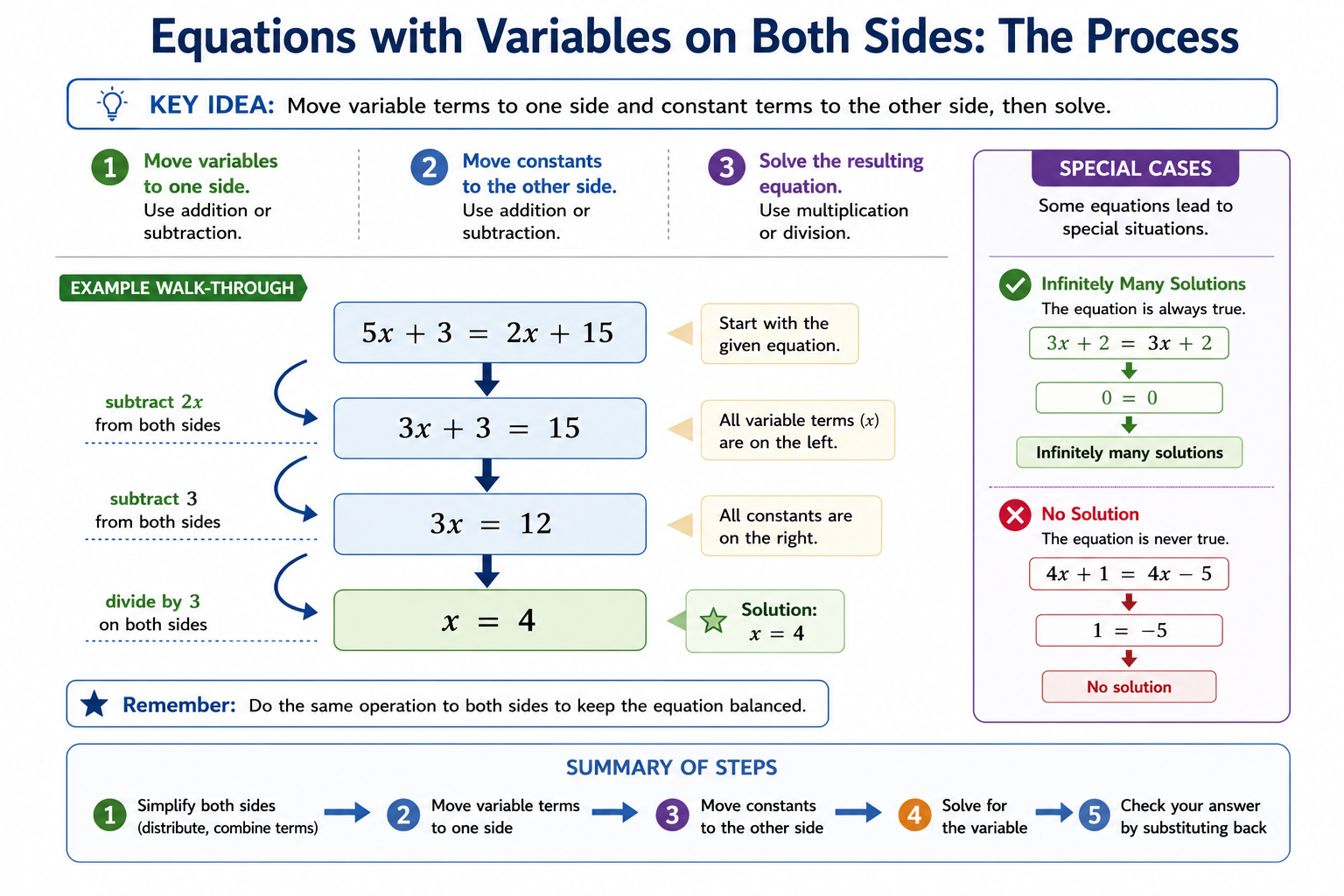
Some equations lead to special cases:
- True statement (e.g., \(0 = 0\)) → infinitely many solutions
- False statement (e.g., \(5 = 2\)) → no solution
Common Problem Types
1. Simple Variable Move
Solve:
\[
5x + 3 = 2x + 15
\]
Subtract \(2x\): \(3x + 3 = 15\)
Subtract 3: \(3x = 12\)
Divide:
\[
x = 4
\]
2. Variables and Distribution
Solve:
\[
2(x + 4) = 3x - 2
\]
Distribute: \(2x + 8 = 3x - 2\)
Subtract \(2x\): \(8 = x - 2\)
Add 2:
\[
x = 10
\]
3. No Solution / Infinite Solutions
\(3x + 2 = 3x + 2\)
→ always true
→ infinitely many solutions\(4x + 1 = 4x - 5\)
→ \(1 = -5\) (false)
→ no solution
Strategies
- Move the variable term from the smaller coefficient side to the larger one to avoid negatives (optional but helpful).
- Always simplify both sides before moving terms.
- After moving variables, the equation should look like a standard one- or two-step equation.
Worked Examples
Example 1
Solve:
\[
4x - 7 = 2x + 5
\]
Step-by-step Solution:
- Subtract \(2x\) → \(2x - 7 = 5\)
- Add 7 → \(2x = 12\)
- Divide → \(x = 6\)
Answer: \(6\)
Example 2
Solve:
\[
3(x - 1) = 2(x + 4) - 3
\]
Step-by-step Solution:
- Distribute → \(3x - 3 = 2x + 8 - 3\)
- Combine → \(3x - 3 = 2x + 5\)
- Subtract \(2x\) → \(x - 3 = 5\)
- Add 3 → \(x = 8\)
Answer: \(8\)
- Moving constants before simplifying each side.
- Moving variable terms in the wrong direction (causing sign errors).
- Forgetting to distribute before combining or moving terms.
- Misinterpreting \(0 = 0\) (infinite solutions) or \(5 = 2\) (no solution).
Practice Problems
- \(6x + 4 = 2x + 20\)
- \(5x - 3 = 3x + 7\)
- \(2(x + 1) = x + 8\)
- \(4x + 6 = 4x - 10\)
- \(3(x - 2) - 1 = 2(x + 1)\)
1. \(6x + 4 = 2x + 20\)
Subtract \(2x\) → \(4x + 4 = 20\)
Subtract 4 → \(4x = 16\)
Divide → \(x = 4\)
2. \(5x - 3 = 3x + 7\)
Subtract \(3x\) → \(2x - 3 = 7\)
Add 3 → \(2x = 10\)
Divide → \(x = 5\)
3. \(2(x + 1) = x + 8\)
Distribute → \(2x + 2 = x + 8\)
Subtract \(x\) → \(x + 2 = 8\)
Subtract 2 → \(x = 6\)
4. \(4x + 6 = 4x - 10\)
Subtract \(4x\) → \(6 = -10\)
False → no solution
5. \(3(x - 2) - 1 = 2(x + 1)\)
Distribute → \(3x - 6 - 1 = 2x + 2\)
Combine → \(3x - 7 = 2x + 2\)
Subtract \(2x\) → \(x - 7 = 2\)
Add 7 → \(x = 9\)
Summary
- Move variable terms to one side, constants to the other.
- Simplify first, then solve normally.
- True statements → infinitely many solutions; false statements → no solution.
- Organize work carefully to avoid sign errors.
- Move variables first, then isolate the constant.
- Choose the side with the larger coefficient to avoid negatives.
- Always simplify before deciding if an equation has 0, 1, or infinitely many solutions.
- If variables cancel, check whether the leftover statement is true or false.