Order of Operations (PEMDAS)
By the end of this lesson, you’ll be able to:
- Apply the correct order of operations to evaluate expressions.
- Distinguish between subtraction and the negative sign.
- Use grouping symbols correctly (parentheses, brackets, fraction bars).
- Interpret expressions with exponents, negatives, and nested grouping.
Key Ideas
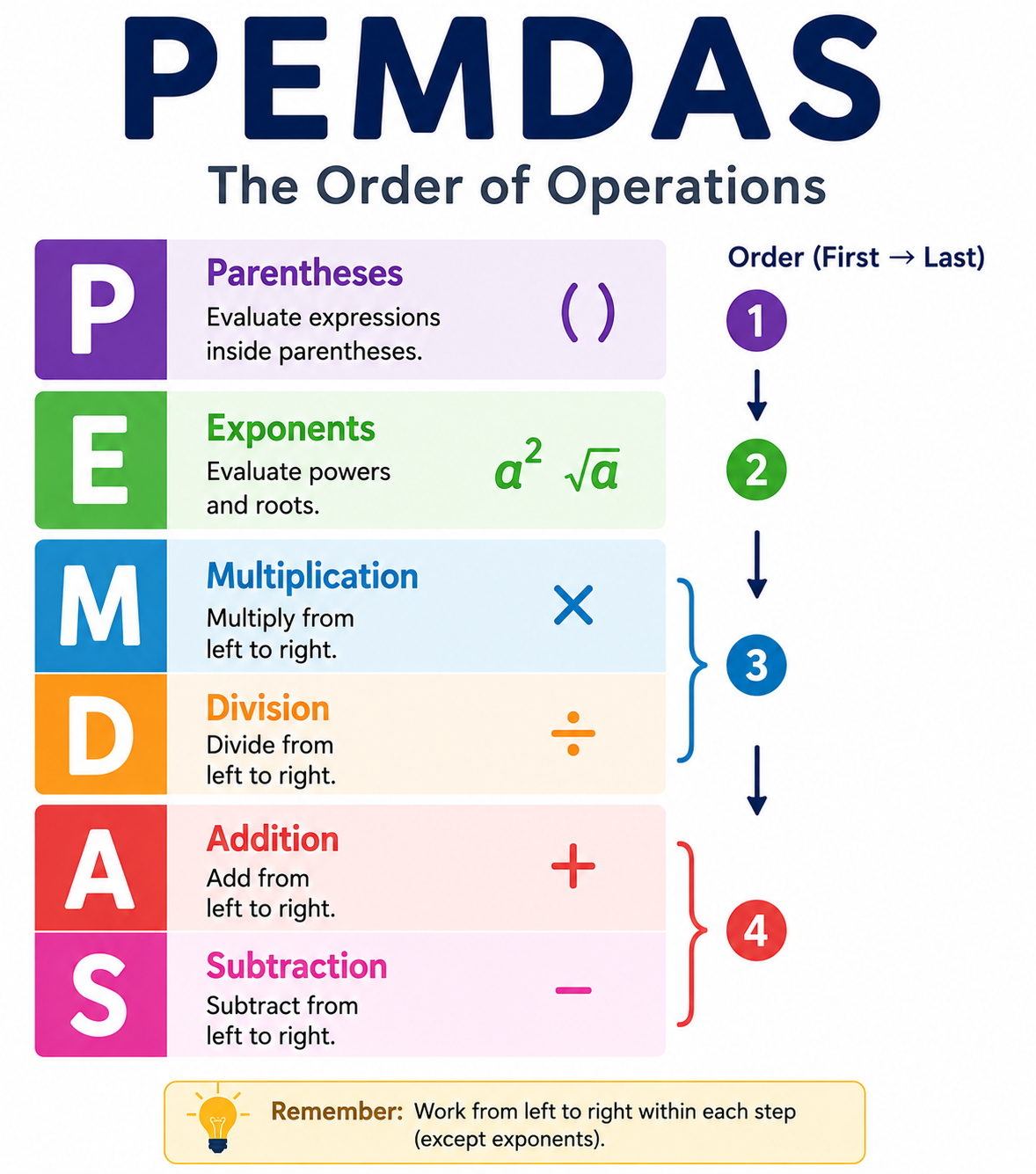
The order of operations is remembered by PEMDAS:
- P – Parentheses / grouping symbols
- E – Exponents
- M – Multiplication
- D – Division
- A – Addition
- S – Subtraction
Multiplication and division have equal priority (work left to right).
Addition and subtraction also have equal priority (work left to right).
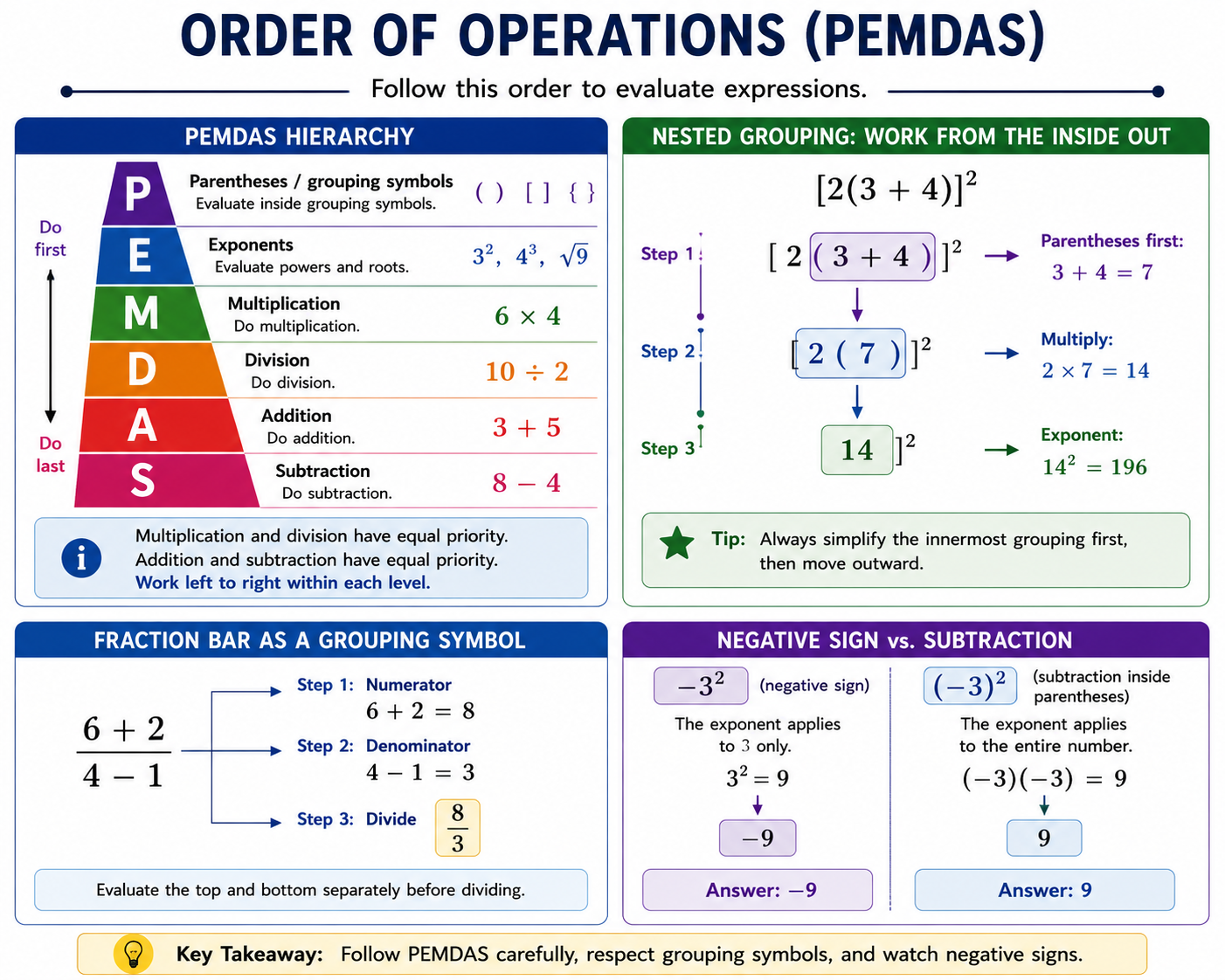
A fraction bar acts like a grouping symbol. For
\[ \frac{a + b}{c + d} \]
evaluate the numerator and denominator separately before dividing.
Common Problem Types
1. Evaluating Expressions
Example:
\[
3 + 6 \times 4
\]
Step-by-step:
- Multiply: \(6 \times 4 = 24\)
- Add: \(3 + 24 = 27\)
2. Expressions with Parentheses
Example:
\[
(3 + 6) \times 4
\]
Step-by-step:
- Parentheses: \(3 + 6 = 9\)
- Multiply: \(9 \times 4 = 36\)
3. Negative Sign vs Subtraction
Example:
\[
-3^2 \quad \text{vs} \quad (-3)^2
\]
Step-by-step:
- \(-3^2\): exponent applies to 3 only → \(3^2 = 9\) → final answer: \(-9\)
- \((-3)^2\): exponent applies to the entire number → \((-3)(-3) = 9\)
These are not the same.
4. Exponents Before Multiplication
Example:
\[
2 \cdot 3^2
\]
Step-by-step:
- Exponent: \(3^2 = 9\)
- Multiply: \(2 \cdot 9 = 18\)
5. Multi-Level Grouping
Example:
\[
[2(3 + 4)]^2
\]
Step-by-step:
- Parentheses: \(3 + 4 = 7\)
- Multiply: \(2 \cdot 7 = 14\)
- Exponent: \(14^2 = 196\)
Fraction Bar as a Grouping Symbol
Example:
Evaluate
\[
\frac{6 + 2}{4 - 1}
\]
Step-by-step:
- Numerator: \(6 + 2 = 8\)
- Denominator: \(4 - 1 = 3\)
- Fraction: \(\frac{8}{3}\)
Strategies
- Evaluate numerator and denominator separately when a fraction bar is present.
- Keep negative signs attached to numbers unless parentheses explicitly change grouping.
- Follow left-to-right for both multiplication/division and addition/subtraction.
- Rewrite complex expressions one line at a time to maintain clarity.
Worked Examples
Example 1
Question:
\[
8 - 3 \times 2^2
\]
Step-by-step Solution:
- Exponent: \(2^2 = 4\)
- Multiply: \(3 \times 4 = 12\)
- Subtract: \(8 - 12 = -4\)
Answer: \(-4\)
Example 2
Question:
\[
\frac{12 - 4}{2 + 1}
\]
Step-by-step Solution:
- Numerator: \(12 - 4 = 8\)
- Denominator: \(2 + 1 = 3\)
- Fraction: \(\frac{8}{3}\)
Answer: \(\frac{8}{3}\)
Example 3
Question:
\[
5 - (-3)^2
\]
Step-by-step Solution:
- Exponent: \((-3)^2 = 9\)
- Substitute: \(5 - 9\)
- Subtract: \(5 - 9 = -4\)
Answer: \(-4\)
- Doing addition before multiplication due to misreading PEMDAS.
- Ignoring the left-to-right rule for multiplication and division.
- Treating \(-3^2\) as \(9\) instead of \(-9\).
- Forgetting that a fraction bar groups numerator and denominator.
- Misreading expressions with negatives and exponents due to missing parentheses.
Practice Problems
Evaluate each expression using correct order of operations.
- \(7 + 2 \cdot 5\)
- \((7 + 2) \cdot 5\)
- \(-4^2\)
- \((-4)^2\)
- \(\dfrac{10 - 3}{1 + 2}\)
- \(3 + 6 \div 2\)
- \(3(2 + 5)^2\)
1. \(7 + 2 \cdot 5\)
Step 1: Multiply → \(2 \cdot 5 = 10\)
Step 2: Add → \(7 + 10 = 17\)
Answer: \(17\)
2. \((7 + 2) \cdot 5\)
Step 1: Parentheses → \(7 + 2 = 9\)
Step 2: Multiply → \(9 \cdot 5 = 45\)
Answer: \(45\)
3. \(-4^2\)
Step 1: Exponent applies to 4 → \(4^2 = 16\)
Step 2: Apply negative sign → \(-16\)
Answer: \(-16\)
4. \((-4)^2\)
Step 1: Parentheses group the negative → \((-4)(-4)\)
Step 2: Multiply → \(16\)
Answer: \(16\)
5. \(\dfrac{10 - 3}{1 + 2}\)
Step 1: Numerator → \(7\)
Step 2: Denominator → \(3\)
Answer: \(\dfrac{7}{3}\)
6. \(3 + 6 \div 2\)
Step 1: Division → \(6 \div 2 = 3\)
Step 2: Add → \(3 + 3 = 6\)
Answer: \(6\)
7. \(3(2 + 5)^2\)
Step 1: Parentheses → \(2 + 5 = 7\)
Step 2: Exponent → \(7^2 = 49\)
Step 3: Multiply → \(3 \cdot 49 = 147\)
Answer: \(147\)
Summary
- PEMDAS organizes operations, but multiplication/division and addition/subtraction occur left to right.
- Fraction bars and parentheses act as grouping symbols.
- Parentheses determine how exponents apply to negative numbers.
- Rewriting expressions step-by-step reduces errors.
- Treat a fraction bar like parentheses—simplify top and bottom separately.
- MD and AS follow the left-to-right rule.
- Use parentheses to clarify expressions such as \((-3)^2\).
- For nested grouping, simplify the innermost expression first.