ACT Math Cheat Sheet
Essential Algebra, Geometry, Trigonometry, and Statistics
The ACT does not provide formulas during the test.
You must know all formulas below. This sheet summarizes the essentials.
Number & Quantity
Exponents
\[ a^m \cdot a^n = a^{m+n} \]
\[ \frac{a^m}{a^n} = a^{m-n} \]
\[ (a^m)^n = a^{mn} \]
\[ (ab)^n = a^n b^n \]
\[ a^{-n} = \frac{1}{a^n} \]
\[ a^0 = 1 \]
for \(a \ne 0\).
Roots and Rational Exponents
\[ \sqrt{ab} = \sqrt{a}\sqrt{b} \]
\[ \sqrt{\frac{a}{b}} = \frac{\sqrt{a}}{\sqrt{b}} \]
\[ \sqrt[n]{a^m} = a^{m/n} \]
\[ a^{1/2}=\sqrt{a} \]
Complex Numbers
\[ i^2=-1 \]
\[ i=\sqrt{-1} \]
Powers of \(i\) repeat in a cycle:
\[ i,\ -1,\ -i,\ 1 \]
For complex numbers:
\[ (a+bi)+(c+di)=(a+c)+(b+d)i \]
\[ (a+bi)(c+di)=ac+adi+bci+bd i^2 \]
Absolute Value
\[ |x|=a \]
means:
\[ x=a \]
or
\[ x=-a \]
for \(a \ge 0\).
Algebra & Functions
Linear Equations
Slope Formula
\[ m = \frac{y_2-y_1}{x_2-x_1} \]
Slope-Intercept Form
\[ y = mx+b \]
Point-Slope Form
\[ y-y_1=m(x-x_1) \]
Standard Form
\[ Ax+By=C \]
Slope Relationships
- Parallel lines have the same slope.
- Perpendicular lines have slopes that are negative reciprocals.
Systems of Equations
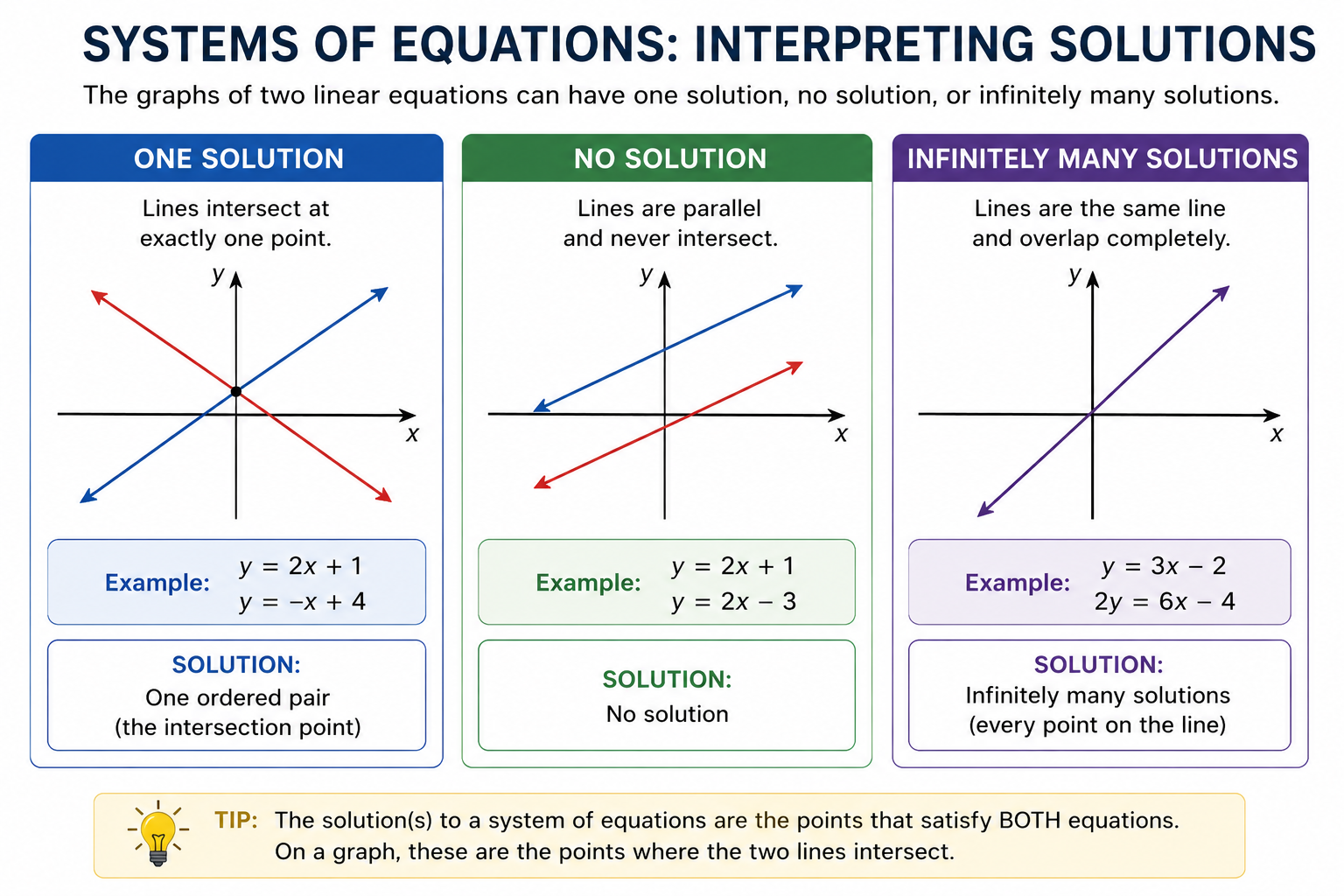
- One solution: lines intersect
- No solution: lines are parallel
- Infinite solutions: same line
Function Basics
Function Notation
\[ y=f(x) \]
A function assigns exactly one output to each input.
Domain and Range
- Domain = allowed inputs
- Range = possible outputs
Function Transformations
| Transformation | Effect on Graph |
|---|---|
| \(f(x)+k\) | Shift up \(k\) units |
| \(f(x)-k\) | Shift down \(k\) units |
| \(f(x-h)\) | Shift right \(h\) units |
| \(f(x+h)\) | Shift left \(h\) units |
| \(-f(x)\) | Reflect across the \(x\)-axis |
| \(f(-x)\) | Reflect across the \(y\)-axis |
| \(af(x)\) | Vertical stretch by factor \(a\) if \(a>1\) |
| \(af(x)\) | Vertical compression if \(0<a<1\) |
| \(f(bx)\) | Horizontal compression if \(b>1\) |
| \(f(bx)\) | Horizontal stretch by factor \(\frac{1}{b}\) if \(0<b<1\) |
Common ACT Traps
- \(f(x-h)\) shifts right, not left.
- \(f(x+h)\) shifts left, not right.
- \(f(bx)\) affects the graph horizontally.
- \(af(x)\) affects the graph vertically.
General Transformation Form
\[ g(x)=a\,f(b(x-h))+k \]
Function Composition
\[ (f \circ g)(x)=f(g(x)) \]
Evaluate the inside function first.
Inverse Functions
An inverse function reverses the effect of a function.
Notation:
\[ f^{-1}(x) \]
To find an inverse:
- Replace \(f(x)\) with \(y\).
- Swap \(x\) and \(y\).
- Solve for \(y\).
Quadratics
Quadratic functions can be written in several useful forms.
Standard Form
\[ y=ax^2+bx+c \]
Vertex Form
\[ y=a(x-h)^2+k \]
Factored Form
\[ y=a(x-r_1)(x-r_2) \]
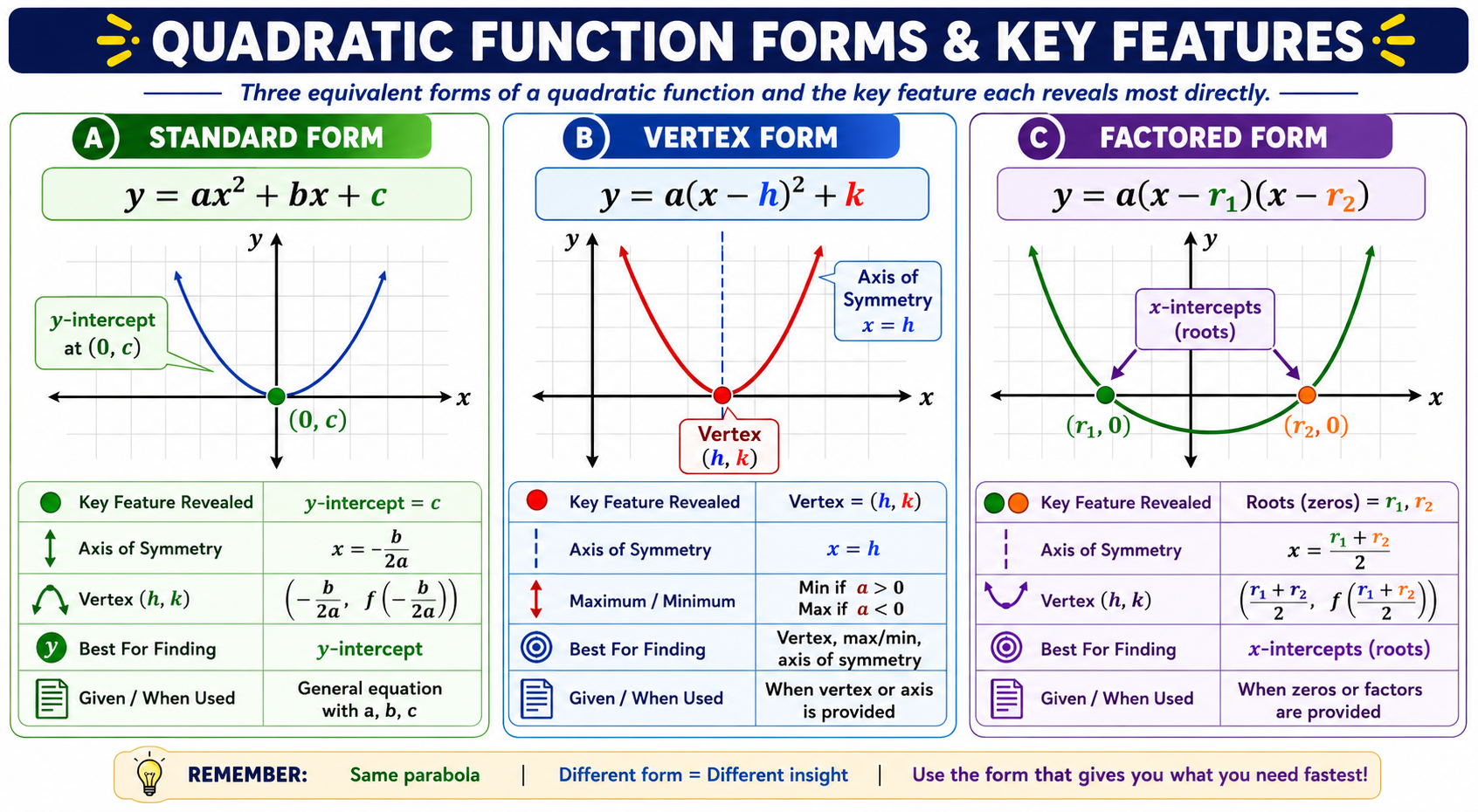
Each form makes a different feature easier to identify.
Vertex Formula
\[ h=-\frac{b}{2a} \]
Vertex Coordinates
\[ \left( -\frac{b}{2a}, f\!\left(-\frac{b}{2a}\right) \right) \]
Quadratic Formula
\[ x= \frac{-b\pm\sqrt{b^2-4ac}} {2a} \]
Discriminant
\[ b^2-4ac \]
- Positive → two real roots
- Zero → one real root
- Negative → no real roots
Polynomials
Remainder Theorem
If a polynomial \(P(x)\) is divided by \(x-c\), the remainder is:
\[ P(c) \]
Difference of Squares
\[ a^2-b^2=(a-b)(a+b) \]
Perfect Square Trinomials
\[ (a+b)^2=a^2+2ab+b^2 \]
\[ (a-b)^2=a^2-2ab+b^2 \]
Rational Expressions and Work Problems
For combined work rates:
\[ \frac{1}{a}+\frac{1}{b}=\frac{1}{t} \]
where:
- \(a\) = time for one person or machine alone
- \(b\) = time for another person or machine alone
- \(t\) = time working together
Exponential, Logarithmic, and Sequence Formulas
Exponential Functions
General Form
\[ y=a(b)^t \]
where:
- \(a\) = initial value
- \(b\) = growth or decay factor
Growth
\[ b=1+r \]
Decay
\[ b=1-r \]
Compound Interest
\[ A=P\left(1+\frac{r}{n}\right)^{nt} \]
where:
- \(P\) = principal
- \(r\) = annual interest rate
- \(n\) = number of compounding periods per year
- \(t\) = time in years
Logarithms
The ACT may test basic logarithm rules.
Product Rule
\[ \log(ab)=\log a+\log b \]
Quotient Rule
\[ \log\left(\frac{a}{b}\right)=\log a-\log b \]
Power Rule
\[ \log(a^n)=n\log a \]
Inverse Relationship
\[ a^{\log_a b}=b \]
\[ \log_a(a^x)=x \]
Converting Between Exponential and Log Form
\[ a^x=b \]
is equivalent to:
\[ \log_a b=x \]
Sequences
Arithmetic Sequence
\[ a_n=a_1+(n-1)d \]
where \(d\) is the common difference.
Geometric Sequence
\[ a_n=a_1r^{n-1} \]
where \(r\) is the common ratio.
Geometry
Geometry Formula Reference
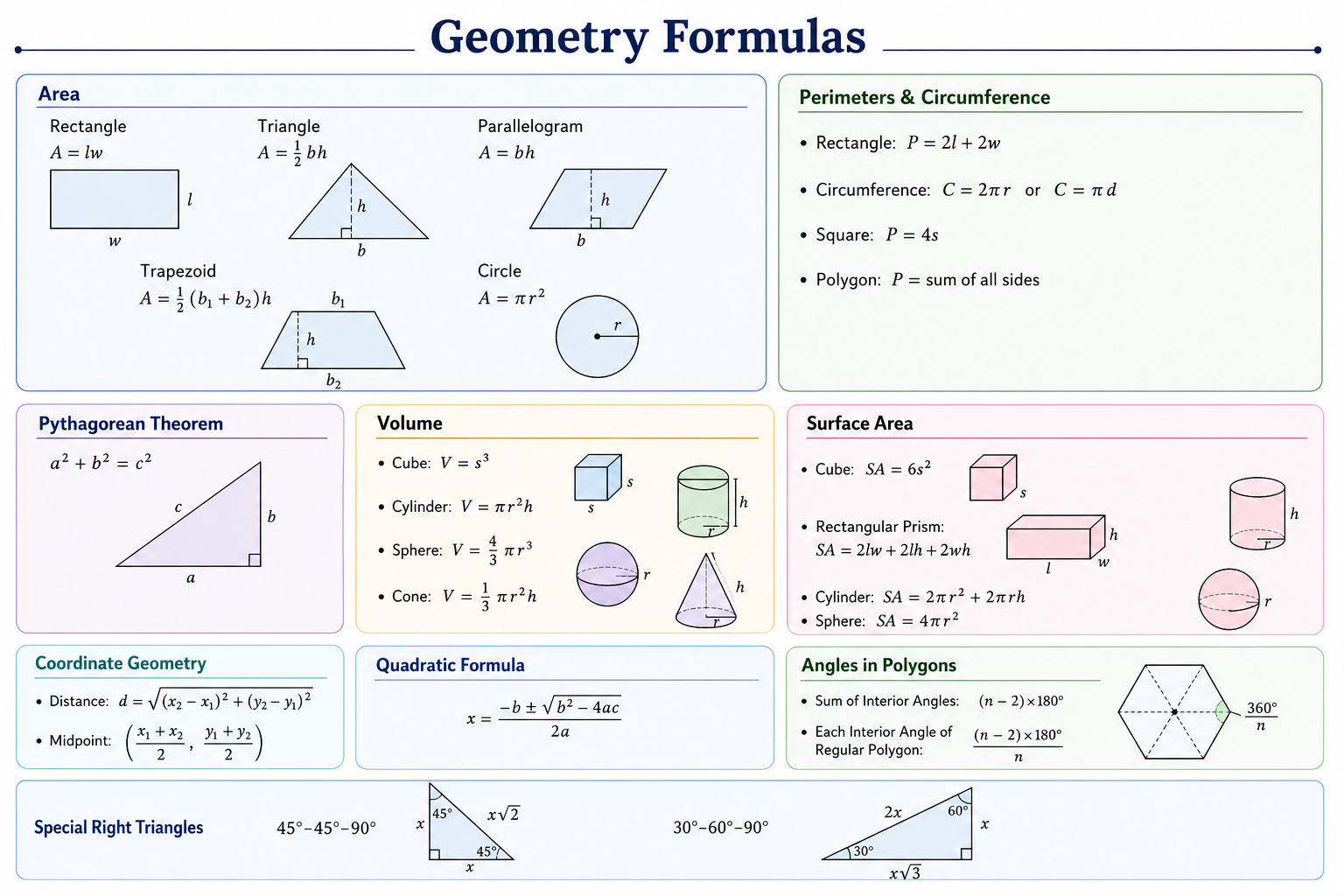
Area Formulas
Rectangle
\[ A=lw \]
Triangle
\[ A=\frac{1}{2}bh \]
Parallelogram
\[ A=bh \]
Trapezoid
\[ A=\frac{1}{2}(b_1+b_2)h \]
Circle
\[ A=\pi r^2 \]
Perimeter and Circumference
Rectangle
\[ P=2l+2w \]
Circle Circumference
\[ C=2\pi r \]
or
\[ C=\pi d \]
Volume Formulas
Cube
\[ V=s^3 \]
Rectangular Prism
\[ V=lwh \]
Cylinder
\[ V=\pi r^2h \]
Pyramid
\[ V=\frac{1}{3}Bh \]
Cone
\[ V=\frac{1}{3}\pi r^2h \]
Sphere
\[ V=\frac{4}{3}\pi r^3 \]
Surface Area Formulas
Cube
\[ SA=6s^2 \]
Rectangular Prism
\[ SA=2lw+2lh+2wh \]
Cylinder
\[ SA=2\pi r^2+2\pi rh \]
Sphere
\[ SA=4\pi r^2 \]
Pythagorean Theorem
\[ a^2+b^2=c^2 \]
Distance and Midpoint
Distance Formula
\[ d= \sqrt{ (x_2-x_1)^2+ (y_2-y_1)^2 } \]
Midpoint Formula
\[ \left( \frac{x_1+x_2}{2}, \frac{y_1+y_2}{2} \right) \]
Circle Equation
\[ (x-h)^2+(y-k)^2=r^2 \]
where:
- \((h,k)\) = center
- \(r\) = radius
Special Right Triangles
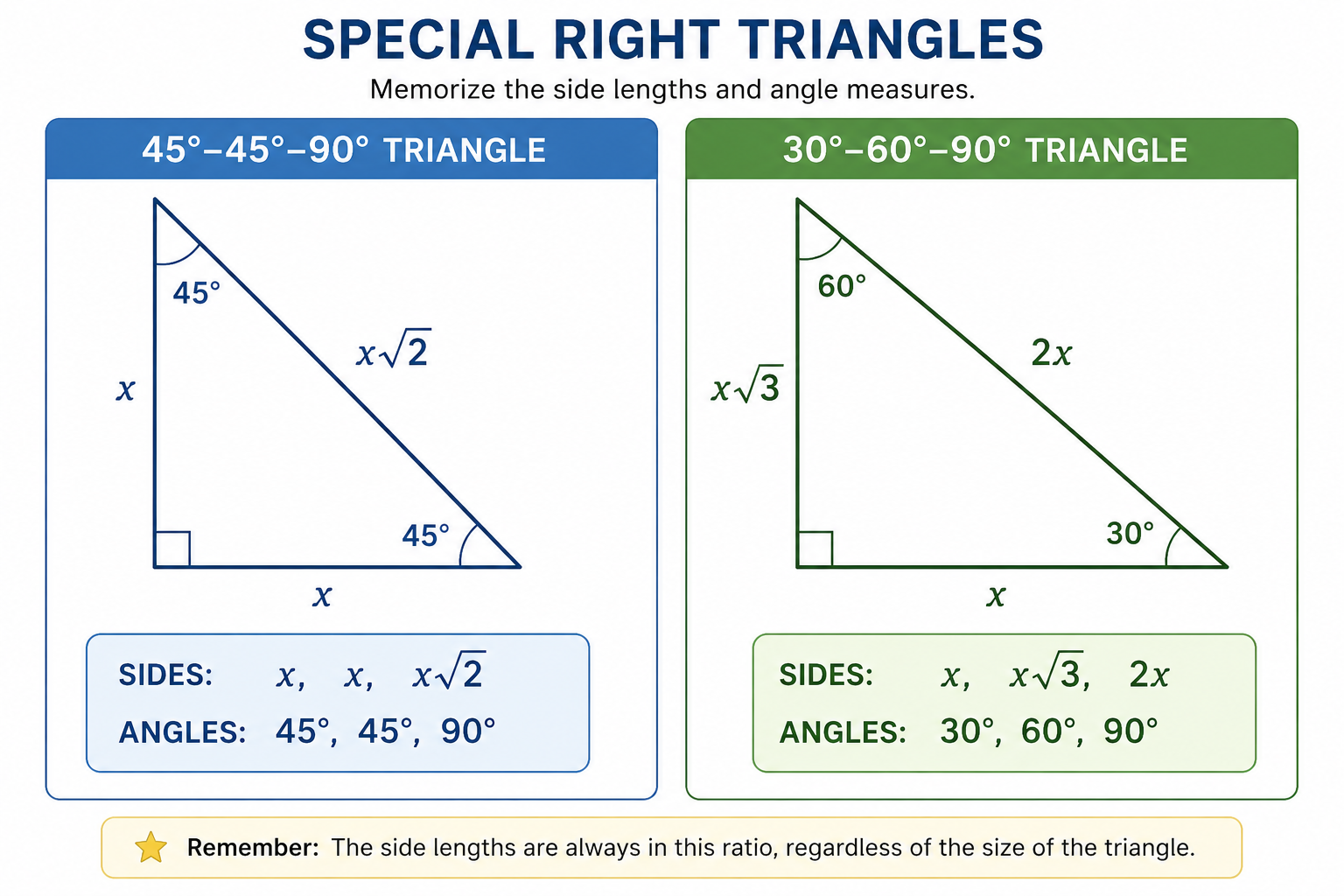
45°-45°-90°
\[ x,\ x,\ x\sqrt{2} \]
30°-60°-90°
\[ x,\ x\sqrt{3},\ 2x \]
Circles — Arcs and Sectors
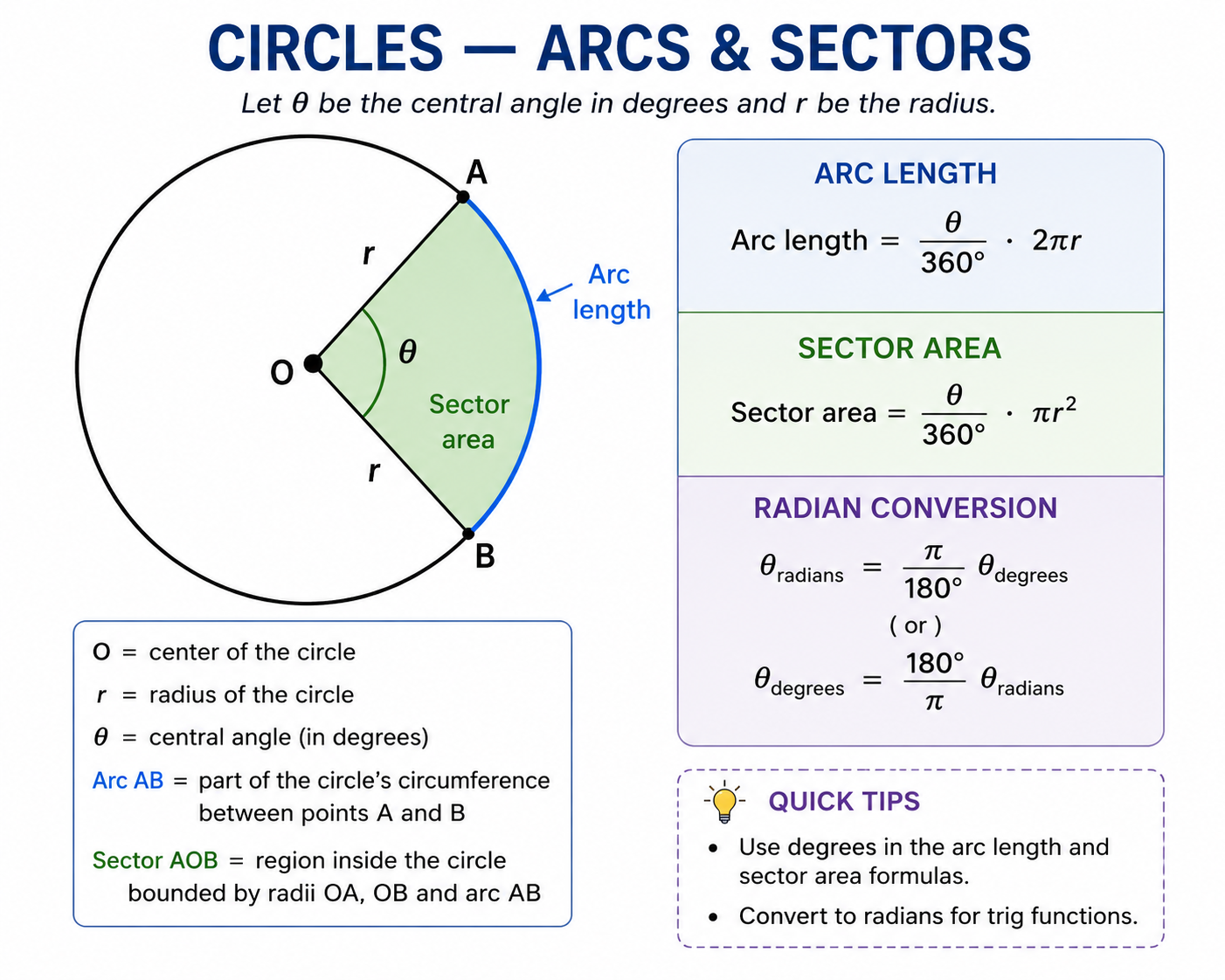
Arc Length Using Radians
\[ s=r\theta \]
where \(\theta\) is in radians.
Sector Area Using Radians
\[ A=\frac{1}{2}r^2\theta \]
where \(\theta\) is in radians.
Arc Length Using Degrees
\[ \text{Arc Length} = \frac{\theta}{360^\circ} \cdot 2\pi r \]
Sector Area Using Degrees
\[ \text{Sector Area} = \frac{\theta}{360^\circ} \cdot \pi r^2 \]
Polygon Angle Sums
Interior Angle Sum
\[ (n-2)180^\circ \]
where \(n\) is the number of sides.
Interior Angle of a Regular Polygon
\[ \frac{(n-2)180^\circ}{n} \]
Exterior Angle Sum
\[ 360^\circ \]
Conic Sections
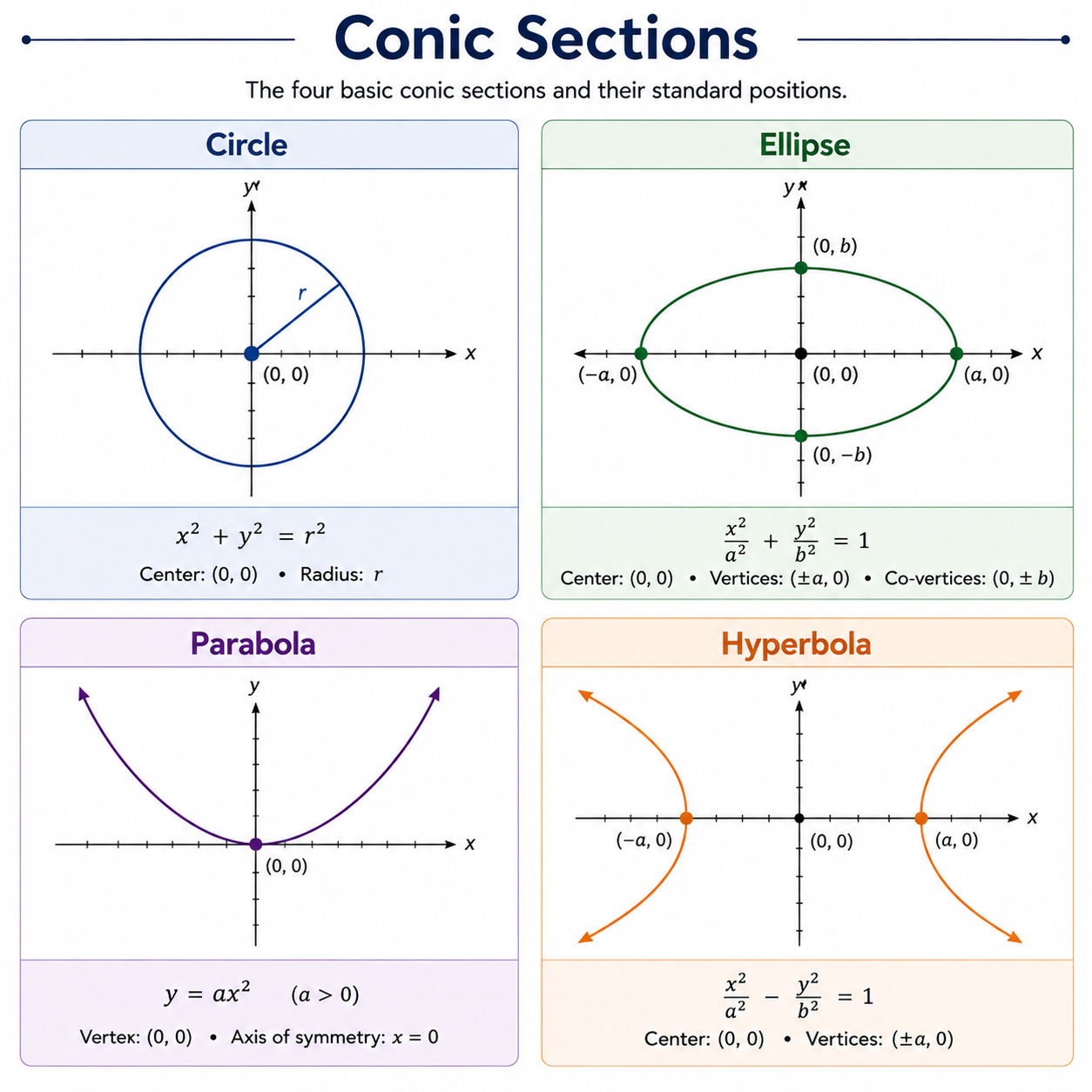
Circle
\[ (x-h)^2+(y-k)^2=r^2 \]
Parabola
Vertical parabola:
\[ y=a(x-h)^2+k \]
Horizontal parabola:
\[ x=a(y-k)^2+h \]
Ellipse
Centered at the origin:
\[ \frac{x^2}{a^2}+\frac{y^2}{b^2}=1 \]
Centered at \((h,k)\):
\[ \frac{(x-h)^2}{a^2}+\frac{(y-k)^2}{b^2}=1 \]
Hyperbola
Horizontal hyperbola:
\[ \frac{x^2}{a^2}-\frac{y^2}{b^2}=1 \]
Vertical hyperbola:
\[ \frac{y^2}{a^2}-\frac{x^2}{b^2}=1 \]
Trigonometry
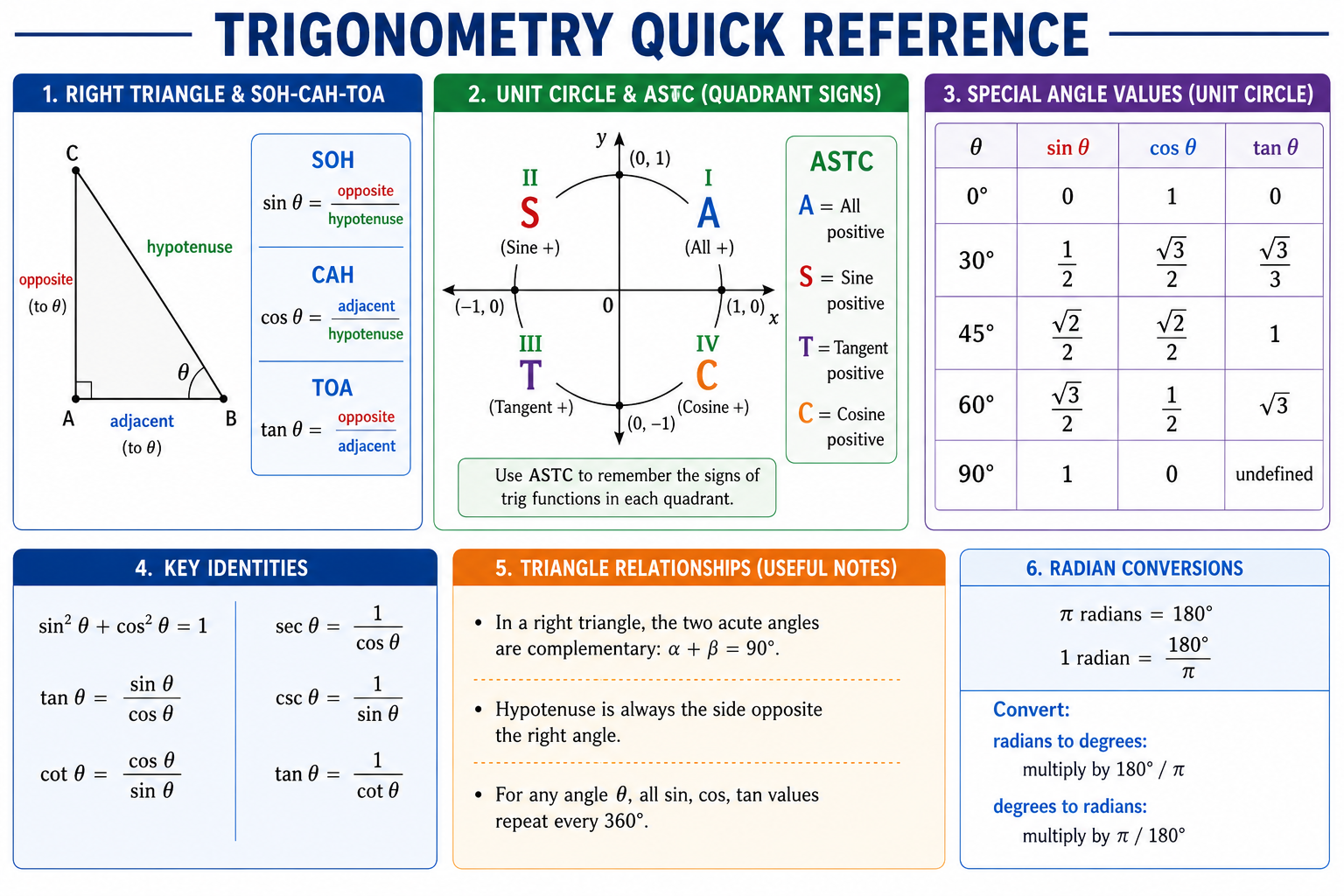
SOH-CAH-TOA
\[ \sin \theta= \frac{\text{opposite}}{\text{hypotenuse}} \]
\[ \cos \theta= \frac{\text{adjacent}}{\text{hypotenuse}} \]
\[ \tan \theta= \frac{\text{opposite}}{\text{adjacent}} \]
Basic Identities
Pythagorean Identity
\[ \sin^2\theta+\cos^2\theta=1 \]
Tangent Identity
\[ \tan\theta=\frac{\sin\theta}{\cos\theta} \]
Reciprocal Identities
\[ \sec\theta=\frac{1}{\cos\theta} \]
\[ \csc\theta=\frac{1}{\sin\theta} \]
\[ \cot\theta=\frac{1}{\tan\theta} \]
Radian Conversions
\[ \pi \text{ radians}=180^\circ \]
\[ 2\pi \text{ radians}=360^\circ \]
\[ \theta_{\text{radians}} = \frac{\pi}{180^\circ} \theta_{\text{degrees}} \]
\[ \theta_{\text{degrees}} = \frac{180^\circ}{\pi} \theta_{\text{radians}} \]
Unit Circle
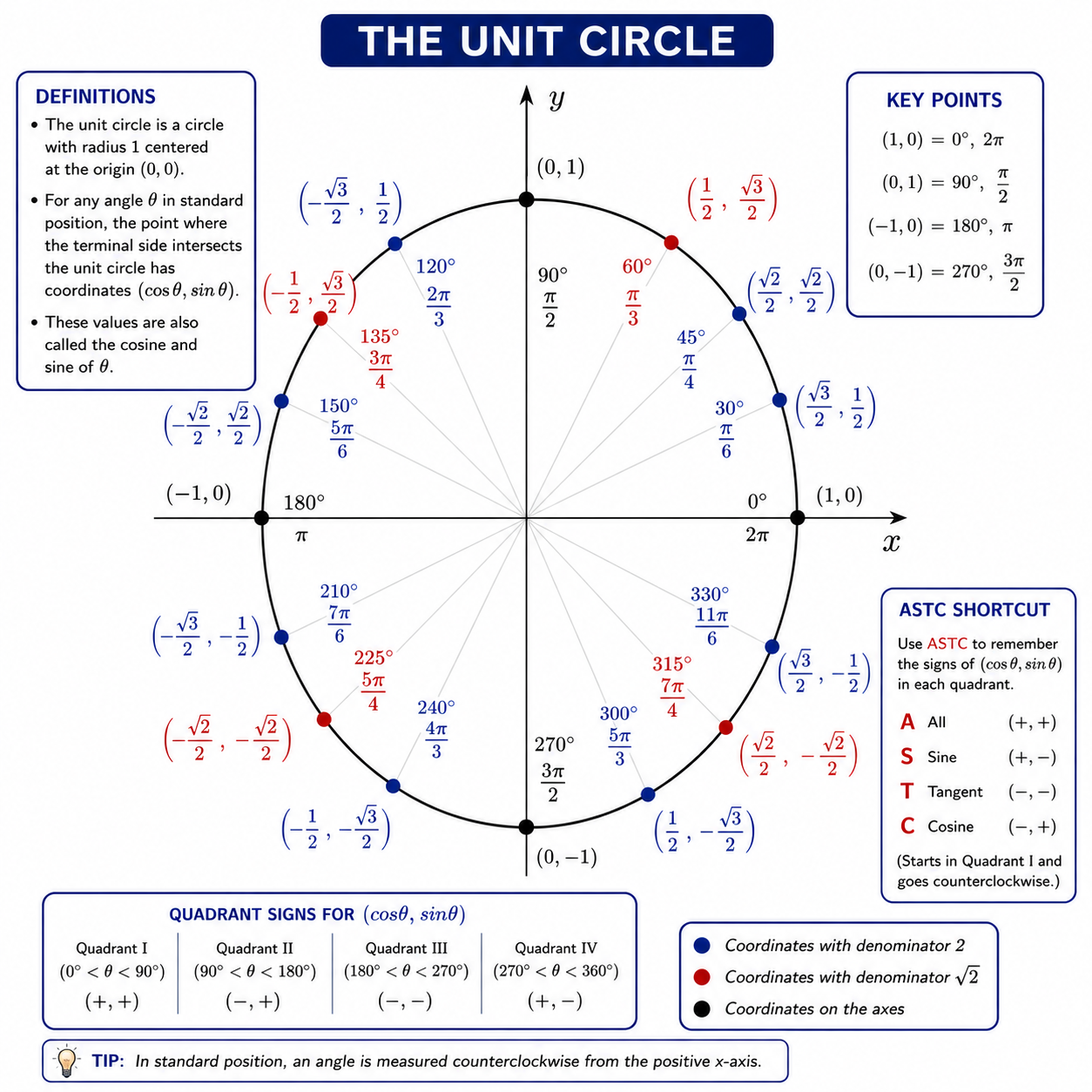
The coordinates on the unit circle are:
\[ (\cos\theta,\sin\theta) \]
Use the ASTC shortcut to remember which trig function is positive in each quadrant:
- Quadrant I: All positive
- Quadrant II: Sine positive
- Quadrant III: Tangent positive
- Quadrant IV: Cosine positive
Law of Sines and Law of Cosines
Law of Sines
\[ \frac{a}{\sin A} = \frac{b}{\sin B} = \frac{c}{\sin C} \]
Law of Cosines
\[ c^2=a^2+b^2-2ab\cos C \]
Vectors and Matrices
Vectors
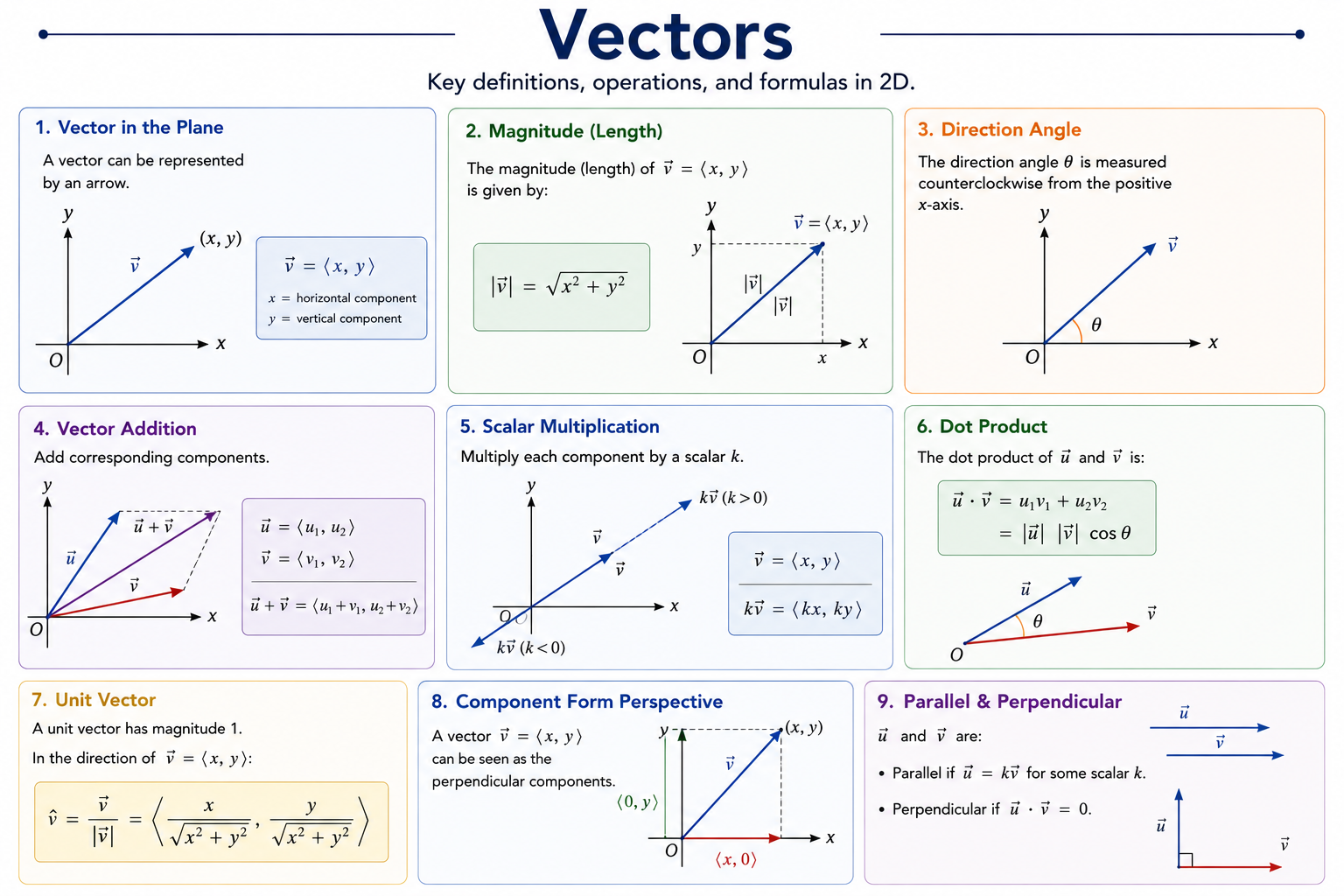
Vector Notation
\[ \vec v=\langle a,b\rangle \]
Vector Magnitude
\[ |\vec v|=\sqrt{a^2+b^2} \]
Vector Addition
\[ \langle a,b\rangle+\langle c,d\rangle = \langle a+c,b+d\rangle \]
Scalar Multiplication
\[ k\langle a,b\rangle = \langle ka,kb\rangle \]
Matrices
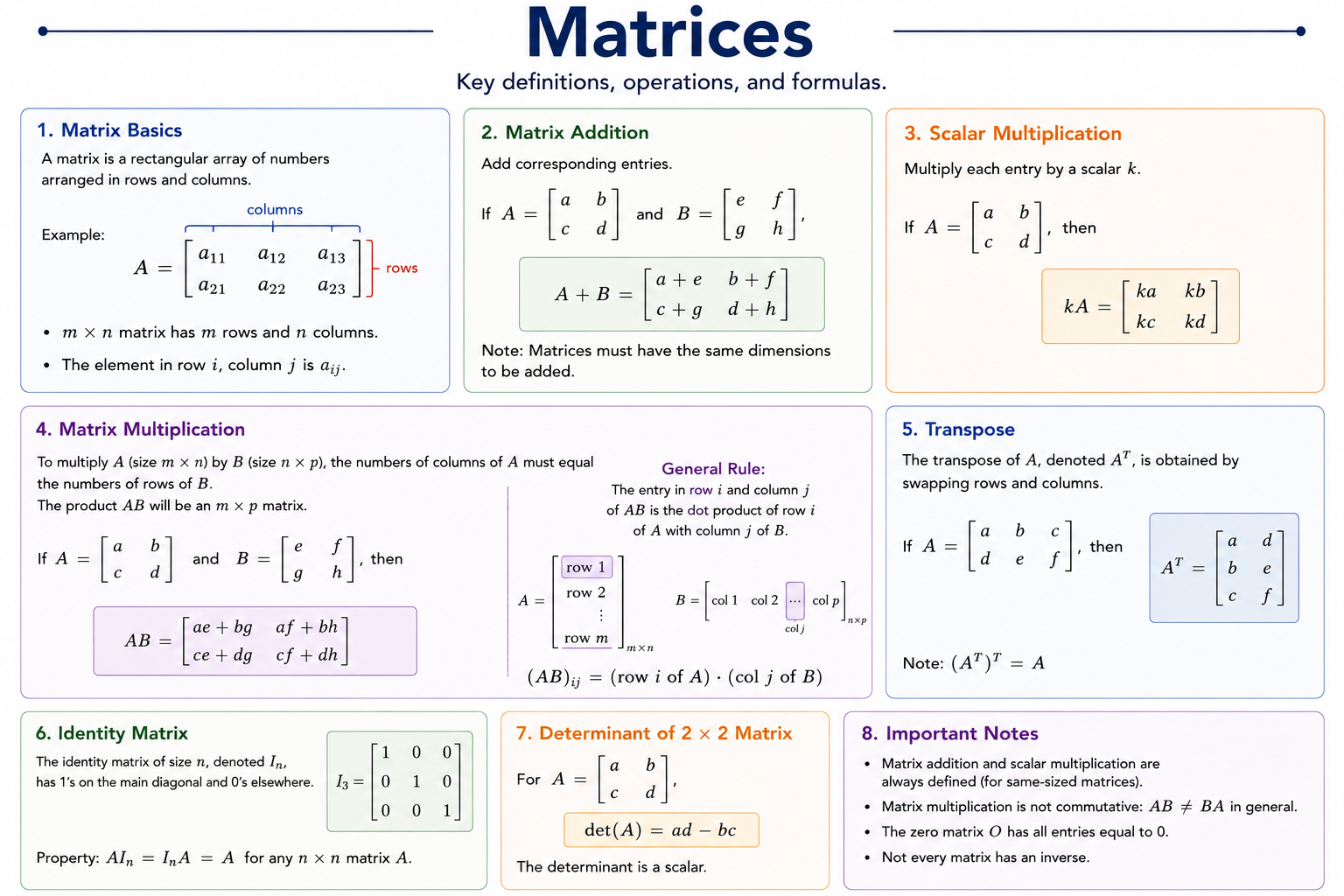
Matrix Addition
\[ \begin{bmatrix} a & b \\ c & d \end{bmatrix} + \begin{bmatrix} e & f \\ g & h \end{bmatrix} = \begin{bmatrix} a+e & b+f \\ c+g & d+h \end{bmatrix} \]
Matrix Multiplication
For:
\[ A= \begin{bmatrix} a & b \\ c & d \end{bmatrix} \]
and
\[ B= \begin{bmatrix} e & f \\ g & h \end{bmatrix} \]
then:
\[ AB= \begin{bmatrix} ae+bg & af+bh \\ ce+dg & cf+dh \end{bmatrix} \]
Determinant of a 2×2 Matrix
\[ \det \begin{bmatrix} a & b \\ c & d \end{bmatrix} = ad-bc \]
Statistics & Probability
Mean
\[ \text{mean}=\frac{\text{sum}}{\text{count}} \]
Weighted Mean
\[ \frac{\sum w_ix_i}{\sum w_i} \]
Median, Mode, and Range
- Median = middle value
- Mode = most common value
- Range = maximum − minimum
Standard Deviation Concept
- Low standard deviation → values are close to the mean.
- High standard deviation → values are spread out.
Probability
Simple Probability
\[ P(A)=\frac{\text{favorable}}{\text{total}} \]
Independent Events
\[ P(A \text{ and } B)=P(A)P(B) \]
Conditional Probability
\[ P(A \mid B)=\frac{P(A\cap B)}{P(B)} \]
Union Rule
\[ P(A \text{ or } B) = P(A)+P(B)-P(A\cap B) \]
Combinatorics
Fundamental Counting Principle
If one choice can happen in \(m\) ways and another independent choice can happen in \(n\) ways, then the two choices together can happen in:
\[ m\cdot n \]
ways.
Permutations
Use permutations when order matters.
\[ {}_nP_r=\frac{n!}{(n-r)!} \]
Combinations
Use combinations when order does not matter.
\[ {}_nC_r=\frac{n!}{r!(n-r)!} \]
Final Tips
The ACT does not provide a formula sheet. Memorize:
- Geometry area, volume, and surface area formulas
- Special right triangles
- Slope, distance, midpoint, and circle equations
- Quadratic formula and discriminant
- Function transformations
- Exponential, logarithmic, and sequence formulas
- Trigonometric ratios, identities, and unit-circle values
- Law of sines and law of cosines
- Probability and combinatorics rules
- Complex numbers
- Vector and matrix basics
Highest-Priority ACT Memorization
- Quadratic Formula
- Special Right Triangles
- SOH-CAH-TOA
- Law of Sines
- Law of Cosines
- Circle Equation
- Distance Formula
- Logarithm Rules
Coordinate Transformation Rules
| Transformation | Rule |
|---|---|
| Reflect across x-axis | \((x,y)\rightarrow(x,-y)\) |
| Reflect across y-axis | \((x,y)\rightarrow(-x,y)\) |
| Reflect across origin | \((x,y)\rightarrow(-x,-y)\) |
| Rotate 90° CCW | \((x,y)\rightarrow(-y,x)\) |
| Rotate 180° | \((x,y)\rightarrow(-x,-y)\) |
| Rotate 270° CCW | \((x,y)\rightarrow(y,-x)\) |
| Dilation by factor \(k\) | \((x,y)\rightarrow(kx,ky)\) |
Function Transformation Summary
| Transformation | Effect |
|---|---|
| \(f(x)+k\) | Up \(k\) |
| \(f(x)-k\) | Down \(k\) |
| \(f(x-h)\) | Right \(h\) |
| \(f(x+h)\) | Left \(h\) |
| \(-f(x)\) | Reflect across x-axis |
| \(f(-x)\) | Reflect across y-axis |