Absolute Value Basics
By the end of this lesson, you’ll be able to:
- Understand absolute value as distance from zero on the number line.
- Evaluate absolute value expressions correctly.
- Interpret absolute value in equations and basic distance problems.
- Work carefully with negative signs inside and outside absolute value bars.
Key Ideas
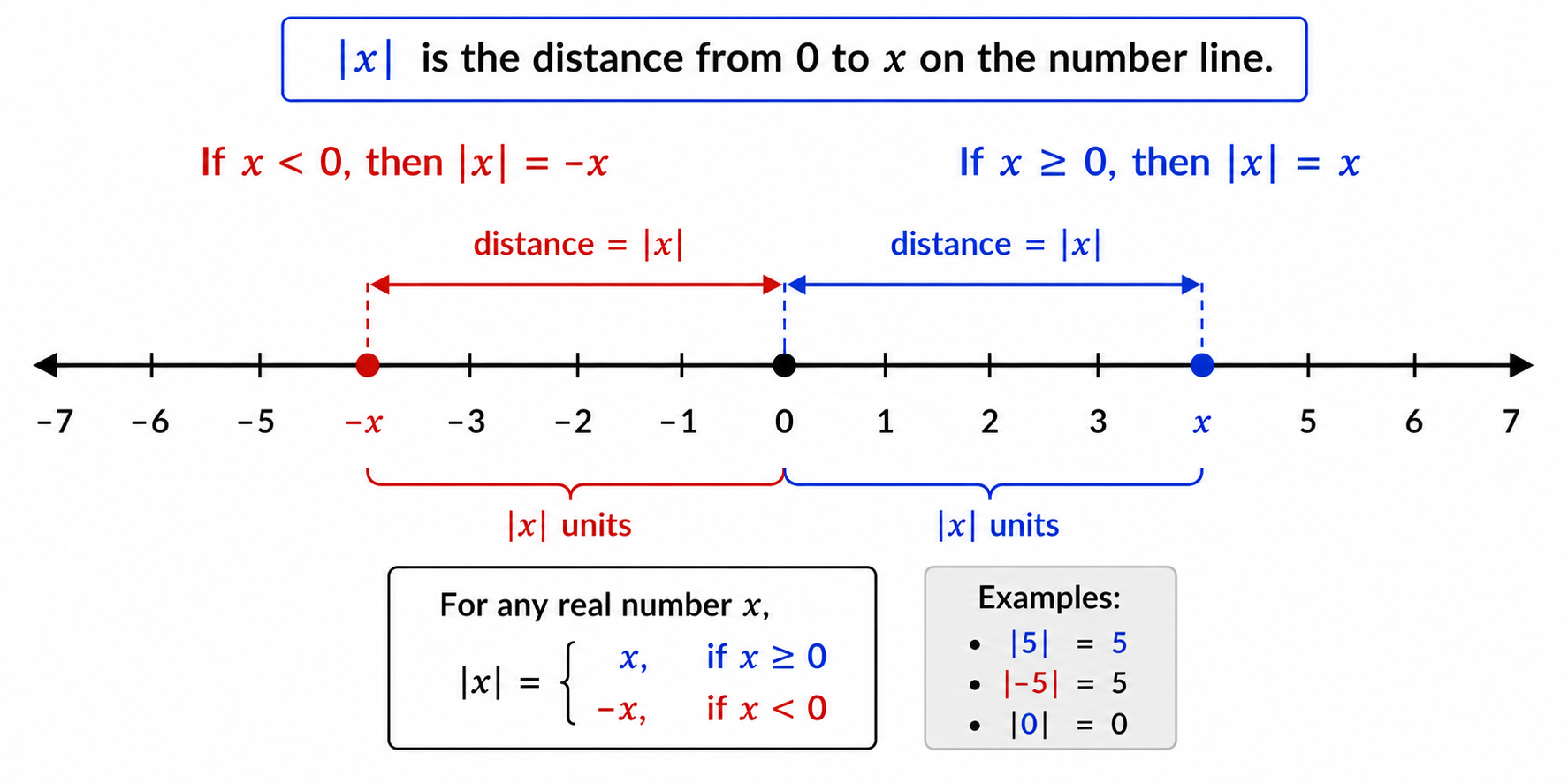
- The absolute value of a number represents its distance from 0, so it is always non-negative.
\[ |x| = \begin{cases} x, & x \ge 0 \\ -x, & x < 0 \end{cases} \]
Examples:
\(|5| = 5\)
\(|-5| = 5\)
\(|0| = 0\)
Absolute value is about distance, not “removing the minus sign.”
It applies to the entire expression inside the bars.
Absolute value bars act as grouping symbols.
Always simplify the expression inside the bars before applying absolute value.
Common Problem Types
1. Evaluating Expressions
Example:
\[
|3 - 7|
\]
Step-by-step:
- Inside first → \(3 - 7 = -4\)
- Absolute value → \(|-4| = 4\)
2. Absolute Value With Multiplication
Example:
\[
|-2 \cdot 6| = |-12| = 12
\]
3. Negative Signs Outside Bars
Example:
\[
-|\, -8 \,|
\]
Step-by-step:
- Inside: \(|-8| = 8\)
- Apply outer negative: \(-8\)
These are two separate operations.
4. Simple Absolute Value Equations
Example: Solve \(|x| = 7\).
Two cases:
- \(x = 7\)
- \(x = -7\)
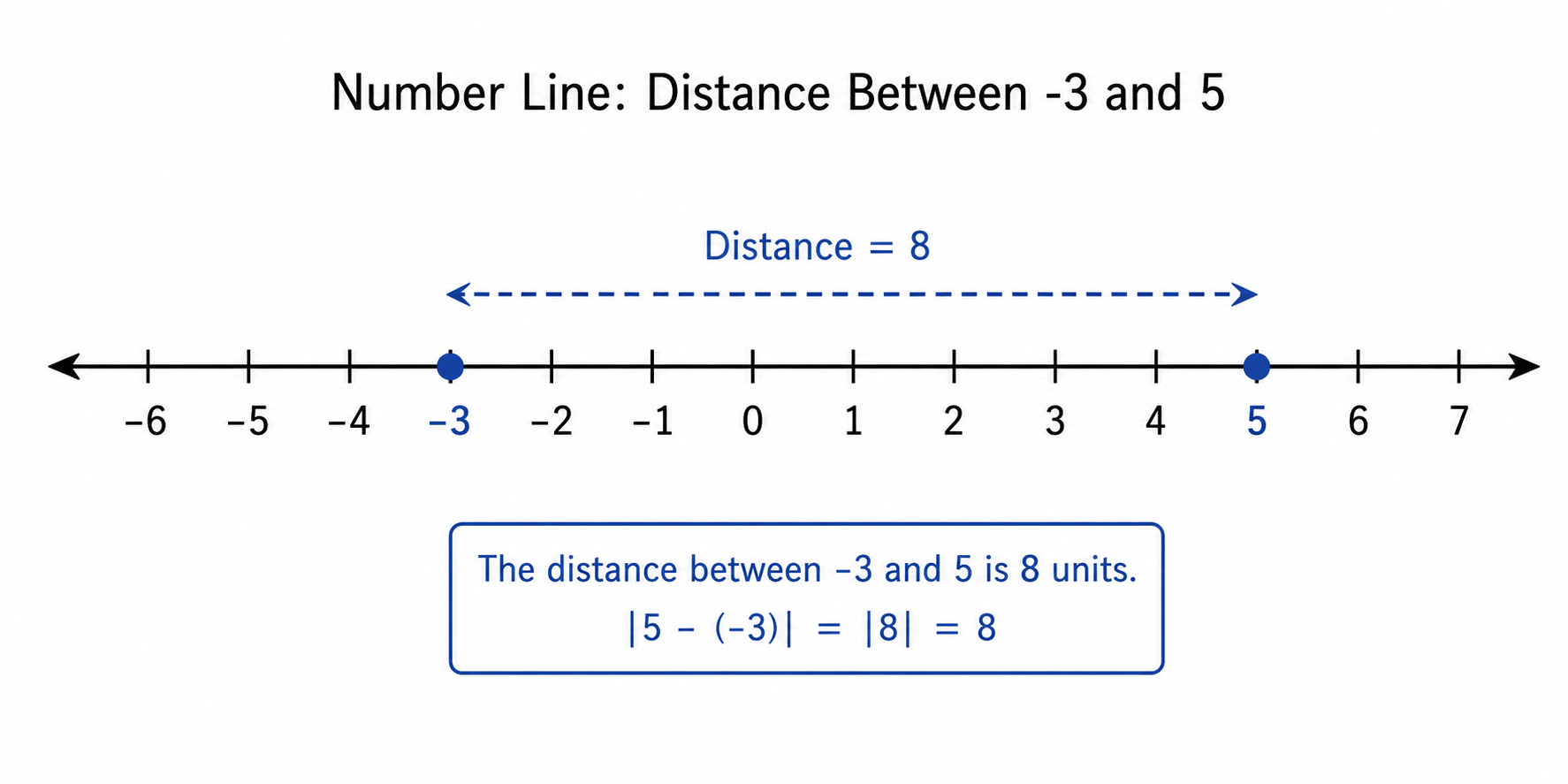
5. Distance on a Number Line
Distance between \(-3\) and \(5\):
\[ |5 - (-3)| = |8| = 8 \]
Strategies
- Always evaluate inside the bars first.
- Keep outside negatives separate.
- Think of absolute value as distance, not a symbol that “makes numbers positive.”
- Equations of the form \(|x| = a\) (with \(a>0\)) always yield two solutions.
Worked Examples
Example 1
Question:
\[
|2 - 9|
\]
Solution:
- Inside: \(2 - 9 = -7\)
- Apply absolute value: \(|-7| = 7\)
Answer: \(7\)
Example 2
Question:
\[
-|4 - 10|
\]
Solution:
- Inside: \(4 - 10 = -6\)
- Absolute value: \(|-6| = 6\)
- Apply outer negative: \(-6\)
Answer: \(-6\)
Example 3
Question: Solve
\[
|x - 3| = 5
\]
Solution:
Split into two cases:
- \(x - 3 = 5\) → \(x = 8\)
- \(x - 3 = -5\) → \(x = -2\)
Answer: \(x = 8\) or \(x = -2\)
- Ignoring an outside negative sign.
- Thinking \(|a+b| = |a| + |b|\) (not true).
- Solving only one branch of an absolute value equation.
- Forgetting to simplify inside the bars first.
- Mixing absolute value with distribution incorrectly.
Practice Problems
- \(|7 - 12|\)
- \(-|\, -9 \,|\)
- \(|3x|\) when \(x = -4\)
- Solve \(|x| = 11\)
- Solve \(|x - 2| = 4\)
1. \(|7 - 12|\)
Inside → \(7 - 12 = -5\)
Absolute value → \(5\)
Answer: \(5\)
2. \(-|\, -9 \,|\)
Inside → \(|-9| = 9\)
Outside → \(-9\)
Answer: \(-9\)
3. \(|3x|\) when \(x = -4\)
Substitute: \(|3(-4)| = |-12| = 12\)
Answer: \(12\)
4. Solve \(|x| = 11\)
Two cases → \(x = 11\) or \(x = -11\)
Answer: \(x = \pm 11\)
5. Solve \(|x - 2| = 4\)
Case 1: \(x - 2 = 4\) → \(x = 6\)
Case 2: \(x - 2 = -4\) → \(x = -2\)
Answer: \(x = 6\) or \(x = -2\)
Summary
- Absolute value measures distance from 0.
- Bars act like grouping symbols—simplify inside first.
- Watch for negative signs outside the bars.
- Equations of the form \(|x - a| = b\) split into two linear equations.
- Evaluate inside the bars first, then apply any outside operations.
- For \(|x - a| = b\) with \(b>0\), expect two solutions.
- Draw a quick number line to visualize distances.