Pythagorean Theorem
- Identify right triangles.
- Apply \(a^2 + b^2 = c^2\).
- Solve for missing side lengths.
Key Ideas
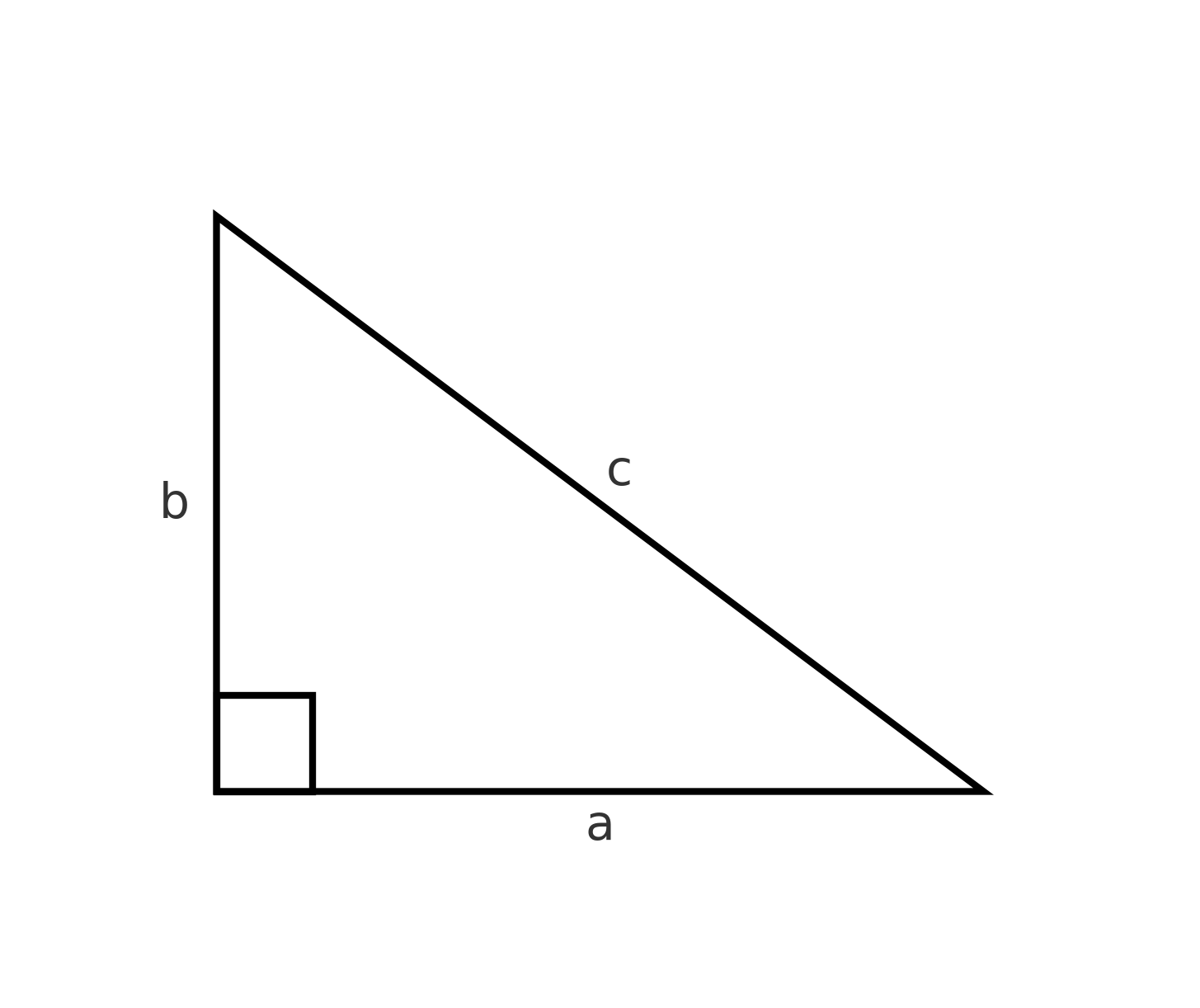
Right triangle side relationship: \[ a^2 + b^2 = c^2 \]
where:
- \(a\) and \(b\) are the legs of the right triangle.
- \(c\) is the hypotenuse, the side opposite the right angle and the longest side..
Common Problem Types
1. Solving for the Hypotenuse
If both legs are known, use:
\[ a^2+b^2=c^2 \]
Then take the square root to find \(c\).
For example, suppose the legs are 6 and 8:
\[ 6^2+8^2=c^2 \]
\[ 36+64=c^2 \]
\[ 100=c^2 \]
\[ c=10 \]
The hypotenuse is 10.
2. Solving for a Leg
If the hypotenuse and one leg are known, substitute them into the Pythagorean Theorem and solve for the missing leg.
For example, suppose \(c=13\) and \(a=5\):
\[ 5^2+b^2=13^2 \]
\[ 25+b^2=169 \]
Subtract 25 from both sides:
\[ b^2=144 \]
Take the square root:
\[ b=12 \]
3. Identifying a Right Triangle
The Pythagorean Theorem can also be used to determine whether three side lengths form a right triangle.
First, identify the longest side and treat it as \(c\).
Then check whether:
\[ a^2+b^2=c^2 \]
If the equation is true, the triangle is a right triangle.
For example, for side lengths 5, 12, and 13:
\[ 5^2+12^2=13^2 \]
\[ 25+144=169 \]
\[ 169=169 \]
Because the equation is true, the triangle is a right triangle.
4. Coordinate Problems
The Pythagorean Theorem is also the idea behind the distance formula:
\[ d=\sqrt{(x_2-x_1)^2+(y_2-y_1)^2} \]
The horizontal and vertical distances between two points form the legs of a right triangle, while the distance between the points is the hypotenuse.
For example, find the distance between \((1,2)\) and \((4,6)\).
The horizontal change is:
\[ 4-1=3 \]
The vertical change is:
\[ 6-2=4 \]
So:
\[ d=\sqrt{3^2+4^2} \]
\[ d=\sqrt{9+16} \]
\[ d=\sqrt{25}=5 \]
Strategies
- Use the Pythagorean Theorem only with right triangles.
- Always identify the hypotenuse first. It is opposite the right angle and is the longest side.
- If finding the hypotenuse, add the squares of the two legs.
- If finding a leg, substitute the hypotenuse for \(c\) and subtract before taking the square root.
- When checking whether a triangle is right, always use the longest side as \(c\).
- Look for perfect squares and familiar Pythagorean triples when possible.
- In coordinate problems, horizontal and vertical changes form the legs of a right triangle.
Worked Examples
Example 1 — Find the Hypotenuse
A right triangle has legs of length 7 and 24. Find the hypotenuse.
The missing side is the hypotenuse, so let it be \(c\).
Start with:
\[ a^2+b^2=c^2 \]
Substitute \(a=7\) and \(b=24\):
\[ 7^2+24^2=c^2 \]
Square each number:
\[ 49+576=c^2 \]
\[ 625=c^2 \]
Take the square root of both sides:
\[ c=\sqrt{625}=25 \]
Therefore:
\[ \boxed{c=25} \]
Example 2 — Check for a Right Triangle
A triangle has side lengths 10, 24, and 26. Is it a right triangle?
The longest side is 26, so use:
\[ c=26 \]
The other two sides are the possible legs.
Check the Pythagorean Theorem:
\[ 10^2+24^2=26^2 \]
Evaluate each square:
\[ 100+576=676 \]
\[ 676=676 \]
The equation is true, so the side lengths satisfy the Pythagorean Theorem.
Therefore, the triangle is:
\[ \boxed{\text{a right triangle}} \]
Example 3 — Find a Missing Leg
A right triangle has a hypotenuse of 13 and one leg of 5. Find the other leg.
Let the missing leg be \(b\).
Start with:
\[ a^2+b^2=c^2 \]
Substitute \(a=5\) and \(c=13\):
\[ 5^2+b^2=13^2 \]
Square:
\[ 25+b^2=169 \]
Subtract 25 from both sides:
\[ b^2=144 \]
Take the square root:
\[ b=12 \]
Therefore:
\[ \boxed{b=12} \]
- Using the Pythagorean Theorem on a triangle that is not a right triangle.
- Forgetting that \(c\) must represent the hypotenuse.
- Treating the longest side as a leg.
- Adding when solving for a missing leg instead of subtracting.
- Forgetting to take the square root after finding \(c^2\) or a missing leg squared.
- In a right-triangle check, failing to use the longest side as \(c\).
Practice Problems
A right triangle has legs of length 9 and 12. Find the hypotenuse.
A right triangle has a hypotenuse of 17 and one leg of length 15. Find the other leg.
A triangle has side lengths 8, 15, and 17. Determine whether it is a right triangle.
1. The two known sides are the legs, so use:
\[ a^2+b^2=c^2 \]
Substitute 9 and 12:
\[ 9^2+12^2=c^2 \]
\[ 81+144=c^2 \]
\[ 225=c^2 \]
Take the square root:
\[ c=\sqrt{225}=15 \]
Therefore:
\[ \boxed{c=15} \]
2. The hypotenuse is 17 and one leg is 15. Let the missing leg be \(b\).
\[ 15^2+b^2=17^2 \]
Square the known values:
\[ 225+b^2=289 \]
Subtract 225 from both sides:
\[ b^2=64 \]
Take the square root:
\[ b=\sqrt{64}=8 \]
Therefore:
\[ \boxed{b=8} \]
3. The longest side is 17, so treat it as the possible hypotenuse.
Check:
\[ 8^2+15^2=17^2 \]
Evaluate the squares:
\[ 64+225=289 \]
\[ 289=289 \]
The equation is true, so the side lengths satisfy the Pythagorean Theorem.
Therefore:
\[ \boxed{\text{Yes, it is a right triangle.}} \]
Summary
- Pythagorean Theorem applies only to right triangles.
- Hypotenuse is always opposite the right angle.
- Check for perfect-square triples.
- Always identify the right angle first.