Exponents: Fundamental Rules
By the end of this lesson, you’ll be able to:
- Interpret exponents as repeated multiplication.
- Apply the product, quotient, and power rules.
- Simplify expressions involving powers of products and quotients.
- Use the identity and zero exponent rules correctly.
Key Ideas
An exponent tells how many times a base is multiplied by itself.
\[ 3^4 = 3 \cdot 3 \cdot 3 \cdot 3 = 81 \]
In the expression \(3^4\):
- 3 is the base
- 4 is the exponent
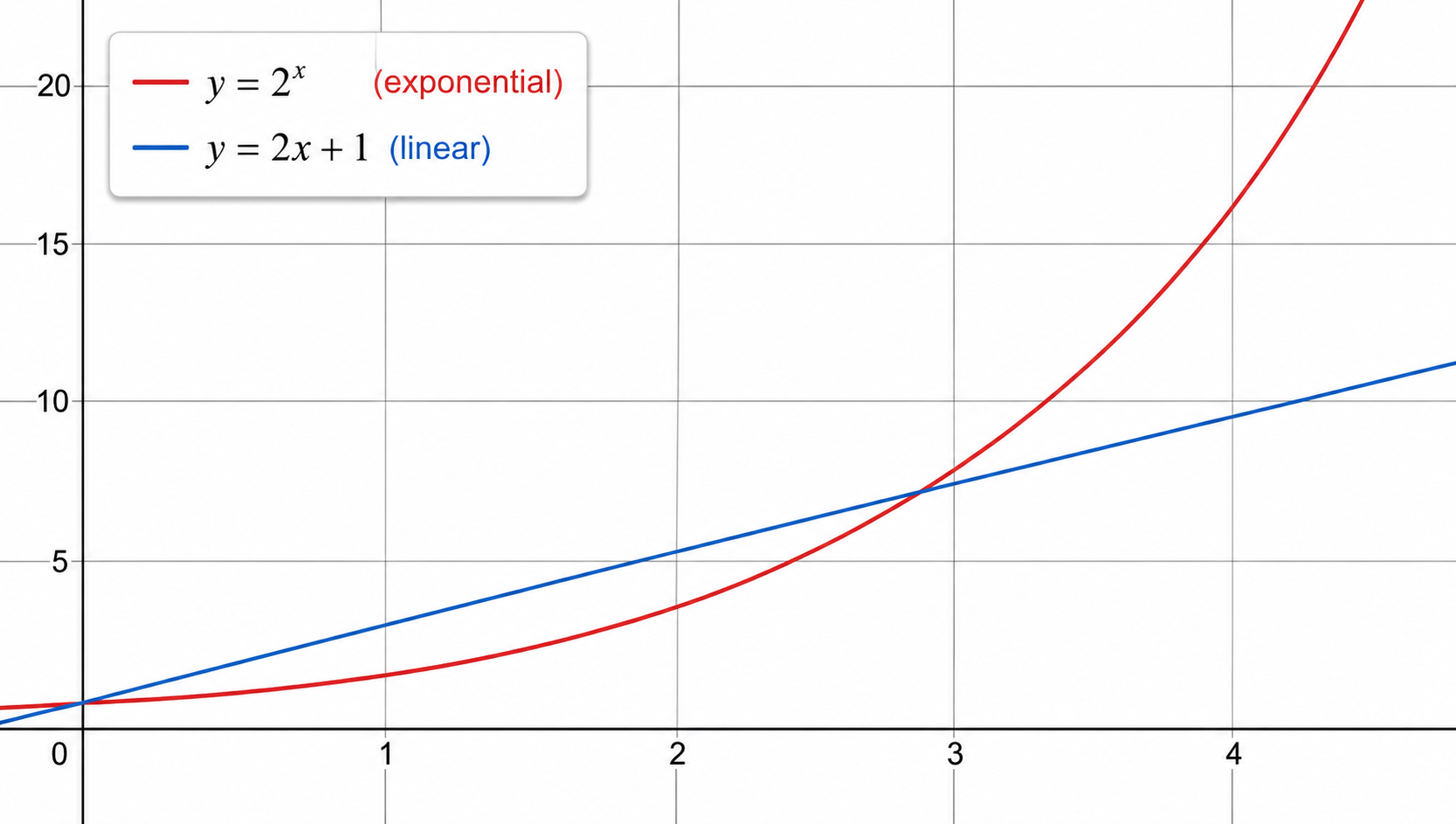
Exponent Rules
| Rule | Formula |
|---|---|
| Identity Rule | \(a^1=a\) |
| Product Rule | \(a^m \cdot a^n = a^{m+n}\) |
| Quotient Rule | \(\frac{a^m}{a^n}=a^{m-n}\) |
| Power Rule | \((a^m)^n=a^{mn}\) |
| Zero Exponent Rule | \(a^0=1,\; a\ne0\) |
| Power of a Product | \((ab)^n=a^n b^n\) |
| Power of a Quotient | \(\left(\frac{a}{b}\right)^n=\frac{a^n}{b^n}\) |
Exponent rules work only when the bases match.
\[ x^3 \cdot x^4 = x^7 \]
but
\[ x^3 \cdot y^4 \]
cannot be combined.
Common Problem Types
1. Product Rule
\[ x^3 \cdot x^5 = x^8 \]
2. Quotient Rule
\[ \frac{y^7}{y^2}=y^5 \]
3. Power Rule
\[ (2^3)^2=2^6=64 \]
4. Zero Exponent
\[ (5x)^0=1 \]
5. Power of a Product
\[ (3xy)^2=9x^2y^2 \]
6. Power of a Quotient
\[ \left(\frac{2x}{3}\right)^2=\frac{4x^2}{9} \]
Strategies
- Look for matching bases first.
- Add exponents when multiplying.
- Subtract exponents when dividing.
- Multiply exponents for powers of powers.
- Apply exponents to every factor inside parentheses.
Worked Examples
Example 1
Simplify:
\[ a^4 \cdot a^6 \]
Solution:
\[ a^{4+6}=a^{10} \]
Answer: \(a^{10}\)
Example 2
Simplify:
\[ \frac{x^9}{x^3} \]
Solution:
\[ x^{9-3}=x^6 \]
Answer: \(x^6\)
Example 3
Simplify:
\[ (5^2)^3 \]
Solution:
\[ 5^{2\cdot3}=5^6 \]
Answer: \(5^6\)
Example 4
Simplify:
\[ (2x)^3 \]
Solution:
\[ 2^3x^3=8x^3 \]
Answer: \(8x^3\)
- Adding exponents when dividing.
- Multiplying exponents when using the product rule.
- Forgetting to apply the exponent to every factor.
- Thinking \(a^0=0\) instead of \(1\).
- Combining exponents when bases are different.
Practice Problems
- \(x^5\cdot x^2\)
- \((3a)^2\)
- \(\frac{y^7}{y^4}\)
- \((t^3)^2\)
- ()^2
1.
\[ x^{5+2}=x^7 \]
2.
\[ (3a)^2=9a^2 \]
3.
\[ y^{7-4}=y^3 \]
4.
\[ t^{3\cdot2}=t^6 \]
5.
\[ \left(\frac{2x}{5}\right)^2=\frac{4x^2}{25} \]
Summary
- Product rule → add exponents.
- Quotient rule → subtract exponents.
- Power rule → multiply exponents.
- Zero exponent gives 1.
- Apply powers to every factor inside parentheses.
- Same base → combine exponents.
- Multiplication = add exponents.
- Division = subtract exponents.
- Parentheses matter.