Simplifying Linear Expressions
By the end of this lesson, you’ll be able to:
- Combine like terms in linear expressions.
- Use the distributive property to expand expressions.
- Rewrite expressions in equivalent simplified forms.
- Avoid common mistakes when combining variables and constants.
Key Ideas
To simplify a linear expression means to rewrite it in its cleanest, most organized form by:
- combining like terms
- applying the distributive property
- keeping negative signs under control
- organizing variable terms first, constants second
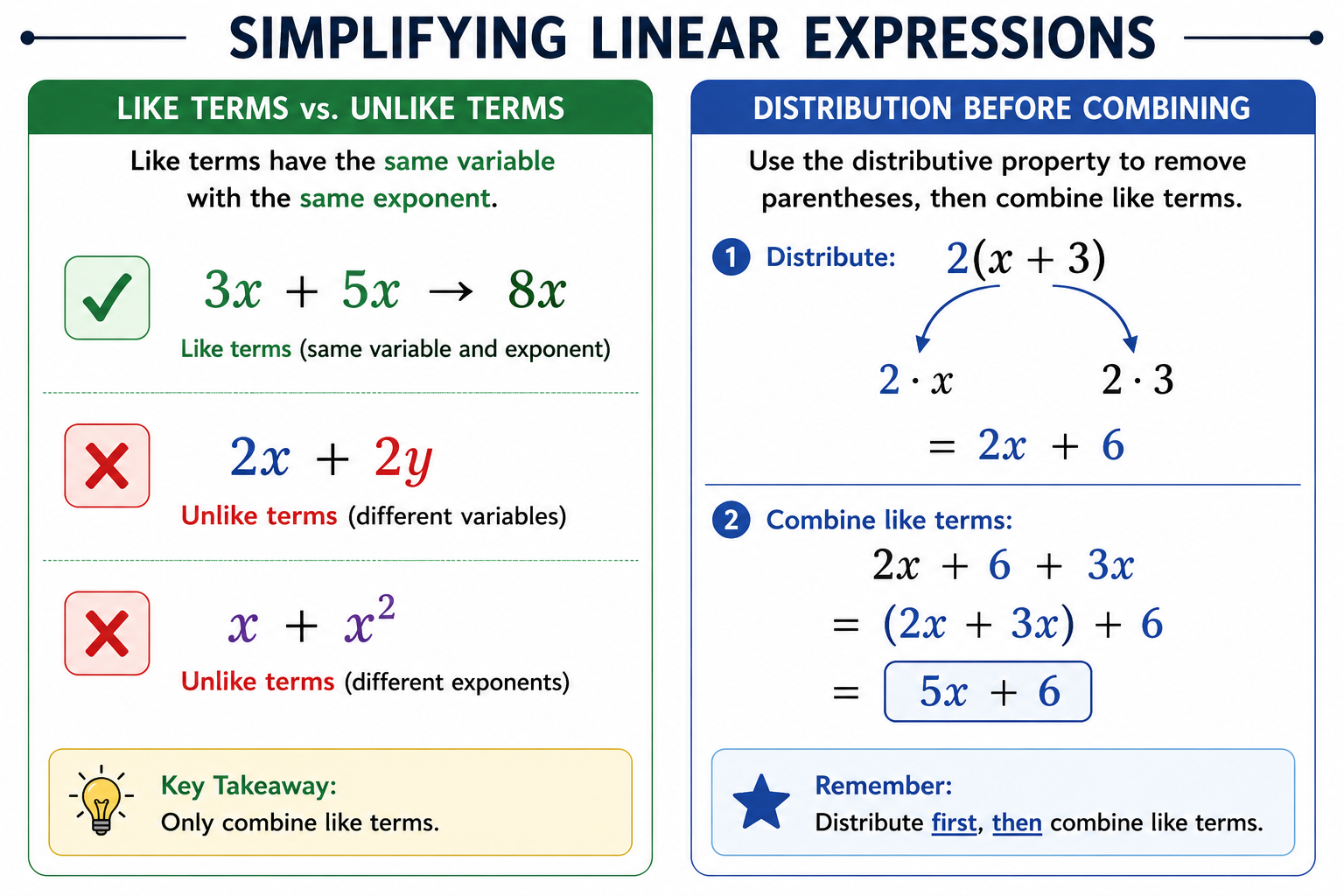
Like Terms
Like terms share the same variable with the same exponent.
- \(3x\) and \(-5x\) → like terms
- \(2y\) and \(2x\) → not like terms
- \(x\) and \(x^2\) → not like terms
Distributive Property
\[ a(b + c) = ab + ac \]
Standard Simplified Form
Write expressions as:
- variable term(s) first
- constant at the end
Example:
\[
5x - 3x + 7 = 2x + 7
\]
Common Problem Types
1. Combining Like Terms
Example:
\[
7x - 3x + 4 = 4x + 4
\]
2. Distributing Before Combining
Example:
\[
2(x + 5) + 3 = 2x + 10 + 3 = 2x + 13
\]
3. Negative Signs Outside Parentheses
Example:
\[
-(3x - 5) = -3x + 5
\]
4. Multiple Variable Types
Example:
\[
3x + 2y - x + y = 2x + 3y
\]
5. Removing Parentheses Carefully
Example:
\[
(x + 4) - (2x - 1) = x + 4 - 2x + 1 = -x + 5
\]
Strategies
- Circle or underline like terms before combining them.
- Distribute first, then simplify.
- Rewrite subtraction as adding a negative to avoid sign mistakes.
- Lay out expressions vertically if the structure gets confusing.
- Constantly track negative signs—this is where most errors occur.
Worked Examples
Example 1
Simplify:
\[
6x - 4 + 3x + 7
\]
Step-by-step Solution:
- Combine variable terms → \(6x + 3x = 9x\)
- Combine constants → \(-4 + 7 = 3\)
- Put together → \(9x + 3\)
Answer: \(9x + 3\)
Example 2
Simplify:
\[
5(2x - 1) - 3x
\]
Step-by-step Solution:
- Distribute the 5 → \(10x - 5\)
- Add the outside term → \(10x - 5 - 3x\)
- Combine like terms → \(7x - 5\)
Answer: \(7x - 5\)
Example 3
Simplify:
\[
-(4x + 6) + 2(x - 3)
\]
Step-by-step Solution:
- Distribute the negative → \(-4x - 6\)
- Distribute the 2 → \(2x - 6\)
- Combine like terms → \(-4x + 2x = -2x\)
- Combine constants → \(-6 - 6 = -12\)
Answer: \(-2x - 12\)
Example 4
Simplify:
\[
3(x - 2) + 4(2 - x)
\]
Step-by-step Solution:
- Expand both expressions → \(3x - 6 + 8 - 4x\)
- Combine variable terms → \(3x - 4x = -x\)
- Combine constants → \(-6 + 8 = 2\)
Answer: \(-x + 2\)
- Combining unlike terms, such as \(x\) with \(x^2\) or \(x\) with constants.
- Forgetting to distribute a negative sign across every term.
- Only partially distributing (e.g., \(3(x + 2) = 3x + 2\)).
- Changing signs incorrectly when removing parentheses.
- Leaving expressions partially simplified.
Practice Problems
- \(8x - 3 + 2x + 5\)
- \(4(3x - 1) + 2x\)
- \(-(x - 7) + 5\)
- \(5y + 3 - 2(4y - 1)\)
- \((2x - 3) - (x + 4)\)
1. \(8x - 3 + 2x + 5\)
Step 1: Combine \(8x + 2x = 10x\)
Step 2: Combine \(-3 + 5 = 2\)
Answer: \(10x + 2\)
2. \(4(3x - 1) + 2x\)
Step 1: Distribute → \(12x - 4\)
Step 2: Add → \(12x - 4 + 2x\)
Step 3: Combine → \(14x - 4\)
Answer: \(14x - 4\)
3. \(-(x - 7) + 5\)
Step 1: Distribute negative → \(-x + 7\)
Step 2: Add +5 → \(-x + 12\)
Answer: \(-x + 12\)
4. \(5y + 3 - 2(4y - 1)\)
Step 1: Distribute → \(-8y + 2\)
Step 2: Combine variables → \(5y - 8y = -3y\)
Step 3: Combine constants → \(3 + 2 = 5\)
Answer: \(-3y + 5\)
5. \((2x - 3) - (x + 4)\)
Step 1: Distribute subtraction → \(2x - 3 - x - 4\)
Step 2: Combine → \(x - 7\)
Answer: \(x - 7\)
Summary
- Combine like terms to simplify.
- Distribute before combining when parentheses are present.
- Track negative signs carefully—most errors happen there.
- Write final expressions with variables first, constants last.
- Combine like terms only when both the variable and exponent match.
- Distribute before combining to avoid overlooking terms.
- Rewrite subtraction as adding a negative to prevent sign mistakes.
- Arrange expressions so variable terms come first and constants last.