Sequences: Arithmetic & Geometric
By the end of this lesson, you’ll be able to:
- Identify whether a sequence is arithmetic or geometric.
- Use formulas for the nth term and for the common difference/ratio.
- Recognize how different types of sequences grow (linear vs exponential).
- Compute missing terms and apply sequence formulas confidently.
Key Ideas
A sequence is an ordered list of numbers that follow a rule.
In this lesson we focus on the two most common types:
- Arithmetic sequences (add/subtract the same amount each step)
- Geometric sequences (multiply/divide by the same amount each step)
Arithmetic Sequences
Arithmetic sequences change by adding the same value each time.
- That fixed value is the common difference, \(d\).
Example:
\[
5,\; 8,\; 11,\; 14,\; 17,\ldots \quad (d = 3)
\]
nth-term formula
If \(a_1\) is the first term:
\[ a_n = a_1 + (n-1)d \]
This represents linear growth.
Geometric Sequences
Geometric sequences change by multiplying by the same value each time.
- That multiplier is the common ratio, \(r\).
Example:
\[
2,\; 6,\; 18,\; 54,\ldots \quad (r = 3)
\]
nth-term formula
If \(a_1\) is the first term:
\[ a_n = a_1 \cdot r^{\,n-1} \]
This represents exponential growth.
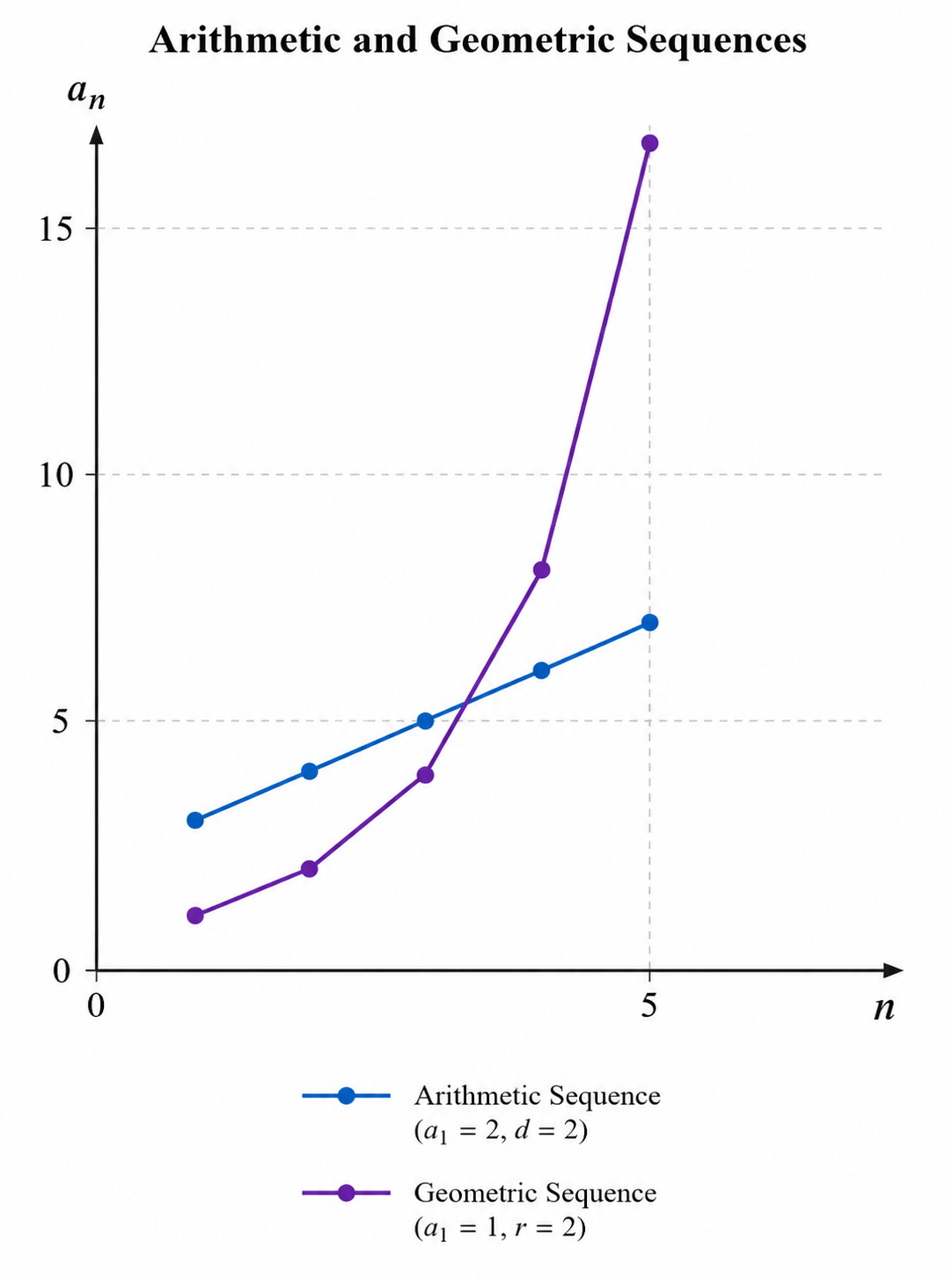
If the pattern changes by adding/subtracting, it’s arithmetic.
If it changes by multiplying/dividing, it’s geometric.
Common Problem Types
1. Finding the Next Terms
Example (Arithmetic):
Sequence: \(12,\; 7,\; 2,\ldots\)
\(d = -5\)
Next term: \(2 - 5 = -3\)
Example (Geometric):
Sequence: \(4,\; 10,\; 25,\ldots\)
\(r = \frac{10}{4} = 2.5\)
Next term: \(25 \cdot 2.5 = 62.5\)
2. Using the nth-Term Formula (Arithmetic)
Example:
Find \(a_{20}\) for \(a_1 = 7\) and \(d = 4\):
\[ a_{20} = 7 + (20-1)4 = 7 + 76 = 83 \]
3. Using the nth-Term Formula (Geometric)
Example:
Find \(a_6\) for \(a_1 = 3\) and \(r = 2\):
\[ a_6 = 3 \cdot 2^{5} = 96 \]
4. Identifying Type Using Differences or Ratios
- Constant differences → arithmetic
- Constant ratios → geometric
Example:
Sequence: \(9,\; 6,\; 4,\; \frac{8}{3},\ldots\)
Ratios:
\[ \frac{6}{9}=\frac{2}{3},\quad \frac{4}{6}=\frac{2}{3} \]
Constant ratio → geometric.
5. Finding a Missing Term
Example:
In an arithmetic sequence, \(a_1 = 10\) and \(a_4 = 4\). Find \(d\).
Use \(a_n = a_1 + (n-1)d\):
\[ 4 = 10 + 3d \] \[ 3d = -6 \] \[ d = -2 \]
Strategies
- Check differences first, then ratios.
- Arithmetic → steady, linear growth.
- Geometric → grows or shrinks rapidly.
- Use nth-term formulas for distant terms.
- Visualizing patterns often reveals the type quickly.
Worked Examples
Example 1 (Arithmetic)
Find the 12th term of \(4,\; 9,\; 14,\; 19,\ldots\)
\(d = 5\)
\[ a_{12} = 4 + 11 \cdot 5 = 59 \]
Answer: \(59\)
Example 2 (Geometric)
Find the 7th term of \(a_1 = 5\), \(r = \frac{1}{2}\).
\[ a_7 = 5 \cdot \left(\frac12\right)^6 = \frac{5}{64} \]
Answer: \(\frac{5}{64}\)
Example 3 (Identify Sequence Type)
Sequence: \(3,\; 6,\; 12,\; 24,\ldots\)
Ratios:
\[ 2,\; 2,\; 2 \]
Answer: Geometric, \(r = 2\)
- Calling a sequence arithmetic after only checking one pair of terms.
- Using differences for geometric sequences instead of ratios.
- Forgetting the exponent is \(n-1\) in the geometric nth-term formula.
- Mixing up the first term \(a_1\) with the term number \(n\).
- Assuming every growing sequence is arithmetic.
Practice Problems
- Identify the sequence type: \(7,\; 11,\; 15,\; 19,\ldots\)
- Identify the sequence type: \(100,\; 50,\; 25,\; 12.5,\ldots\)
- Arithmetic: \(a_1 = 2\), \(d = -3\). Find \(a_{10}\).
- Geometric: \(a_1 = 9\), \(r = \frac{1}{3}\). Find \(a_5\).
- In a geometric sequence, \(a_1 = 4\) and \(a_4 = 108\). Find \(r\).
1. Differences → \(+4\) each time → arithmetic
Answer: Arithmetic
2. Ratio → \(\frac12\) each time → geometric
Answer: Geometric, \(r=\frac12\)
3.
\[
a_{10} = 2 + 9(-3) = -25
\]
4.
\[
a_5 = 9 \left(\frac13\right)^4 = \frac19
\]
5.
Use \(a_4 = a_1 r^3\):
\[ 108 = 4r^3 \] \[ r^3 = 27 \] \[ r = 3 \]
Summary
- Arithmetic sequences add or subtract the same value each step.
- Geometric sequences multiply or divide by the same value each step.
- Use the nth-term formulas to reach terms far into the sequence.
- Checking differences and ratios quickly identifies the sequence type.
- Arithmetic → constant difference.
- Geometric → constant ratio.
- Visualizing the pattern often reveals the rule immediately.