Volume & Surface Area
By the end of this lesson, you’ll be able to:
- Compute the volume and surface area of common 3D solids.
- Match formulas to the appropriate solids.
- Distinguish between perpendicular height and slant height.
- Solve word problems involving capacity, filling, wrapping, and covering.
- Find volume and surface area of composite solids.
- Understand how scaling affects surface area and volume.
Key Ideas
Two important measurements describe three-dimensional solids:
- Volume measures the amount of space inside a solid.
- Surface area measures the total area covering the outside of a solid.
Because volume measures three-dimensional space, its units are cubic units:
\[ \text{cm}^3,\quad \text{m}^3,\quad \text{in}^3 \]
Surface area uses square units:
\[ \text{cm}^2,\quad \text{m}^2,\quad \text{in}^2 \]
Think about what the problem is asking for:
- How much can it hold? → volume
- How much space is inside? → volume
- How much material fills it? → volume
- How much wrapping paper is needed? → surface area
- How much paint covers it? → surface area
- How much material covers the outside? → surface area
Prisms
For any prism:
\[ \boxed{V=Bh} \]
where:
- \(B\) = area of one base
- \(h\) = perpendicular distance between the bases
For a rectangular prism:
\[ B=lw \]
so:
\[ \boxed{V=lwh} \]
The surface area of a rectangular prism is:
\[ \boxed{SA=2(lw+lh+wh)} \]
because there are three pairs of congruent rectangular faces.
Cylinders
A cylinder has circular bases, so:
\[ B=\pi r^2 \]
Therefore:
\[ \boxed{V=\pi r^2h} \]
The total surface area consists of:
- two circular bases
- one curved lateral surface
So:
\[ \boxed{SA=2\pi r^2+2\pi rh} \]
The term:
\[ 2\pi r^2 \]
represents the two circular bases.
The term:
\[ 2\pi rh \]
represents the curved lateral surface.
Pyramids
A pyramid has volume:
\[ \boxed{V=\frac13Bh} \]
where:
- \(B\) = area of the base
- \(h\) = perpendicular height from the base to the apex
A pyramid with the same base and perpendicular height as a prism has exactly one-third the volume of that prism.
For surface area:
\[ SA=\text{base area}+\text{areas of the triangular faces} \]
For a regular pyramid, this is often written:
\[ \boxed{SA=B+\frac12P\ell} \]
where:
- \(B\) = base area
- \(P\) = perimeter of the base
- \(\ell\) = slant height
Cones
A cone has a circular base, so:
\[ B=\pi r^2 \]
Its volume is:
\[ \boxed{ V=\frac13\pi r^2h } \]
Its total surface area is:
\[ \boxed{ SA=\pi r^2+\pi r\ell } \]
where:
- \(r\) = radius
- \(h\) = perpendicular height
- \(\ell\) = slant height
For a cone:
Volume uses the perpendicular height \(h\):
\[ V=\frac13\pi r^2h \]
Surface area uses the slant height \(\ell\):
\[ SA=\pi r^2+\pi r\ell \]
Do not substitute the slant height into the volume formula.
Spheres
For a sphere with radius \(r\):
Volume:
\[ \boxed{ V=\frac43\pi r^3 } \]
Surface area:
\[ \boxed{ SA=4\pi r^2 } \]
A sphere has no bases, edges, or vertices.
Formula Summary
| Shape | Volume | Surface Area |
|---|---|---|
| Rectangular Prism | \(lwh\) | \(2(lw+lh+wh)\) |
| General Prism | \(Bh\) | Sum of all faces |
| Cylinder | \(\pi r^2h\) | \(2\pi r^2+2\pi rh\) |
| Pyramid | \(\frac13Bh\) | \(B+\frac12P\ell\) for a regular pyramid |
| Cone | \(\frac13\pi r^2h\) | \(\pi r^2+\pi r\ell\) |
| Sphere | \(\frac43\pi r^3\) | \(4\pi r^2\) |
Scaling
Suppose every linear dimension of a solid is multiplied by a scale factor \(k\).
Lengths multiply by:
\[ k \]
Surface areas multiply by:
\[ \boxed{k^2} \]
Volumes multiply by:
\[ \boxed{k^3} \]
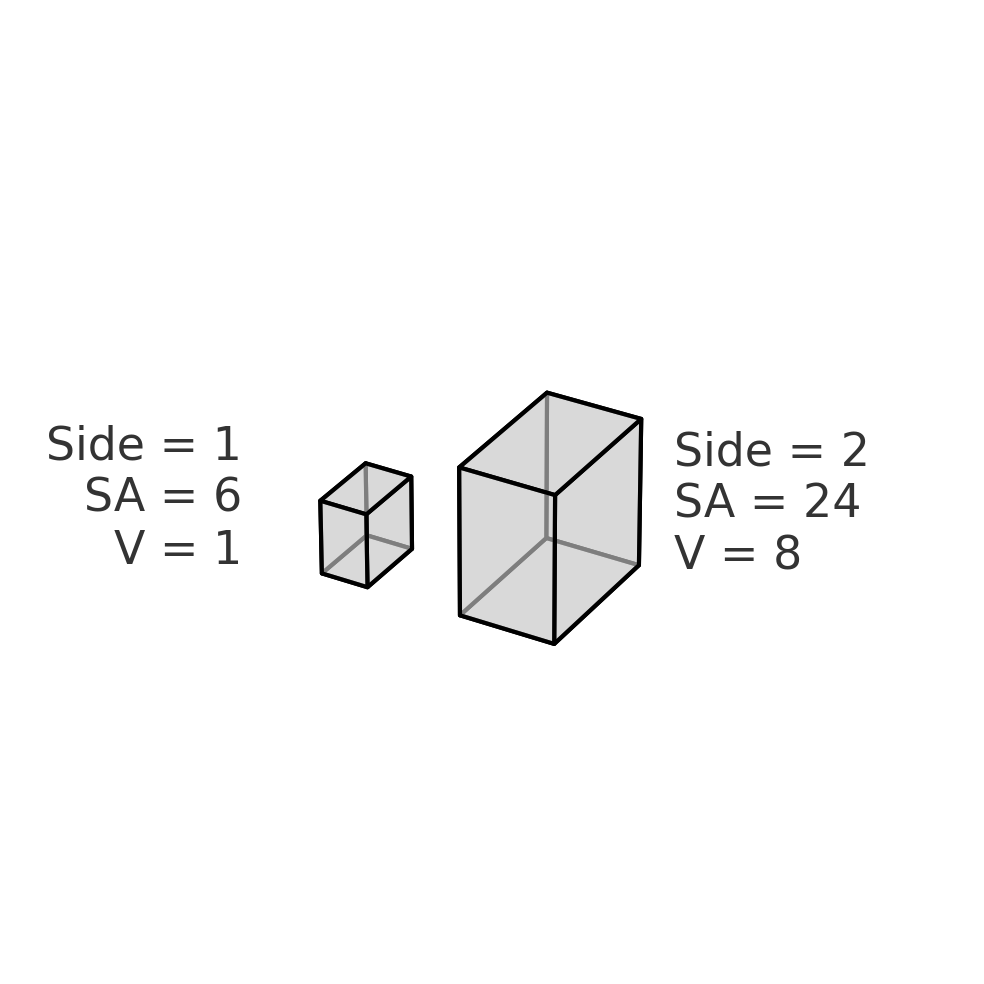
For example, if every dimension doubles:
\[ k=2 \]
Surface area is multiplied by:
\[ 2^2=4 \]
Volume is multiplied by:
\[ 2^3=8 \]
So doubling every dimension does not merely double the surface area or volume.
Common Problem Types
1. Computing Volume Directly
Identify the solid and choose its volume formula.
For a cylinder with:
\[ r=3,\qquad h=10 \]
use:
\[ V=\pi r^2h \]
Substitute:
\[ V=\pi(3)^2(10) \]
\[ V=90\pi \]
Therefore:
\[ \boxed{V=90\pi} \]
cubic units.
2. Computing Surface Area
Surface area includes all exposed outer surfaces.
For a rectangular prism with dimensions:
\[ l=3,\qquad w=4,\qquad h=5 \]
use:
\[ SA=2(lw+lh+wh) \]
Substitute:
\[ SA=2(3\cdot4+3\cdot5+4\cdot5) \]
\[ SA=2(12+15+20) \]
\[ SA=94 \]
Therefore:
\[ \boxed{SA=94} \]
square units.
3. Capacity and Filling Problems
Words such as:
- capacity
- holds
- contains
- fills
- space inside
usually indicate volume.
For example, if a rectangular container measures:
\[ 8\text{ in}\times5\text{ in}\times4\text{ in} \]
then its capacity is:
\[ V=8(5)(4) \]
\[ \boxed{160\text{ in}^3} \]
4. Covering and Wrapping Problems
Words such as:
- paint
- cover
- wrap
- label
- outside
usually indicate surface area.
However, determine which surfaces are actually being covered.
For example, an open-top box does not include the area of a top face.
5. Composite Solids
A composite solid is made from two or more simpler solids.
For volume:
- Break the figure into known solids.
- Find the volume of each piece.
- Add or subtract as needed.
For example, a cylinder topped with a hemisphere has:
\[ V_{\text{total}} = V_{\text{cylinder}} + V_{\text{hemisphere}} \]
Since a hemisphere is half a sphere:
\[ V_{\text{hemisphere}} = \frac12\left(\frac43\pi r^3\right) \]
\[ = \frac23\pi r^3 \]
6. Surface Area of Composite Solids
Surface area requires extra care.
When two solids are joined together, the surfaces where they touch are inside the composite solid and are not exposed.
Therefore, do not count those hidden surfaces in the exterior surface area.
For volume, adding the volumes of joined pieces usually works directly.
For surface area, count only the surfaces visible from the outside.
7. Scaling Questions
If every dimension is multiplied by \(k\):
\[ \text{Surface area factor}=k^2 \]
\[ \text{Volume factor}=k^3 \]
For example, if every dimension triples:
\[ k=3 \]
then:
\[ SA\rightarrow9SA \]
and:
\[ V\rightarrow27V \]
8. Nets and Surface Area
A net unfolds a solid into its individual surfaces.
This can make surface area easier to calculate because each surface becomes a familiar 2D shape.
For example, a rectangular prism’s net contains six rectangles.
Find the area of each face and add them together.
Strategies
- Decide first: volume or surface area?
- Identify the type of solid before choosing a formula.
- Identify the base area \(B\) when working with prisms, cylinders, pyramids, or cones.
- Label all dimensions before substituting into a formula.
- Check whether a given measurement is a radius or diameter.
- For pyramids and cones, distinguish between perpendicular height \(h\) and slant height \(\ell\).
- For composite solids, calculate each piece separately.
- For composite surface area, exclude hidden surfaces where pieces touch.
- Make sure all measurements use the same units before calculating.
- Keep answers in terms of \(\pi\) unless a decimal approximation is requested.
- Always include appropriate square or cubic units.
Worked Examples
Example 1 — Volume of a Cylinder
A cylinder has:
\[ r=4,\qquad h=12 \]
Use:
\[ V=\pi r^2h \]
Substitute:
\[ V=\pi(4)^2(12) \]
Square the radius:
\[ V=\pi(16)(12) \]
Multiply:
\[ V=192\pi \]
Therefore:
\[ \boxed{V=192\pi} \]
cubic units.
Example 2 — Surface Area of a Rectangular Prism
A rectangular prism has dimensions:
\[ 3\times4\times5 \]
Use:
\[ SA=2(lw+lh+wh) \]
Substitute:
\[ SA=2(3\cdot4+3\cdot5+4\cdot5) \]
Calculate each face area:
\[ SA=2(12+15+20) \]
\[ SA=2(47) \]
\[ SA=94 \]
Therefore:
\[ \boxed{SA=94} \]
square units.
Example 3 — Volume of a Cone
A cone has radius 3 and perpendicular height 8.
Use:
\[ V=\frac13\pi r^2h \]
Substitute:
\[ V=\frac13\pi(3)^2(8) \]
\[ V=\frac13\pi(9)(8) \]
\[ V=\frac{72}{3}\pi \]
\[ V=24\pi \]
Therefore:
\[ \boxed{V=24\pi} \]
cubic units.
Example 4 — Composite Solid
A cylinder with radius 2 and height 6 is topped with a hemisphere of radius 2.
For the cylinder:
\[ V_{\text{cylinder}}=\pi r^2h \]
\[ V_{\text{cylinder}}=\pi(2)^2(6) \]
\[ V_{\text{cylinder}}=24\pi \]
For the hemisphere:
\[ V_{\text{hemisphere}} = \frac12\left(\frac43\pi r^3\right) \]
Substitute:
\[ V_{\text{hemisphere}} = \frac23\pi(2)^3 \]
\[ V_{\text{hemisphere}} = \frac{16}{3}\pi \]
Add the volumes:
\[ V_{\text{total}} = 24\pi+\frac{16}{3}\pi \]
Write \(24\pi\) with denominator 3:
\[ V_{\text{total}} = \frac{72}{3}\pi+\frac{16}{3}\pi \]
\[ V_{\text{total}} = \frac{88}{3}\pi \]
Therefore:
\[ \boxed{ V=\frac{88}{3}\pi } \]
cubic units.
Example 5 — Scaling
A solid is enlarged so that every dimension becomes 3 times as long.
The scale factor is:
\[ k=3 \]
Surface area changes by:
\[ k^2=3^2=9 \]
So:
\[ \boxed{\text{surface area is multiplied by }9} \]
Volume changes by:
\[ k^3=3^3=27 \]
So:
\[ \boxed{\text{volume is multiplied by }27} \]
- Mixing up surface area and volume.
- Giving square units for volume or cubic units for surface area.
- Forgetting the \(\frac13\) factor for pyramids and cones.
- Using the diameter as the radius.
- Forgetting one or both circular bases when finding the total surface area of a cylinder.
- Confusing perpendicular height \(h\) with slant height \(\ell\).
- Using slant height in a cone’s volume formula.
- Counting hidden surfaces in the surface area of composite solids.
- Forgetting that a hemisphere is half of a sphere.
- Adding dimensions instead of calculating areas or volumes.
- Multiplying volume by \(k^2\) instead of \(k^3\) when a solid is scaled.
Practice Problems
- Find the volume of a rectangular prism with dimensions:
\[ 4\times5\times6 \]
- Find the volume of a cone with:
\[ r=3,\qquad h=9 \]
- Find the total surface area of a cylinder with:
\[ r=2,\qquad h=10 \]
A sphere has radius 3. Find its volume.
A cube has side length 4. Find its surface area.
If every edge of a cube is doubled, by what factors do its surface area and volume change?
1. For a rectangular prism:
\[ V=lwh \]
Substitute:
\[ V=4(5)(6) \]
\[ V=120 \]
Therefore:
\[ \boxed{V=120} \]
cubic units.
2. For a cone:
\[ V=\frac13\pi r^2h \]
Substitute:
\[ V=\frac13\pi(3)^2(9) \]
\[ V=\frac13\pi(9)(9) \]
\[ V=27\pi \]
Therefore:
\[ \boxed{V=27\pi} \]
cubic units.
3. For a cylinder:
\[ SA=2\pi r^2+2\pi rh \]
Substitute:
\[ SA=2\pi(2)^2+2\pi(2)(10) \]
Calculate each part:
\[ SA=8\pi+40\pi \]
\[ SA=48\pi \]
Therefore:
\[ \boxed{SA=48\pi} \]
square units.
4. For a sphere:
\[ V=\frac43\pi r^3 \]
Substitute:
\[ V=\frac43\pi(3)^3 \]
\[ V=\frac43\pi(27) \]
\[ V=36\pi \]
Therefore:
\[ \boxed{V=36\pi} \]
cubic units.
5. A cube has 6 congruent square faces.
Each face has area:
\[ 4^2=16 \]
So:
\[ SA=6(16) \]
\[ SA=96 \]
Therefore:
\[ \boxed{SA=96} \]
square units.
6. Doubling every edge gives a scale factor of:
\[ k=2 \]
Surface area changes by:
\[ k^2=2^2=4 \]
Volume changes by:
\[ k^3=2^3=8 \]
Therefore:
\[ \boxed{\text{Surface area }\times4} \]
and:
\[ \boxed{\text{Volume }\times8} \]
Summary
- Volume measures the space inside a solid and uses cubic units.
- Surface area measures the outside covering and uses square units.
- Prisms and cylinders follow the volume pattern:
\[ V=Bh \]
- Pyramids and cones follow:
\[ V=\frac13Bh \]
- For a sphere:
\[ V=\frac43\pi r^3 \]
and:
\[ SA=4\pi r^2 \]
- Cone volume uses perpendicular height \(h\), while cone surface area uses slant height \(\ell\).
- Composite volumes can be added or subtracted by pieces.
- Composite surface area includes only exposed surfaces.
- If linear dimensions scale by \(k\):
\[ SA\rightarrow k^2SA \]
\[ V\rightarrow k^3V \]
- Inside/capacity → volume.
- Cover/wrap/paint → surface area.
- Surface area → square units.
- Volume → cubic units.
- Prism/cylinder → \(Bh\).
- Pyramid/cone → \(\frac13Bh\).
- Check radius vs. diameter.
- Check height vs. slant height.
- Keep \(\pi\) unless a decimal is requested.
- Composite surface area → don’t count hidden surfaces.