Hyperbolas
By the end of this lesson, you’ll be able to:
- Identify the center, vertices, transverse axis, asymptotes, and foci of a hyperbola.
- Write and interpret hyperbolas in standard form.
- Determine whether a hyperbola opens horizontally or vertically.
- Find asymptote equations from standard form.
- Convert hyperbola equations from general form to standard form.
- Connect algebraic parameters to geometric features.
Key Ideas
A hyperbola is the set of all points for which the difference of the distances to two fixed points, called the foci, is constant.
A hyperbola has two separate branches.
The direction in which the branches open is determined by the transverse axis.
Standard Form — Horizontal Hyperbola
If the hyperbola opens left and right:
\[ \frac{(x-h)^2}{a^2} - \frac{(y-k)^2}{b^2} = 1 \]
The center is:
\[ (h,k) \]
The vertices are:
\[ (h\pm a,k) \]
The foci are:
\[ (h\pm c,k) \]
Standard Form — Vertical Hyperbola
If the hyperbola opens up and down:
\[ \frac{(y-k)^2}{a^2} - \frac{(x-h)^2}{b^2} = 1 \]
The center is:
\[ (h,k) \]
The vertices are:
\[ (h,k\pm a) \]
The foci are:
\[ (h,k\pm c) \]
Understanding \(a\), \(b\), and \(c\)
The value \(a\) gives the distance from the center to each vertex.
The value \(b\) helps determine the slopes of the asymptotes.
The focal distance \(c\) is found using:
\[ c^2=a^2+b^2 \]
This differs from the ellipse relationship:
\[ c^2=a^2-b^2 \]
For a hyperbola:
\[ c>a \]
so the foci lie farther from the center than the vertices.
Asymptotes
The branches of a hyperbola approach two diagonal lines called asymptotes.
For a horizontal hyperbola:
\[ y-k=\pm\frac{b}{a}(x-h) \]
For a vertical hyperbola:
\[ y-k=\pm\frac{a}{b}(x-h) \]
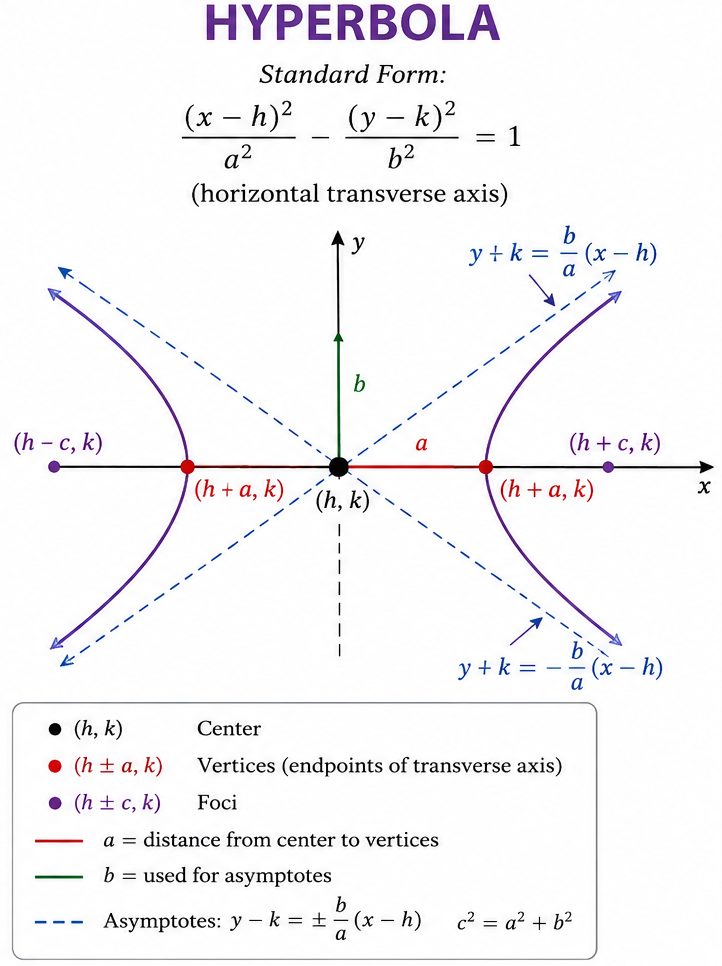
Look at which squared term is positive.
- Positive \(x\)-term → horizontal opening
- Positive \(y\)-term → vertical opening
Common Problem Types
1. Identifying the Center and Orientation
Compare the equation to standard form and read the center from \((x-h)^2\) and \((y-k)^2\).
The positive squared term determines the orientation:
- positive \(x\)-term → opens left and right
- positive \(y\)-term → opens up and down
2. Finding the Vertices
Find \(a\) from \(a^2\), then move \(a\) units from the center along the transverse axis.
For a horizontal hyperbola, move left and right.
For a vertical hyperbola, move up and down.
3. Finding the Foci
Use the hyperbola relationship:
\[ c^2=a^2+b^2 \]
The foci lie \(c\) units from the center along the transverse axis.
4. Finding the Asymptotes
For a horizontal hyperbola:
\[ \frac{(x-h)^2}{a^2} - \frac{(y-k)^2}{b^2} = 1 \]
the asymptotes are:
\[ y-k=\pm\frac{b}{a}(x-h) \]
For a vertical hyperbola, switch the slope ratio:
\[ y-k=\pm\frac{a}{b}(x-h) \]
5. Graphing From Standard Form
To graph a hyperbola:
- Find the center.
- Determine whether it opens horizontally or vertically.
- Find \(a\) and locate the vertices.
- Use \(a\) and \(b\) to sketch a guide rectangle centered at \((h,k)\).
- Draw the asymptotes through opposite corners of the rectangle.
- Sketch the two branches through the vertices, approaching the asymptotes.
For a horizontal hyperbola, the guide rectangle extends:
- \(a\) units left and right
- \(b\) units up and down
For a vertical hyperbola, it extends:
- \(b\) units left and right
- \(a\) units up and down
6. Writing an Equation From Features
Use the center, orientation, \(a\), and \(b\) to choose the correct form.
For a vertical hyperbola, the positive term is the \(y\)-term:
\[ \frac{(y-k)^2}{a^2} - \frac{(x-h)^2}{b^2} = 1 \]
7. Converting General Form to Standard Form
To convert it:
- Group the \(x\)-terms and \(y\)-terms.
- Factor out coefficients.
- Complete the square.
- Move constants and simplify.
- Divide so the right side becomes 1.
Be especially careful with negative coefficients when completing the square.
Strategies
- Look for a minus sign between the squared terms.
- The positive term determines the opening direction.
- Positive \(x\)-term → horizontal opening.
- Positive \(y\)-term → vertical opening.
- Find the center before anything else.
- Use \(a\) to locate the vertices.
- Use:
\[ c^2=a^2+b^2 \]
to find the foci. - Sketch the asymptotes before drawing the branches. - Keep the ellipse and hyperbola focal formulas separate:
\[ \text{Ellipse: }c^2=a^2-b^2 \]
\[ \text{Hyperbola: }c^2=a^2+b^2 \]
- When converting from general form: group → factor → complete the square → divide.
Worked Examples
Example 1 — Identify Key Features
Find the center, orientation, vertices, and foci of:
\[ \frac{(x-1)^2}{16} - \frac{(y+2)^2}{9} = 1 \]
The center is:
\[ \boxed{(1,-2)} \]
The positive term is the \(x\)-term, so the hyperbola opens:
\[ \boxed{\text{horizontally}} \]
We have:
\[ a^2=16 \Rightarrow a=4 \]
and:
\[ b^2=9 \Rightarrow b=3 \]
The vertices are 4 units left and right of the center:
\[ (1\pm4,-2) \]
Therefore:
\[ \boxed{(-3,-2)\text{ and }(5,-2)} \]
Now find \(c\):
\[ c^2=a^2+b^2 \]
\[ c^2=16+9 \]
\[ c^2=25 \]
\[ c=5 \]
The foci are:
\[ (1\pm5,-2) \]
Therefore:
\[ \boxed{(-4,-2)\text{ and }(6,-2)} \]
Example 2 — Find the Asymptotes
Find the asymptotes of:
\[ \frac{(x-1)^2}{16} - \frac{(y+2)^2}{9} = 1 \]
This is a horizontal hyperbola, so use:
\[ y-k=\pm\frac{b}{a}(x-h) \]
The center is:
\[ (h,k)=(1,-2) \]
and:
\[ a=4,\qquad b=3 \]
Substitute:
\[ y+2=\pm\frac34(x-1) \]
Therefore:
\[ \boxed{ y+2=\frac34(x-1) } \]
and:
\[ \boxed{ y+2=-\frac34(x-1) } \]
Example 3 — Write the Equation
A hyperbola has:
- center \((0,0)\)
- vertical transverse axis
- \(a=3\)
- \(b=5\)
A vertical hyperbola has standard form:
\[ \frac{y^2}{a^2} - \frac{x^2}{b^2} = 1 \]
Substitute:
\[ a^2=9 \]
and:
\[ b^2=25 \]
Therefore:
\[ \boxed{ \frac{y^2}{9} - \frac{x^2}{25} = 1 } \]
Example 4 — Convert to Standard Form
Convert:
\[ 4x^2-9y^2-16x-54y-101=0 \]
to standard form.
Move the constant:
\[ 4x^2-16x-9y^2-54y=101 \]
Group and factor:
\[ 4(x^2-4x)-9(y^2+6y)=101 \]
Complete the square.
For the \(x\)-terms:
\[ x^2-4x=(x-2)^2-4 \]
For the \(y\)-terms:
\[ y^2+6y=(y+3)^2-9 \]
Substitute:
\[ 4[(x-2)^2-4] - 9[(y+3)^2-9] = 101 \]
Distribute:
\[ 4(x-2)^2-16 - 9(y+3)^2+81 = 101 \]
Combine the constants:
\[ 4(x-2)^2 - 9(y+3)^2 = 36 \]
Divide by 36:
\[ \boxed{ \frac{(x-2)^2}{9} - \frac{(y+3)^2}{4} = 1 } \]
The center is:
\[ \boxed{(2,-3)} \]
and the positive \(x\)-term shows that the hyperbola opens:
\[ \boxed{\text{horizontally}} \]
Example 5 — Find an Equation From the Foci
A horizontal hyperbola has center \((0,0)\) and foci:
\[ (\pm13,0) \]
The vertices are 5 units from the center, so:
\[ a=5 \]
The foci tell us:
\[ c=13 \]
Use:
\[ c^2=a^2+b^2 \]
Substitute:
\[ 13^2=5^2+b^2 \]
\[ 169=25+b^2 \]
Subtract 25:
\[ b^2=144 \]
Because the hyperbola is horizontal:
\[ \boxed{ \frac{x^2}{25} - \frac{y^2}{144} = 1 } \]
- Forgetting that the squared terms in a hyperbola have opposite signs.
- Assuming the larger denominator determines orientation. For hyperbolas, the positive term determines orientation.
- Using the ellipse formula:
\[ c^2=a^2-b^2 \]
instead of:
\[ c^2=a^2+b^2 \]
- Putting the vertices along the wrong axis.
- Putting the foci along the wrong axis.
- Mixing up the horizontal and vertical asymptote formulas.
- Forgetting that asymptotes pass through the center.
- Losing negative signs while completing the square.
- Forgetting to divide the entire equation so the right side equals 1.
Practice Problems
- Find the center, orientation, vertices, and foci of:
\[ \frac{(x+2)^2}{25} - \frac{(y-1)^2}{16} = 1 \]
Write the equation of a hyperbola with center \((3,-4)\), vertical transverse axis, \(a=2\), and \(b=6\).
Convert the hyperbola:
\[ 9x^2-4y^2-54x-16y+29=0 \]
to standard form. Then identify its center and orientation.
- Identify whether the hyperbola opens horizontally or vertically:
\[ \frac{(y+1)^2}{36} - \frac{(x-5)^2}{9} = 1 \]
A horizontal hyperbola has center \((0,0)\) and foci at \((\pm13,0)\). If \(a=5\), find the equation.
Find the asymptotes of:
\[ \frac{(x-2)^2}{9} - \frac{(y+1)^2}{4} = 1 \]
1. Start with:
\[ \frac{(x+2)^2}{25} - \frac{(y-1)^2}{16} = 1 \]
The center is:
\[ \boxed{(-2,1)} \]
The positive term is the \(x\)-term, so the hyperbola opens:
\[ \boxed{\text{horizontally}} \]
We have:
\[ a^2=25 \Rightarrow a=5 \]
and:
\[ b^2=16 \Rightarrow b=4 \]
The vertices are 5 units left and right of the center:
\[ (-2\pm5,1) \]
Therefore:
\[ \boxed{(-7,1)\text{ and }(3,1)} \]
Now find \(c\):
\[ c^2=a^2+b^2 \]
\[ c^2=25+16 \]
\[ c^2=41 \]
\[ c=\sqrt{41} \]
The foci are:
\[ (-2\pm\sqrt{41},1) \]
Therefore:
\[ \boxed{ (-2-\sqrt{41},1) \text{ and } (-2+\sqrt{41},1) } \]
2. A vertical hyperbola has standard form:
\[ \frac{(y-k)^2}{a^2} - \frac{(x-h)^2}{b^2} = 1 \]
Substitute:
\[ h=3,\qquad k=-4,\qquad a=2,\qquad b=6 \]
\[ \frac{(y+4)^2}{4} - \frac{(x-3)^2}{36} = 1 \]
Therefore:
\[ \boxed{ \frac{(y+4)^2}{4} - \frac{(x-3)^2}{36} = 1 } \]
3. Start with:
\[ 9x^2-4y^2-54x-16y+29=0 \]
Move the constant:
\[ 9x^2-54x-4y^2-16y=-29 \]
Group and factor:
\[ 9(x^2-6x)-4(y^2+4y)=-29 \]
Complete the square.
For the \(x\)-terms:
\[ x^2-6x=(x-3)^2-9 \]
For the \(y\)-terms:
\[ y^2+4y=(y+2)^2-4 \]
Substitute:
\[ 9[(x-3)^2-9] - 4[(y+2)^2-4] = -29 \]
Distribute:
\[ 9(x-3)^2-81 - 4(y+2)^2+16 = -29 \]
Combine constants:
\[ 9(x-3)^2 - 4(y+2)^2 = 36 \]
Divide by 36:
\[ \boxed{ \frac{(x-3)^2}{4} - \frac{(y+2)^2}{9} = 1 } \]
The center is:
\[ \boxed{(3,-2)} \]
The positive term is the \(x\)-term, so the hyperbola opens:
\[ \boxed{\text{horizontally}} \]
4. The positive term is:
\[ \frac{(y+1)^2}{36} \]
Therefore, the hyperbola opens:
\[ \boxed{\text{vertically}} \]
5. The foci are:
\[ (\pm13,0) \]
so:
\[ c=13 \]
We are given:
\[ a=5 \]
so:
\[ a^2=25 \]
Use:
\[ c^2=a^2+b^2 \]
Substitute:
\[ 169=25+b^2 \]
Subtract 25:
\[ b^2=144 \]
Because the hyperbola is horizontal:
\[ \boxed{ \frac{x^2}{25} - \frac{y^2}{144} = 1 } \]
6. The hyperbola is:
\[ \frac{(x-2)^2}{9} - \frac{(y+1)^2}{4} = 1 \]
The positive term is the \(x\)-term, so the hyperbola is horizontal.
Use:
\[ y-k=\pm\frac{b}{a}(x-h) \]
From the equation:
\[ h=2,\qquad k=-1 \]
and:
\[ a=3,\qquad b=2 \]
Substitute:
\[ y+1=\pm\frac23(x-2) \]
Therefore, the asymptotes are:
\[ \boxed{ y+1=\frac23(x-2) } \]
and:
\[ \boxed{ y+1=-\frac23(x-2) } \]
Summary
- A hyperbola has two separate branches.
- Hyperbola equations contain a difference of squared terms.
- The positive term determines the opening direction.
- Positive \(x\)-term → horizontal opening.
- Positive \(y\)-term → vertical opening.
- \(a\) gives the distance from the center to each vertex.
- The foci lie along the transverse axis.
- Find the focal distance using:
\[ c^2=a^2+b^2 \]
- Horizontal asymptotes:
\[ y-k=\pm\frac{b}{a}(x-h) \]
- Vertical asymptotes:
\[ y-k=\pm\frac{a}{b}(x-h) \]
- To graph: find the center → vertices → guide rectangle → asymptotes → branches.
- To convert from general form:
group → factor → complete the square → divide
- Hyperbola → subtraction
- Positive \(x\)-term → horizontal
- Positive \(y\)-term → vertical
- Vertices move \(a\) units along the opening direction.
- Foci move \(c\) units along the same axis.
- Hyperbola:
\[ c^2=a^2+b^2 \]
- Sketch asymptotes before drawing the branches.