Operations with Complex Numbers
By the end of this lesson, you’ll be able to:
- Add, subtract, and multiply complex numbers.
- Divide complex numbers using conjugates.
- Simplify expressions involving \(i\) and \(i^2 = -1\).
- Rewrite any complex expression in the form \(a + bi\).
Key Ideas
A complex number has the form: \[ a + bi \] where \(a\) and \(b\) are real numbers.
- Real part = \(a\)
- Imaginary part = \(b\)
Imaginary unit identity: \[ i^2 = -1 \]
Visualizing Complex Numbers
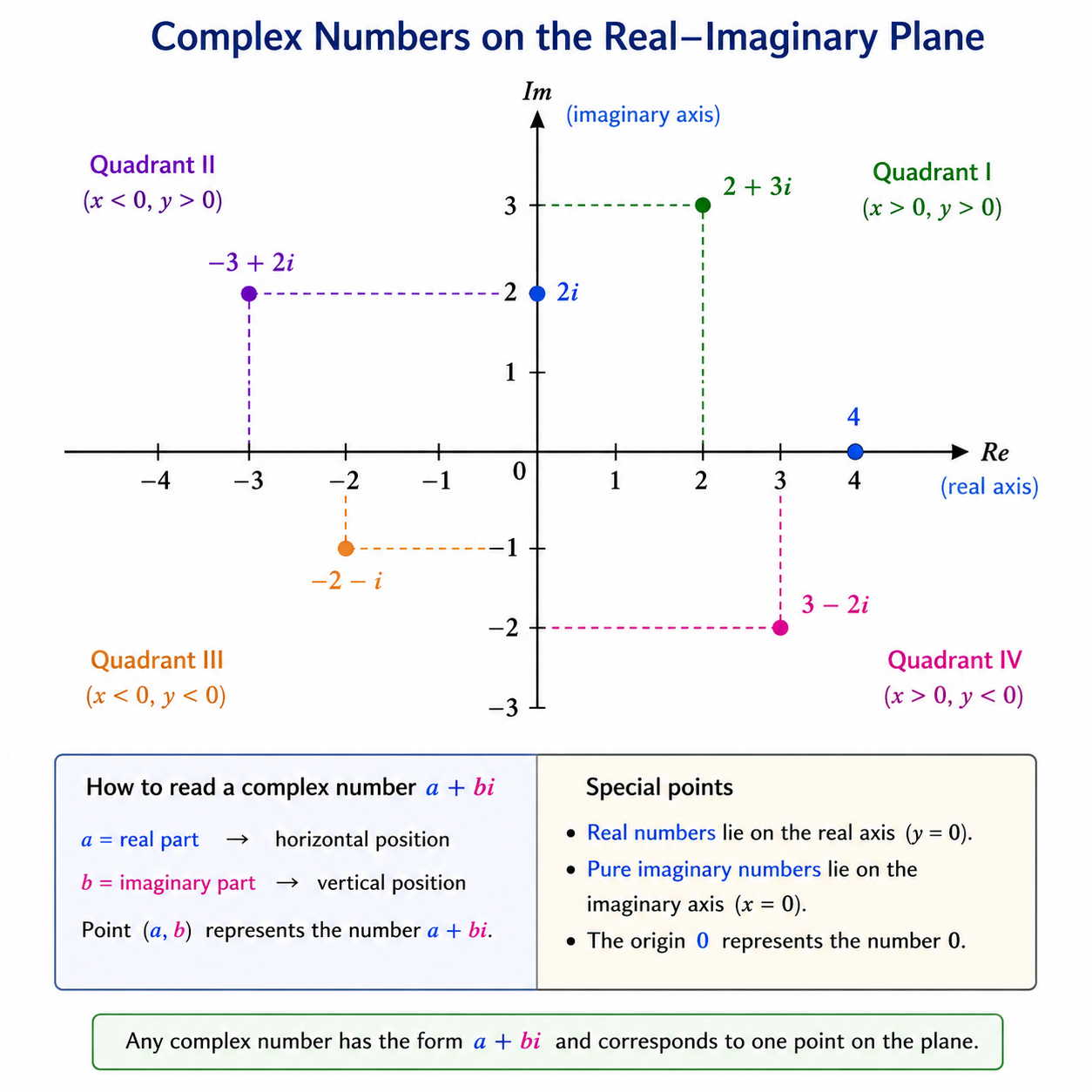
Complex numbers can be represented on the complex plane.
- Horizontal axis = Real part
- Vertical axis = Imaginary part
The complex number
\[ 3 + 2i \]
is represented by the point \((3,2)\).
Complex Conjugate
For \(a + bi\), the conjugate is: \[ a - bi \]
Useful for division: \[ \frac{a+bi}{c+di} \cdot \frac{c-di}{c-di} \]
Common Problem Types
Adding & Subtracting
Combine like terms (real with real, imaginary with imaginary).
Example:
\((3 + 5i) + (2 - 7i) = 5 - 2i\)
Multiplying Complex Numbers
Use distributive property or FOIL; replace \(i^2\) with \(-1\).
Example:
\((4 + i)(3 - 2i)\)
Real: \(4 \cdot 3 = 12\)
Outer: \(4 \cdot (-2i) = -8i\)
Inner: \(i \cdot 3 = 3i\)
Last: \(i \cdot (-2i) = -2i^2 = 2\)
Total: \(14 - 5i\)
Dividing Complex Numbers
Multiply top and bottom by the conjugate of the denominator.
Example:
\[
\frac{5 + i}{2 - 3i} \cdot \frac{2 + 3i}{2 + 3i}
\]
Simplifying Using \(i^2 = -1\)
Replace \(i^2\) immediately.
Example:
\(6 - 4i + i^2 = 6 - 4i - 1 = 5 - 4i\)
Converting to Rectangular Form (\(a+bi\))
Even complicated expressions can be rewritten this way.
Example:
\(\frac{8}{1 - i}\) → multiply by \((1 + i)\).
Strategies
- Treat \(i\) like a variable, but replace \(i^2\) with \(-1\).
- Combine real parts and imaginary parts separately.
- For division: conjugate, multiply, simplify, separate real/imag parts.
- Always write your final answer in \(a + bi\) form.
Worked Examples
Example 1 — Add & Subtract
Compute: \[ (7 - 3i) - (2 + 5i) \]
Real: \(7 - 2 = 5\)
Imaginary: \(-3i - 5i = -8i\)
Final: \[
5 - 8i
\]
Example 2 — Multiply
Compute: \[ (3 + 2i)(4 - i) \]
FOIL:
\(3 \cdot 4 = 12\)
\(3 \cdot (-i) = -3i\)
\(2i \cdot 4 = 8i\)
\(2i \cdot (-i) = -2i^2 = 2\)
Add: \[ 14 + 5i \]
Example 3 — Divide
Compute: \[ \frac{6 - i}{3 + 2i} \]
Multiply by the conjugate: \[ \frac{(6 - i)(3 - 2i)}{(3 + 2i)(3 - 2i)} \]
Denominator: \[ 3^2 - (2i)^2 = 9 - (-4) = 13 \]
Numerator: \(6 \cdot 3 = 18\)
\(6 \cdot (-2i) = -12i\)
\(-i \cdot 3 = -3i\)
\(-i \cdot (-2i) = 2i^2 = -2\)
Combine: \[ (18 - 2) + (-12i - 3i) = 16 - 15i \]
Final: \[ \frac{16}{13} - \frac{15}{13}i \]
- Forgetting \(i^2 = -1\).
- Not multiplying by the conjugate when dividing.
- Mixing real and imaginary parts incorrectly.
- Leaving final answers not in \(a + bi\) form.
- Dropping negative signs in multiplication.
Practice Problems
- \((4 + 7i) + (3 - 2i)\)
- \((5 - i)(2 - 3i)\)
- \(\frac{7 + 4i}{1 - 2i}\)
- Simplify: \(9 + 6i - 3i^2\)
- Put in \(a+bi\) form: \(\frac{10}{3 + i}\)
1. \(7 + 5i\)
2.
\((5 - i)(2 - 3i)\)
\(= 10 -15i -2i + 3i^2\)
\(= 10 -17i -3\)
\(= 7 - 17i\)
3.
Multiply by conjugate \((1 + 2i)\):
\[
\frac{(7+4i)(1+2i)}{1^2 - (2i)^2}
\]
Denominator: \(1 - (-4) = 5\)
Numerator: \(7 + 14i + 4i + 8i^2 = 7 + 18i - 8\)
So: \(-1 + 18i\)
Final:
\[
-\frac{1}{5} + \frac{18}{5}i
\]
4.
\(9 + 6i - 3i^2 = 9 + 6i + 3 = 12 + 6i\)
5.
Multiply by conjugate \((3 - i)\):
\[
\frac{10(3 - i)}{3^2 - i^2} = \frac{30 - 10i}{9 + 1}
\]
Final:
\[
3 - i
\]
Summary
- Add/subtract by combining like parts.
- Multiply using FOIL; replace \(i^2\) with \(-1\).
- Divide by multiplying by the conjugate.
- Always express answers in \(a + bi\).
- Real with real, imaginary with imaginary.
- Conjugate for division every time.
- \(i^2\) is your shortcut to simplify.
- Keep track of negative signs!