Angle Relationships
TipLearning Objectives
- Identify and use vertical, adjacent, complementary, and supplementary angles.
- Write and solve equations based on angle relationships.
- Understand how linear pairs and vertical angles help solve diagrams.
Key Ideas
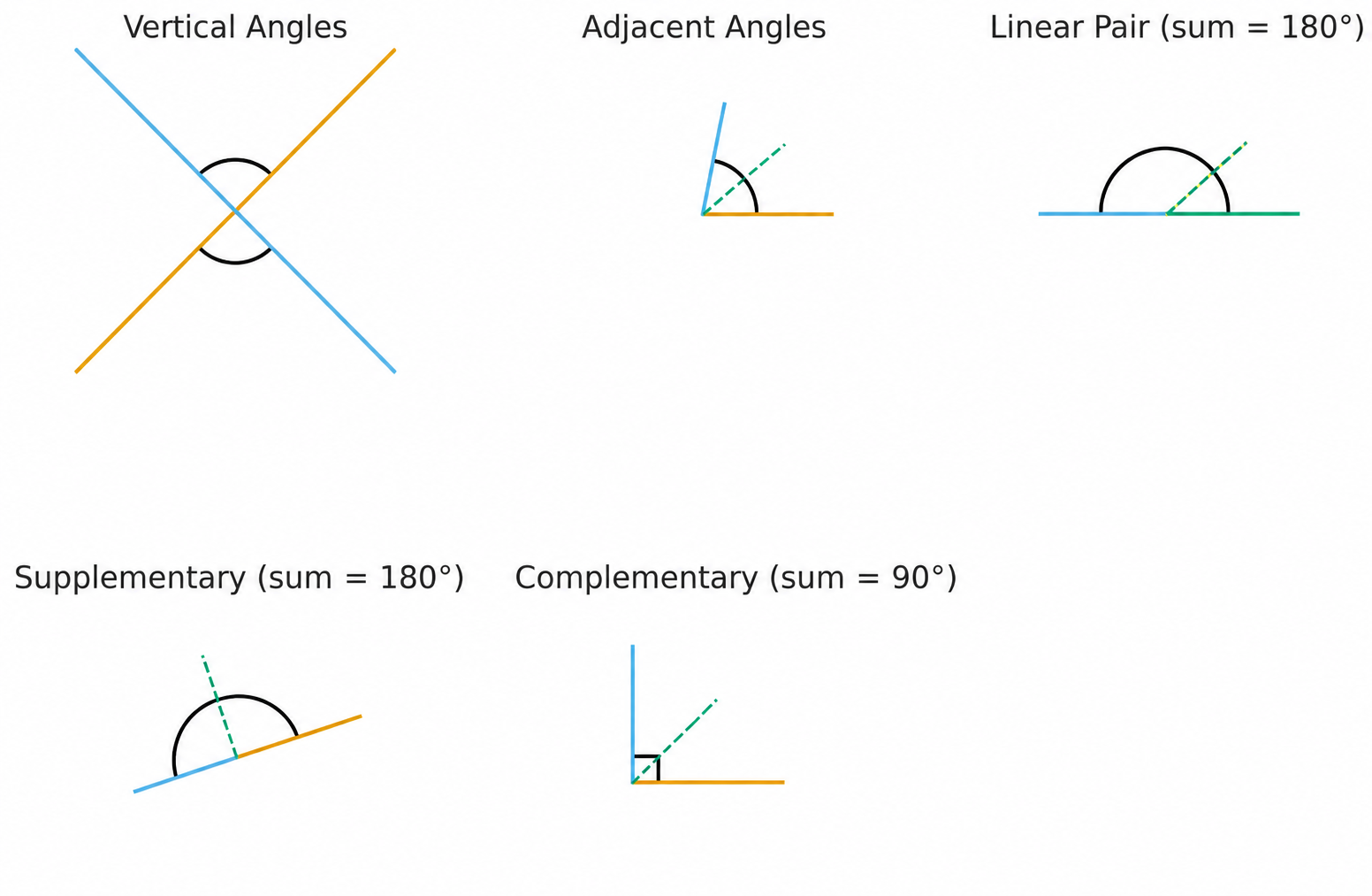
Important angle relationships:
- Vertical Angles: opposite angles formed by intersecting lines → equal
- Adjacent Angles: share a vertex and side
- Linear Pair: adjacent angles forming a straight line → sum to 180°
- Supplementary: sum to 180°
- Complementary: sum to 90°
Common Problem Types
Vertical Angle Equations
Vertical angles are equal.
Example:
If ∠1 = 3x + 10 and ∠2 = x + 30 → set equal.
Linear Pairs
Sum to 180°.
Example:
If ∠A = 120°, ∠B = 60°.
Complementary Angle Problems
Sum to 90°.
Adjacent Angle Sums
Shared vertex → add/subtract if given total.
Summary Table of Angle Relationships
| Relationship | Rule |
|---|---|
| Vertical | Equal |
| Linear Pair | Sum to 180° |
| Supplementary | Sum to 180° |
| Complementary | Sum to 90° |
| Adjacent | Share a side & vertex |
Strategies
- Look for intersecting lines → vertical & linear pairs.
- Use equations when angles are algebraic.
- Always identify whether the angle sum is 90° or 180°.
Worked Examples
Example 1 — Vertical
∠1 = 2x + 10
∠2 = 40
Vertical → 2x + 10 = 40 → x = 15.
Example 2 — Linear Pair
Angles on a line:
If ∠A = 4x and ∠B = 2x + 30:
\[ 4x + (2x+30) = 180 \]
WarningCommon Mistakes
- Confusing vertical with adjacent angles.
- Forgetting that linear pairs must form a straight line.
- Using the wrong sum (90° vs 180°).
- Solving equations without checking if the geometry fits.
Practice Problems
- Vertical angles: ∠1 = 50°. Find ∠2.
- Linear pair: angles are 5x and x + 30. Solve for x.
- Complementary: ∠A = 20°, find ∠B.
- If ∠B = 3x and ∠C = 180 - ∠B, what type of angles are B and C?
TipStep-by-Step Solutions
- 50°
- \(5x + x + 30 = 180 → x = 25\)
- 70°
- Supplementary
Summary
- Vertical angles are equal.
- Linear pairs, supplementary = 180°.
- Complementary = 90°.
- Adjacent angles share a vertex and side.
TipQuick Tips
- Opposite = vertical.
- On a line = linear pair.
- Look for right angles when complementary.