Circles in the Coordinate Plane
By the end of this lesson, you’ll be able to:
- Identify the center and radius of a circle from its equation.
- Write and interpret the standard equation of a circle.
- Determine whether a point lies inside, on, or outside a circle.
- Convert a circle equation from expanded form to standard form by completing the square.
- Connect circle equations to their graphs in the coordinate plane.
Key Ideas
Standard Form of a Circle
A circle with center \((h,k)\) and radius \(r\) has equation:
\[ \boxed{ (x-h)^2+(y-k)^2=r^2 } \]
where:
- \((h,k)\) = center
- \(r\) = radius
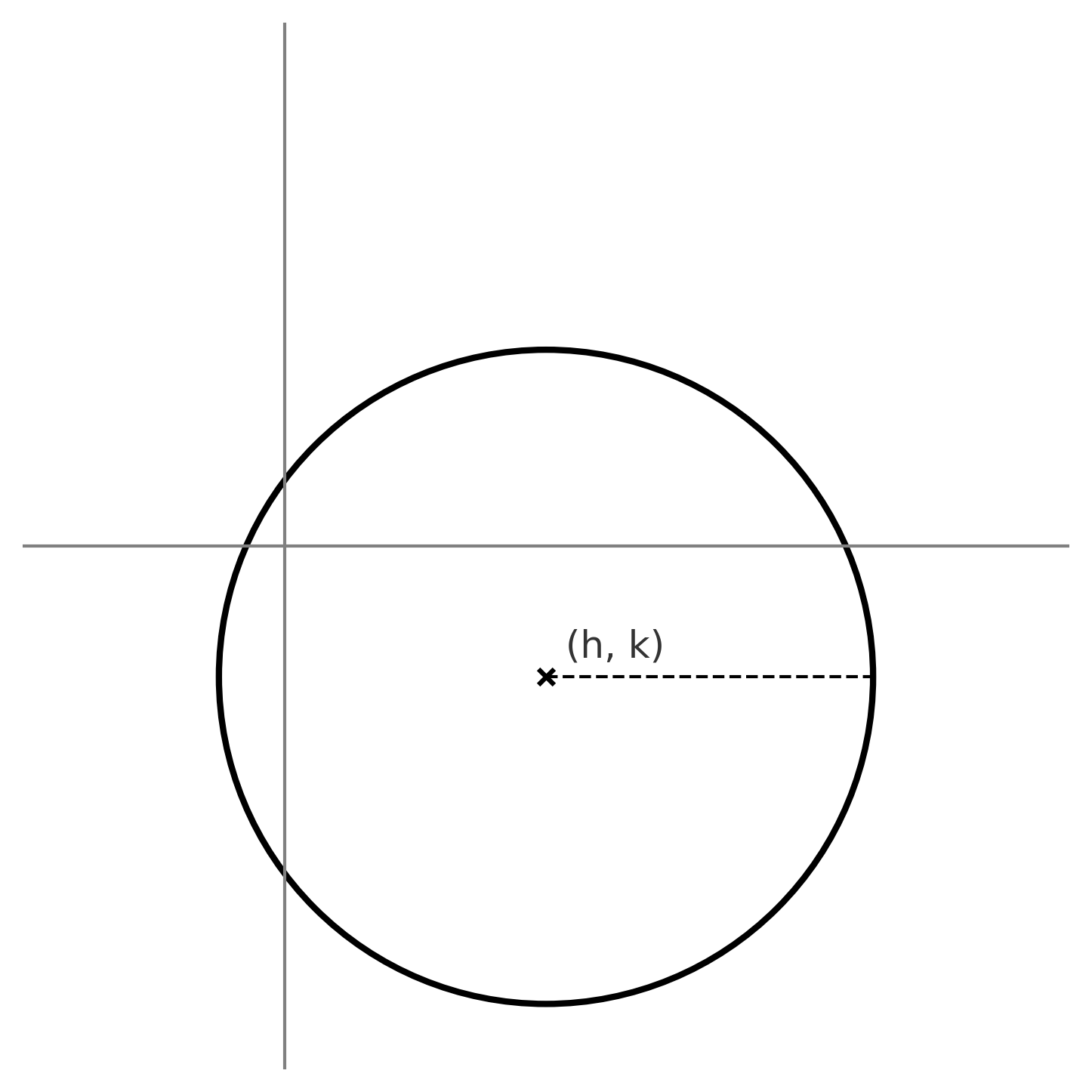
For example:
\[ (x-3)^2+(y+2)^2=25 \]
can be written as:
\[ (x-3)^2+(y-(-2))^2=5^2 \]
So the center is:
\[ \boxed{(3,-2)} \]
and the radius is:
\[ \boxed{5} \]
The standard form contains:
\[ (x-h)^2+(y-k)^2 \]
so the signs inside the parentheses appear opposite the coordinates of the center.
For example:
\[ (x+4)^2=(x-(-4))^2 \]
so the \(x\)-coordinate of the center is \(-4\).
Why This Equation Represents a Circle
The circle equation comes from the distance formula.
Any point \((x,y)\) on a circle is exactly \(r\) units from its center \((h,k)\).
Using the distance formula:
\[ \sqrt{(x-h)^2+(y-k)^2}=r \]
Square both sides:
\[ (x-h)^2+(y-k)^2=r^2 \]
So the standard equation simply says:
Every point \((x,y)\) on the circle is exactly \(r\) units from the center \((h,k)\).
Expanded Form
A circle equation may also appear in expanded form, such as:
\[ x^2+y^2-4x+6y+9=0 \]
The center and radius are not immediately visible.
To reveal them, convert the equation to standard form by completing the square for both \(x\) and \(y\).
Common Problem Types
1. Identifying the Center and Radius
Compare the equation with:
\[ (x-h)^2+(y-k)^2=r^2 \]
Remember that the number on the right is \(r^2\), not \(r\).
2. Writing an Equation From a Center and Radius
If the center and radius are given, substitute them directly into:
\[ (x-h)^2+(y-k)^2=r^2 \]
3. Determining Whether a Point Is on a Circle
Substitute the coordinates of the point into the circle equation.
If the result equals \(r^2\), the point lies on the circle.
4. Determining Whether a Point Is Inside or Outside
Substitution can also tell us whether a point lies inside or outside the circle.
For:
\[ (x-h)^2+(y-k)^2=r^2 \]
calculate:
\[ (x-h)^2+(y-k)^2 \]
for the given point.
Then compare it with \(r^2\):
\[ \begin{aligned} \text{less than }r^2 &\rightarrow \text{inside} \\ \text{equal to }r^2 &\rightarrow \text{on the circle} \\ \text{greater than }r^2 &\rightarrow \text{outside} \end{aligned} \]
This works because the left side represents the squared distance from the center.
5. Converting Expanded Form to Standard Form
To convert an expanded equation to standard form, complete the square.
First group the \(x\)-terms and \(y\)-terms.
For each group:
- Take half the coefficient of the linear term.
- Square it.
- Add that value to both sides.
Once the equation is factored into standard form, the center and radius are visible.
Strategies
- Compare the equation with:
\[ (x-h)^2+(y-k)^2=r^2 \]
- Remember that the signs inside the parentheses are opposite the coordinates of the center.
- The number on the right is \(r^2\), so take its square root to find \(r\).
- To write an equation, substitute the center and radius directly into standard form.
- To test a point, substitute its coordinates for \(x\) and \(y\).
- For expanded equations, move the constant first and group the \(x\)-terms and \(y\)-terms.
- When completing the square, take half the linear coefficient and square it.
- Whatever you add to one side of an equation must also be added to the other side.
Worked Examples
Example 1 — Find the Center and Radius
Find the center and radius of:
\[ (x-3)^2+(y+2)^2=49 \]
Compare with:
\[ (x-h)^2+(y-k)^2=r^2 \]
From:
\[ (x-3)^2 \]
we get:
\[ h=3 \]
From:
\[ (y+2)^2=(y-(-2))^2 \]
we get:
\[ k=-2 \]
Therefore, the center is:
\[ \boxed{(3,-2)} \]
The right side is:
\[ r^2=49 \]
Take the square root:
\[ r=7 \]
Therefore:
\[ \boxed{r=7} \]
Example 2 — Write the Equation of a Circle
A circle has center \((-2,4)\) and radius 5.
Write its equation in standard form.
Start with:
\[ (x-h)^2+(y-k)^2=r^2 \]
Substitute:
\[ h=-2,\qquad k=4,\qquad r=5 \]
\[ (x-(-2))^2+(y-4)^2=5^2 \]
Simplify:
\[ \boxed{ (x+2)^2+(y-4)^2=25 } \]
Example 3 — Convert to Standard Form
Convert:
\[ x^2+y^2-4x+6y+9=0 \]
to standard form.
Move the constant:
\[ x^2+y^2-4x+6y=-9 \]
Group the variables:
\[ (x^2-4x)+(y^2+6y)=-9 \]
Complete the square for the \(x\)-terms.
Half of \(-4\) is:
\[ -2 \]
Square it:
\[ (-2)^2=4 \]
Complete the square for the \(y\)-terms.
Half of 6 is:
\[ 3 \]
Square it:
\[ 3^2=9 \]
Add 4 and 9 to both sides:
\[ (x^2-4x+4)+(y^2+6y+9) = -9+4+9 \]
Factor:
\[ (x-2)^2+(y+3)^2=4 \]
Therefore:
\[ \boxed{ (x-2)^2+(y+3)^2=4 } \]
The center is:
\[ \boxed{(2,-3)} \]
and the radius is:
\[ \boxed{2} \]
Example 4 — Test a Point
Does the point \((4,6)\) lie on the circle:
\[ (x-1)^2+(y-2)^2=25 \]
Substitute:
\[ x=4,\qquad y=6 \]
\[ (4-1)^2+(6-2)^2 \]
\[ 3^2+4^2 \]
\[ 9+16=25 \]
The result equals \(r^2\):
\[ 25=25 \]
Therefore:
\[ \boxed{(4,6)\text{ lies on the circle}} \]
- Reading the signs of the center incorrectly.
- Saying the center of \((x+3)^2+(y-2)^2=r^2\) is \((3,-2)\) instead of \((-3,2)\).
- Using \(r^2\) as the radius instead of taking the square root.
- Forgetting to add completing-square values to both sides of the equation.
- Completing the square using the full linear coefficient instead of half of it.
- Mixing the \(x\)-terms and \(y\)-terms when completing the square.
- Assuming a point lies on a circle without substituting or checking its distance from the center.
Practice Problems
- Find the center and radius of:
\[ (x+1)^2+(y-5)^2=64 \]
Write the equation of a circle with center \((3,-2)\) and radius 4.
Convert to standard form:
\[ x^2+y^2+8x-4y-5=0 \]
Then identify the center and radius.
- Does the point \((6,6)\) lie on the circle:
\[ (x-2)^2+(y-3)^2=25 \]
- Is the point \((3,2)\) inside, on, or outside the circle:
\[ (x-3)^2+(y-2)^2=16 \]
1. Compare:
\[ (x+1)^2+(y-5)^2=64 \]
with:
\[ (x-h)^2+(y-k)^2=r^2 \]
Since:
\[ x+1=x-(-1) \]
the \(x\)-coordinate of the center is:
\[ -1 \]
The \(y\)-coordinate is:
\[ 5 \]
So the center is:
\[ \boxed{(-1,5)} \]
The radius satisfies:
\[ r^2=64 \]
so:
\[ r=8 \]
Therefore:
\[ \boxed{r=8} \]
2. Use:
\[ (x-h)^2+(y-k)^2=r^2 \]
Substitute:
\[ h=3,\qquad k=-2,\qquad r=4 \]
\[ (x-3)^2+(y-(-2))^2=4^2 \]
Simplify:
\[ \boxed{ (x-3)^2+(y+2)^2=16 } \]
3. Start with:
\[ x^2+y^2+8x-4y-5=0 \]
Move the constant:
\[ x^2+y^2+8x-4y=5 \]
Group the terms:
\[ (x^2+8x)+(y^2-4y)=5 \]
For the \(x\)-terms, half of 8 is 4:
\[ 4^2=16 \]
For the \(y\)-terms, half of \(-4\) is \(-2\):
\[ (-2)^2=4 \]
Add both values to both sides:
\[ (x^2+8x+16)+(y^2-4y+4) = 5+16+4 \]
Factor:
\[ (x+4)^2+(y-2)^2=25 \]
Therefore:
\[ \boxed{ (x+4)^2+(y-2)^2=25 } \]
The center is:
\[ \boxed{(-4,2)} \]
and the radius is:
\[ \boxed{5} \]
4. Substitute \((6,6)\) into:
\[ (x-2)^2+(y-3)^2=25 \]
\[ (6-2)^2+(6-3)^2 \]
\[ 4^2+3^2 \]
\[ 16+9=25 \]
Since the result equals \(25\):
\[ \boxed{(6,6)\text{ lies on the circle}} \]
5. The circle is:
\[ (x-3)^2+(y-2)^2=16 \]
Substitute \((3,2)\):
\[ (3-3)^2+(2-2)^2 \]
\[ 0^2+0^2=0 \]
Compare this with:
\[ r^2=16 \]
Since:
\[ 0<16 \]
the point lies inside the circle.
In fact, \((3,2)\) is the center.
Therefore:
\[ \boxed{\text{inside the circle}} \]
Summary
- The standard form of a circle is:
\[ (x-h)^2+(y-k)^2=r^2 \]
- The center is:
\[ (h,k) \]
- The radius is:
\[ r=\sqrt{r^2} \]
- The signs inside the parentheses appear opposite the coordinates of the center.
- Complete the square to convert expanded equations to standard form.
- Substitute a point into the equation to determine its position relative to the circle.
- Comparing the squared distance with \(r^2\) tells you:
\[ \begin{aligned} <r^2 &\rightarrow \text{inside} \\ =r^2 &\rightarrow \text{on} \\ >r^2 &\rightarrow \text{outside} \end{aligned} \]
- \((x-3)^2\) → center \(x\)-coordinate is \(3\).
- \((x+3)^2\) → center \(x\)-coordinate is \(-3\).
- The right side is radius squared, not the radius.
- Completing the square? → half the coefficient, then square it.
- Testing a point? → substitute and compare with \(r^2\).