Function Symmetry: Even & Odd Functions
By the end of this lesson, you’ll be able to:
- Determine whether a function is even, odd, or neither.
- Use algebraic tests involving \(f(-x)\).
- Recognize symmetry visually from graphs.
- Understand how symmetry shows up in standardized test questions.
Key Ideas
Some functions have special symmetry that makes them easier to analyze.
Even Functions
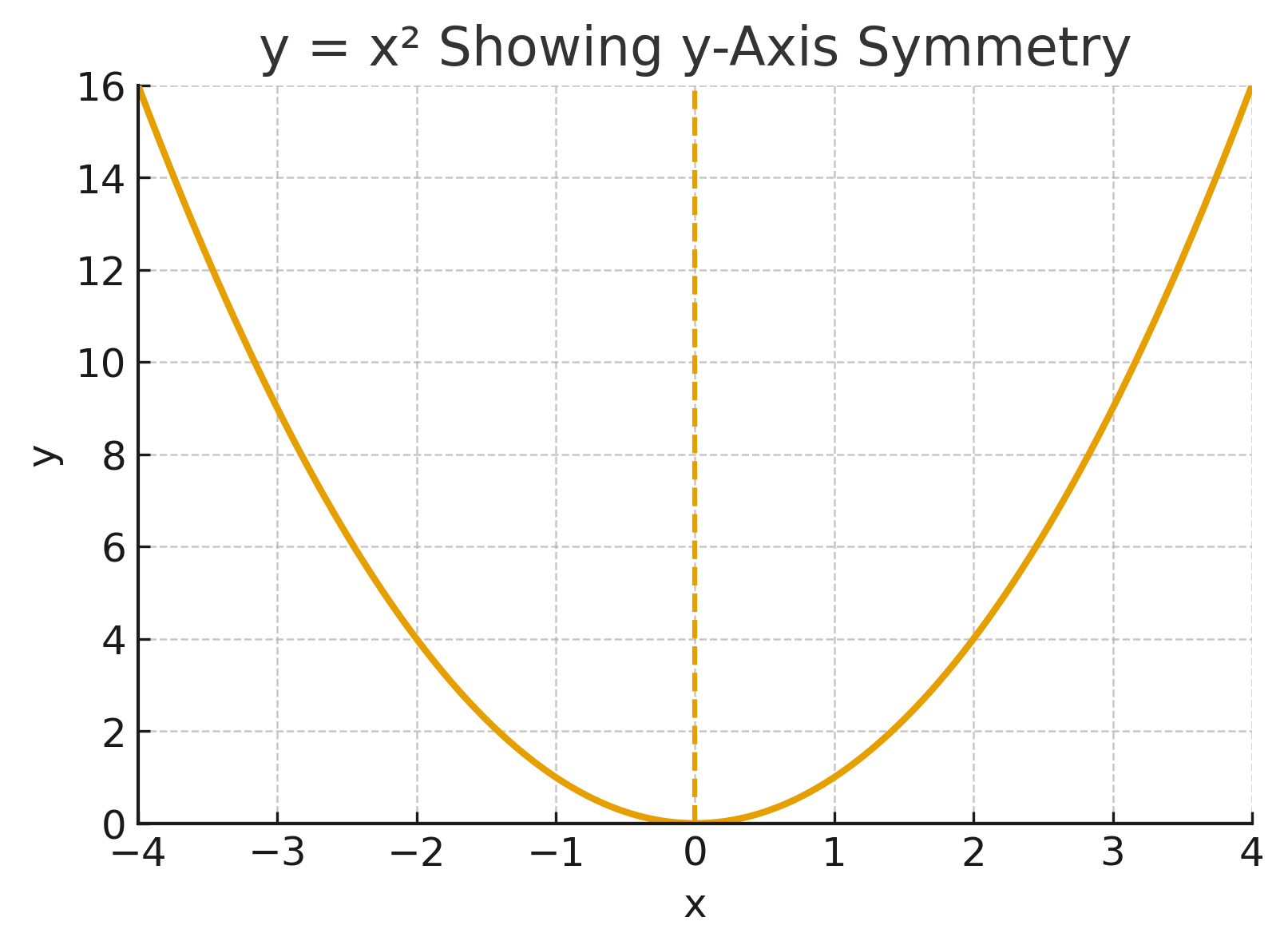
A function is even if: \[ f(-x) = f(x) \]
Graphically: the graph is symmetric across the \(y\)-axis.
Common examples:
- \(f(x) = x^2\)
- \(f(x) = |x|\)
- \(f(x) = \cos x\)
Odd Functions
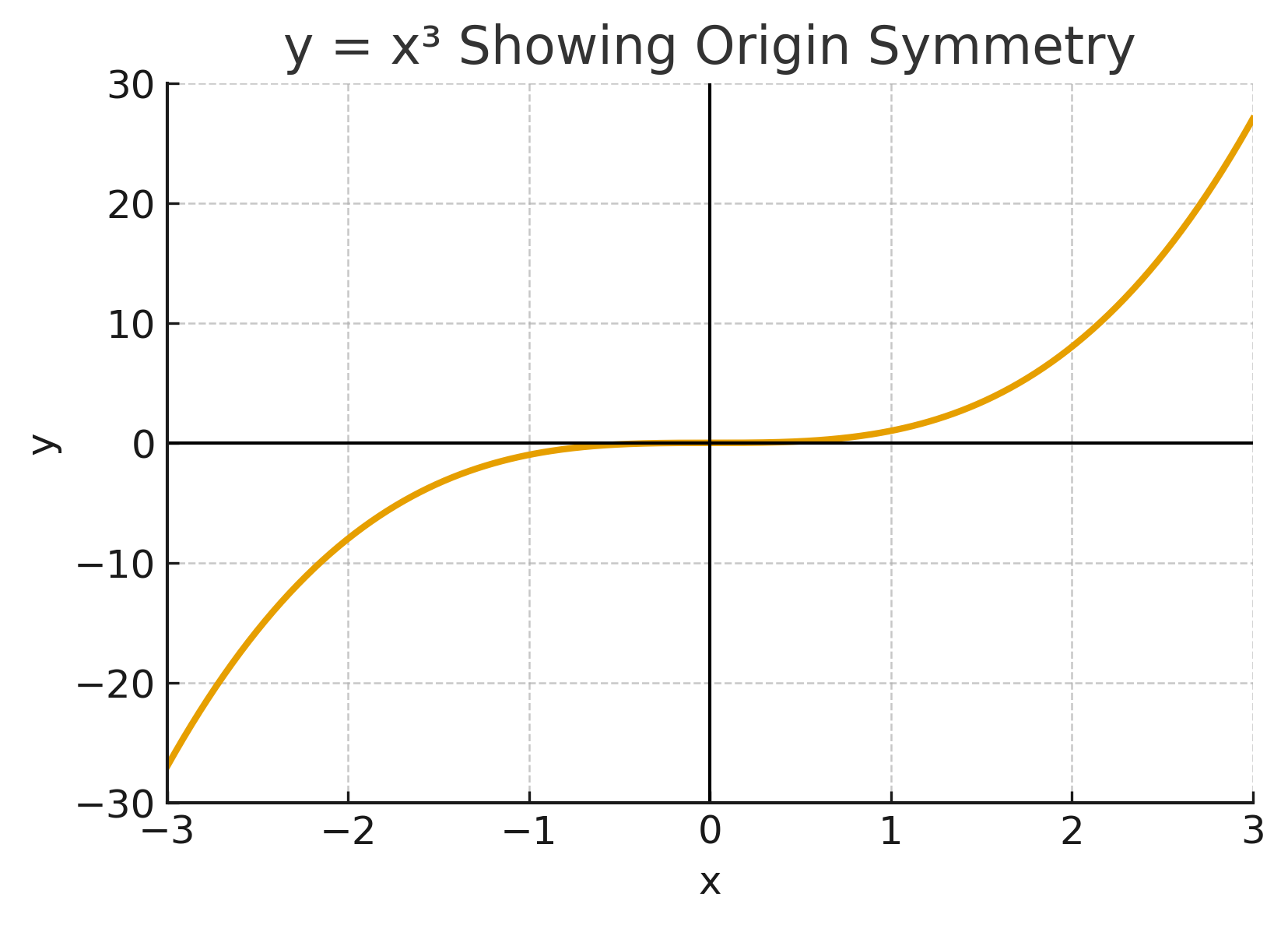
A function is odd if: \[ f(-x) = -f(x) \]
Graphically: the graph is symmetric about the origin
(rotate the graph 180° about the origin).
Common examples:
- \(f(x) = x^3\)
- \(f(x) = x\)
- \(f(x) = \sin x\)
Neither
Many functions are neither even nor odd.
For example: \(x^2 + x\), \(e^x\), or any graph without symmetry.
Common Problem Types
1. Algebraic Test
Compute \(f(-x)\) and compare it with \(f(x)\) or \(-f(x)\).
2. Graph-Based Identification
Check for \(y\)-axis symmetry (even) or origin symmetry (odd).
3. Table or Mapping Tests
Look for matching or opposite pairs.
4. Domain Considerations
A function cannot be even or odd unless its domain is symmetric about 0.
Strategies
- Always use parentheses when computing \(f(-x)\).
- Check the domain—square roots and logs often fail symmetry due to domain limits.
- For graphs:
- Even → mirror across \(y\)-axis
- Odd → rotate 180° around the origin
- Even → mirror across \(y\)-axis
- If neither comparison works, the function is neither.
Worked Examples
Example 1 — Algebraic Test (Even)
Check if: \[ f(x) = x^2 - 4 \]
Compute: \[ \begin{split} f(-x) &= (-x)^2 - 4 \\ &= x^2 - 4 \end{split} \]
Since \(f(-x) = f(x)\), the function is even.
Example 2 — Algebraic Test (Odd)
Check if: \[ g(x) = x^3 + x \]
Compute: \[ \begin{split} g(-x) &= (-x)^3 + (-x) \\ &= -x^3 - x \\ &= -(x^3 + x) \end{split} \]
Since \(g(-x) = -g(x)\), the function is odd.
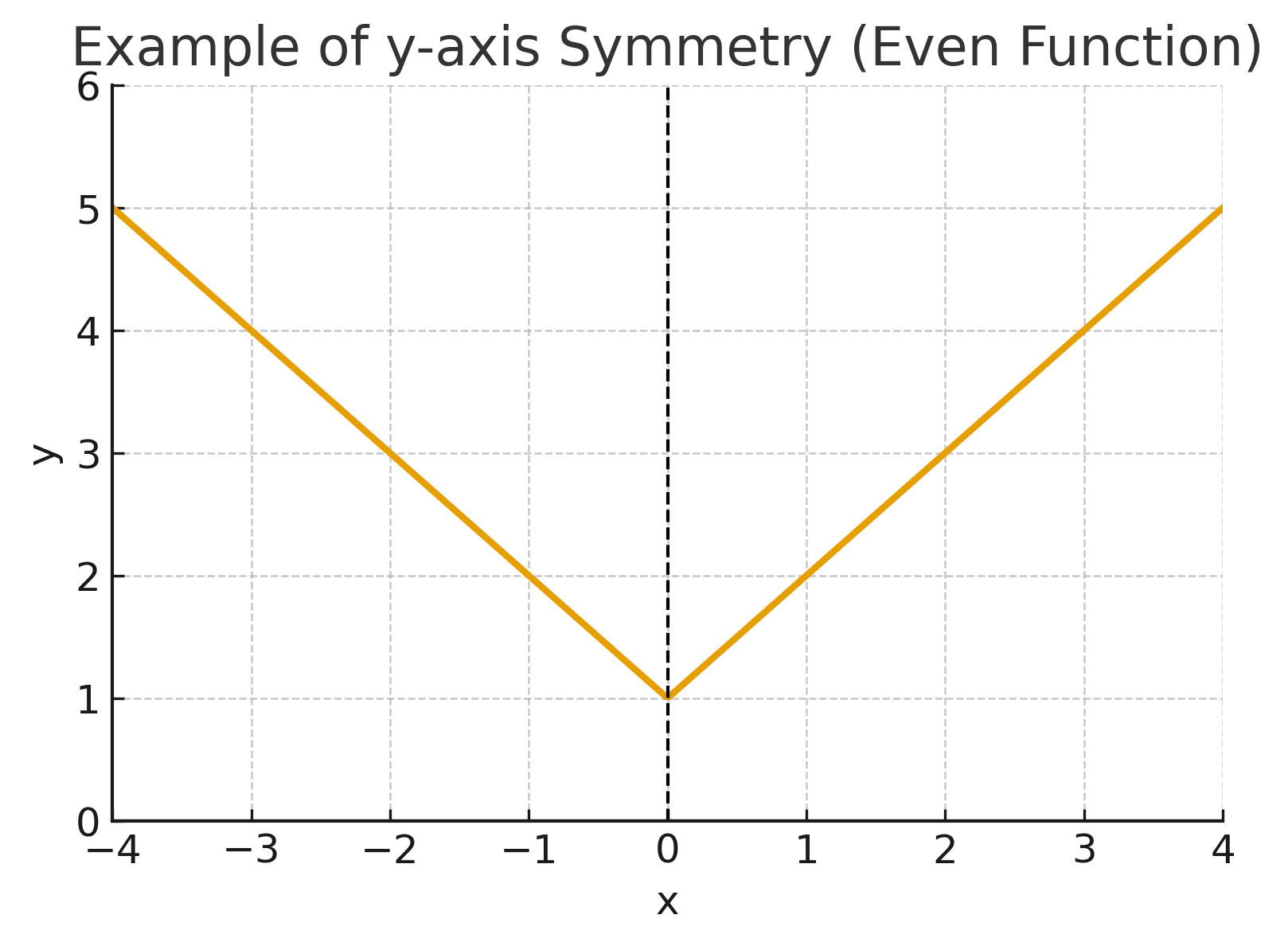
Example 3 — Graph Test
If a graph mirrors perfectly across the \(y\)-axis, the function is even.
- Thinking “even = even powers” and “odd = odd powers.”
(Not always true—mixed terms break symmetry.)
- Forgetting parentheses when evaluating \(f(-x)\).
- Assuming symmetry without checking.
- Ignoring domain: a function like \(\sqrt{x}\) cannot be even or odd.
Practice Problems
- Is \(f(x) = x^4 - 7\) even, odd, or neither?
- Test \(g(x) = x^3 - 2x\).
- Is \(h(x) = \sqrt{x}\) even, odd, or neither?
- A graph is symmetric about the origin. What type of function is it?
- If \(f\) is even, which must be true?
- A. \(f(-x) = -f(x)\)
- B. \(f(-x) = f(x)\)
- C. \(f(x) = x\)
- A. \(f(-x) = -f(x)\)
1.
Compute \(f(-x) = (-x)^4 - 7 = x^4 - 7\) → even
2.
\[
g(-x) = (-x)^3 - 2(-x) = -x^3 + 2x = -(x^3 - 2x)
\]
→ odd
3.
Domain of \(\sqrt{x}\) is \(x \ge 0\) → not symmetric → neither
4.
Origin symmetry → odd function
5.
Correct statement: B
Summary
- Even functions satisfy \(f(-x) = f(x)\) and show \(y\)-axis symmetry.
- Odd functions satisfy \(f(-x) = -f(x)\) and show origin symmetry.
- Many functions are neither—mixed parity or restricted domains break symmetry.
- Use algebraic tests for certainty; visual checks support reasoning.
- Use parentheses every time you evaluate \(f(-x)\).
- Check graph symmetry: mirror (even) vs. rotation (odd).
- Domain must include both \(x\) and \(-x\) to qualify.
- Mixed terms often make a function neither even nor odd.