Numbers & Operations
By the end of this lesson, you’ll be able to:
- Recognize and classify key number types (integer, rational, irrational, real).
- Apply order of operations accurately.
- Use commutative, associative, and distributive properties to simplify expressions.
- Work with absolute value using distance-based reasoning.
- Solve basic inequalities, including sign changes when negatives are involved.
Key Ideas
Number Types
Let’s organize the main categories of numbers:
- Natural numbers: \(1, 2, 3, \ldots\) — the positive counting numbers.
- Whole numbers: \(0, 1, 2, 3, \ldots\) — the natural numbers together with \(0\).
- Integers: include whole numbers and negatives
- Rational numbers: can be written as \(\frac{p}{q}\) for integers \(p, q\neq 0\)
- Irrational numbers: cannot be expressed as a simple fraction (e.g., \(\sqrt{2}\), \(\pi\))
- Real numbers: all rational and irrational numbers combined
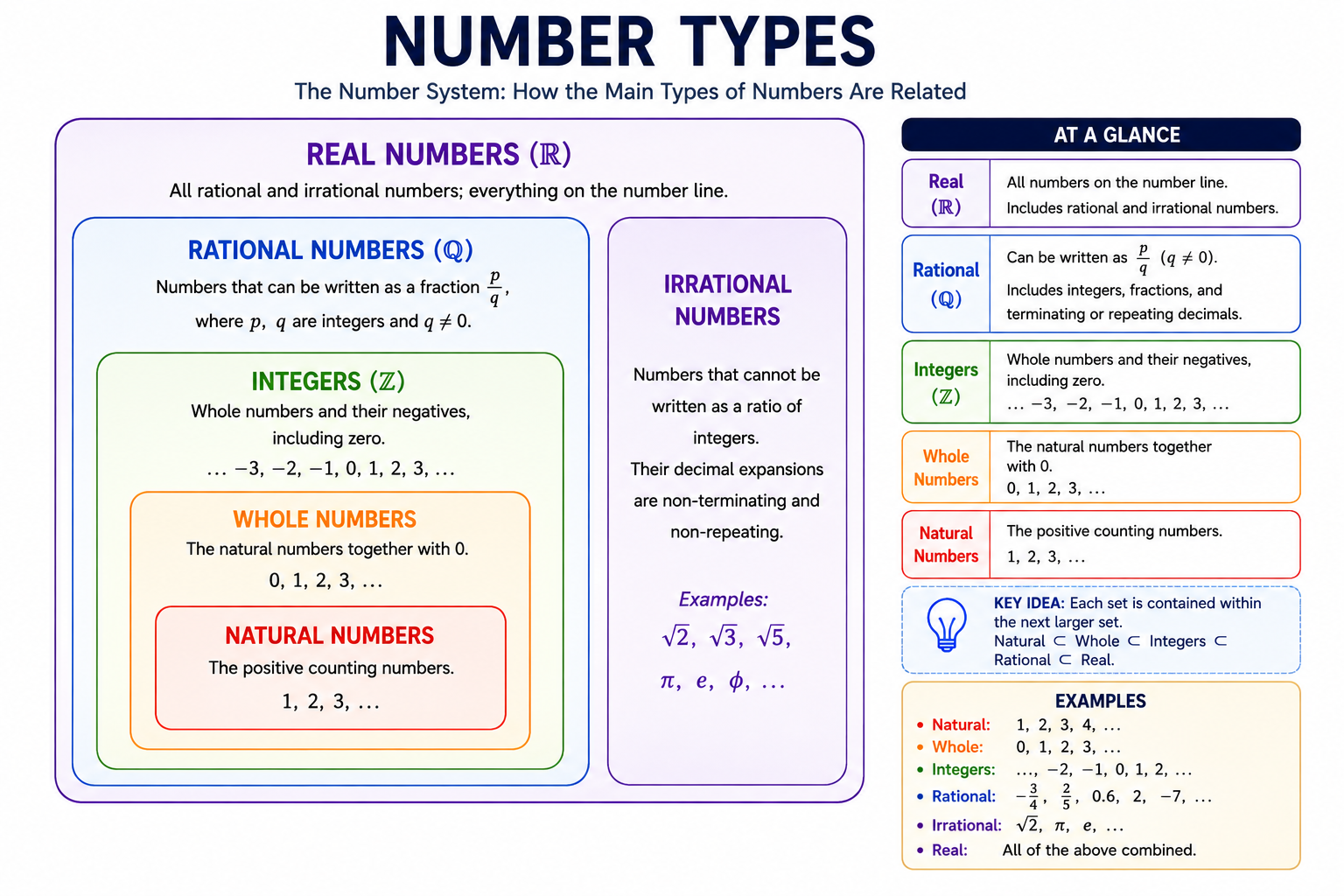
Quick check to think about:
Is \(\sqrt{50}\) a rational number? Keep that in mind as you go.
Order of Operations
Remember:
Parentheses → Exponents → Multiplication/Division → Addition/Subtraction
…but multiplication and division happen left-to-right, as do addition and subtraction.
Example:
\[
3 + 2 \cdot 5^2 = 3 + 2 \cdot 25 = 3 + 50 = 53
\]
Properties of Operations
These help you reorganize expressions safely:
- Commutative: \(a+b=b+a\) and \(ab=ba\)
- Associative: \((a+b)+c = a+(b+c)\)
- Distributive: \(a(b+c)=ab+ac\)
Absolute Value
\(|x|\) is the distance from 0 on a number line, so it is always non-negative.
Examples:
\(|5| = 5\)
\(|-7| = 7\)
Inequalities and Sign Flips
When multiplying or dividing an inequality by a negative, flip the inequality sign.
Example:
\(-3x > 12\) → divide by \(-3\) → \(x < -4\)
If a negative number multiplies or divides the variable, pause and check whether the inequality should flip.
Common Problem Types
Evaluating Expressions
Use parentheses and PEMDAS carefully.
Example:
Evaluate \(4 - 3^2 + 2\).
\(4 - 9 + 2 = -3\).
Classifying Numbers
Ask yourself: Can it be written as a fraction? Can it be simplified?
Example:
\(\sqrt{50} = 5\sqrt{2}\) → irrational.
Simplifying Expressions
Distribute first, then combine like terms.
Working with Absolute Value
Example:
\(|3 - 8| = |-5| = 5\).
Solving Basic Inequalities
Example:
\(5 - 2x \le 11\)
\(-2x \le 6\)
\(x \ge -3\)
Strategies
- If uncertain whether a number is rational, try writing it as a fraction.
- Always simplify expressions under radicals.
- Sketch quick number lines for absolute value problems.
- Rewrite subtraction as \(+(-)\) to reduce sign mistakes.
- Track negatives carefully when working with inequalities.
Worked Examples
Example 1
Simplify:
\(4(3 - x) + 2x\)
Step 1: Distribute the 4
\(4 \cdot 3 = 12\), \(4 \cdot (-x) = -4x\)
So the expression becomes:
\(12 - 4x + 2x\)
Step 2: Combine like terms
\(-4x + 2x = -2x\)
Answer:
\(12 - 2x\)
Example 2
Classify: Is \(\frac{2}{7}\) rational, irrational, or an integer?
Step 1: A rational number can be written as a ratio of integers.
\(\frac{2}{7}\) is already a ratio of integers.
Step 2: It is not a whole number or integer.
Answer:
Rational.
Example 3
Solve: \(|x - 3| = 5\)
Step 1: Set up the two cases:
1) \(x - 3 = 5\)
2) \(x - 3 = -5\)
Step 2: Solve each:
Case 1: \(x = 8\)
Case 2: \(x = -2\)
Answer:
\(x = 8\) or \(x = -2\)
Example 4
Solve: \(-4x > 20\)
Step 1: Divide both sides by \(-4\)
Remember: dividing by a negative flips the inequality.
Step 2:
\(x < -5\)
Answer:
\(x < -5\)
Practice Problems
- Simplify: \(7 - 2(3 - x)\)
- Classify: \(\sqrt{16}\)
- Evaluate: \(| -12 + 5 |\)
- Solve: \(3x - 4 < 11\)
- Is \(\frac{4}{9}\) rational?
1. \(7 - 2(3 - x)\)
Distribute: \(7 - 6 + 2x\)
Combine: \(1 + 2x\)
2. \(\sqrt{16} = 4\) → rational
3. \(|-12 + 5| = |-7| = 7\)
4. \(3x - 4 < 11\)
Add 4: \(3x < 15\)
Divide: \(x < 5\)
5. \(\frac{4}{9}\) is rational (a ratio of integers)
- Forgetting to flip the inequality sign when dividing by a negative
- Dropping negative signs while simplifying
- Treating MD or AS as separate steps instead of left-to-right
- Not simplifying radicals before classifying rational/irrational numbers
Summary
- Numbers fall into main categories: whole, integer, rational, irrational, real.
- Apply order of operations strictly with left-to-right rules for MD and AS.
- Use algebraic properties to simplify expressions.
- Absolute value represents distance and is always non-negative.
- Inequalities may require a sign flip when multiplying or dividing by negatives.
- Multiplication/division and addition/subtraction both follow left-to-right rules.
- Square roots of perfect squares are rational.
- Watch for hidden negatives when solving inequalities.
- Absolute value equations typically produce two solutions.