Point-Slope Form
By the end of this lesson, you’ll be able to:
- Use point-slope form to write equations of lines.
- Convert point-slope equations into slope-intercept form.
- Write equations when given a point and slope, or two points.
Key Ideas
Point-slope form is incredibly useful when a graph or problem gives you one point and the slope, or when you need to build an equation from two points.
Point-slope form:
\[ y - y_1 = m(x - x_1) \]
Where:
- \((x_1, y_1)\) is a known point on the line
- \(m\) is the slope
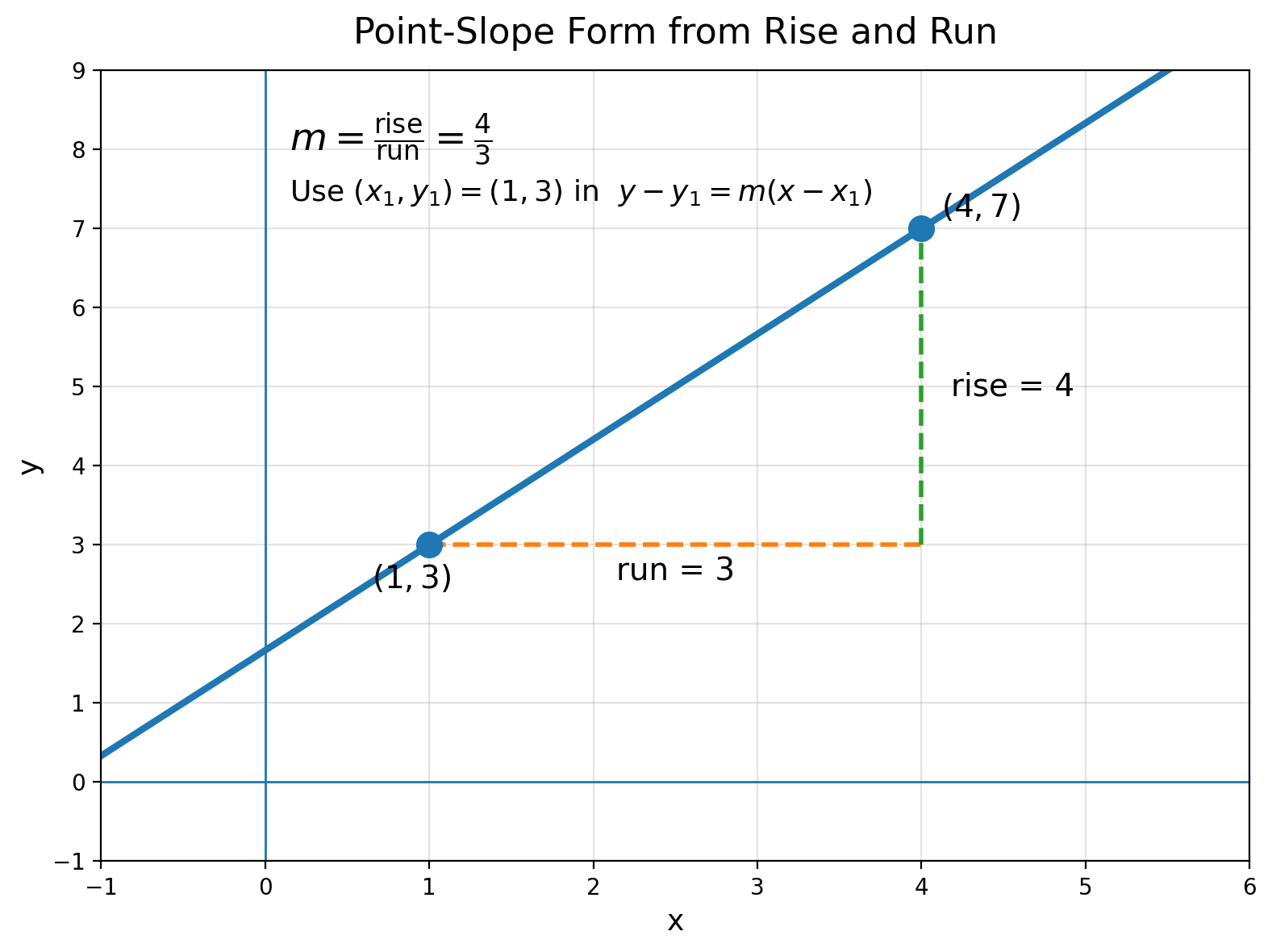
You can rewrite it into slope-intercept form by:
- Distributing the slope
- Moving \(y_1\) to the right side
Common Problem Types
1. Write an equation using a point and a slope
Use the given point \((x_1, y_1)\) and slope \(m\) directly in
\(y - y_1 = m(x - x_1)\).
2. Convert point-slope to slope-intercept
Distribute and simplify to get \(y = mx + b\).
3. Write an equation from two points
Step 1: Compute slope
Step 2: Use point-slope form
Step 3: Optionally convert to slope-intercept form
Strategies
- Always place the point exactly as written: \(y - y_1\) and \(x - x_1\).
- When the point has negatives, keep track of double negatives:
- For example, \((x - (-3))\) becomes \((x + 3)\).
- For example, \((x - (-3))\) becomes \((x + 3)\).
- After using point-slope, check your equation by plugging in the given point.
- If an equation looks messy, convert to slope-intercept to clean it up.
Worked Examples
Example 1 — Use point and slope
Write the equation of a line with slope \(m = 2\) through \((3, 7)\).
Use point-slope:
\[ y - 7 = 2(x - 3) \]
Convert:
\[ y - 7 = 2x - 6 \Rightarrow y = 2x + 1 \]
Example 2 — Use two points
Points: \((1, -2)\) and \((5, 6)\)
Step 1: Find slope
\[ m = \frac{6 - (-2)}{5 - 1} = \frac{8}{4} = 2 \]
Step 2: Use point-slope with point \((1, -2)\)
\[ y + 2 = 2(x - 1) \]
Step 3: Convert (optional)
\[ y + 2 = 2x - 2 \Rightarrow y = 2x - 4 \]
- Forgetting parentheses when writing \(x - x_1\).
- Using the wrong sign for \(x_1\) or \(y_1\).
- Distributing incorrectly when converting.
- Confusing point-slope with slope-intercept.
Practice Problems
- Write the equation of a line with slope \(3\) through \((2, 5)\).
- Convert to slope-intercept:
\(y - 4 = -2(x + 1)\).
- Write an equation through \((0, -3)\) and \((4, 1)\).
- Write point-slope form for slope \(-5\) through \((-1, 7)\).
- Use point-slope to write an equation that passes through \((6, -2)\) and has slope \(\frac{1}{3}\).
1.
\[
y - 5 = 3(x - 2)
\]
Convert (optional):
\[
y = 3x - 1
\]
2.
\[
y - 4 = -2(x + 1) = -2x - 2
\Rightarrow y = -2x + 2
\]
3.
Slope:
\[
m = \frac{1 - (-3)}{4 - 0} = 1
\]
Equation:
\[
y + 3 = 1(x - 0) \Rightarrow y = x - 3
\]
4.
\[
y - 7 = -5(x + 1)
\]
5.
\[
y + 2 = \frac{1}{3}(x - 6)
\]
Summary
- Point-slope form writes a line using a point and slope.
- Convert to slope-intercept by distributing and isolating \(y\).
- Works especially well when a graph or problem gives you a point but not the intercept.
- If a graph doesn’t show the intercept clearly, switch to point-slope.
- When the point has negatives, rewrite carefully to avoid sign errors.
- Plug the original point into your final equation for a quick accuracy check.