Quadratic Formula
By the end of this lesson, you’ll be able to:
- Use the quadratic formula to solve any quadratic equation.
- Interpret the discriminant to predict the number and type of solutions.
- Decide when the quadratic formula is the most efficient method.
Key Ideas
Any quadratic of the form \[ ax^2 + bx + c = 0, \qquad a \ne 0 \] can be solved using the quadratic formula:
\[ x = \frac{-b \pm \sqrt{b^2 - 4ac}}{2a} \]
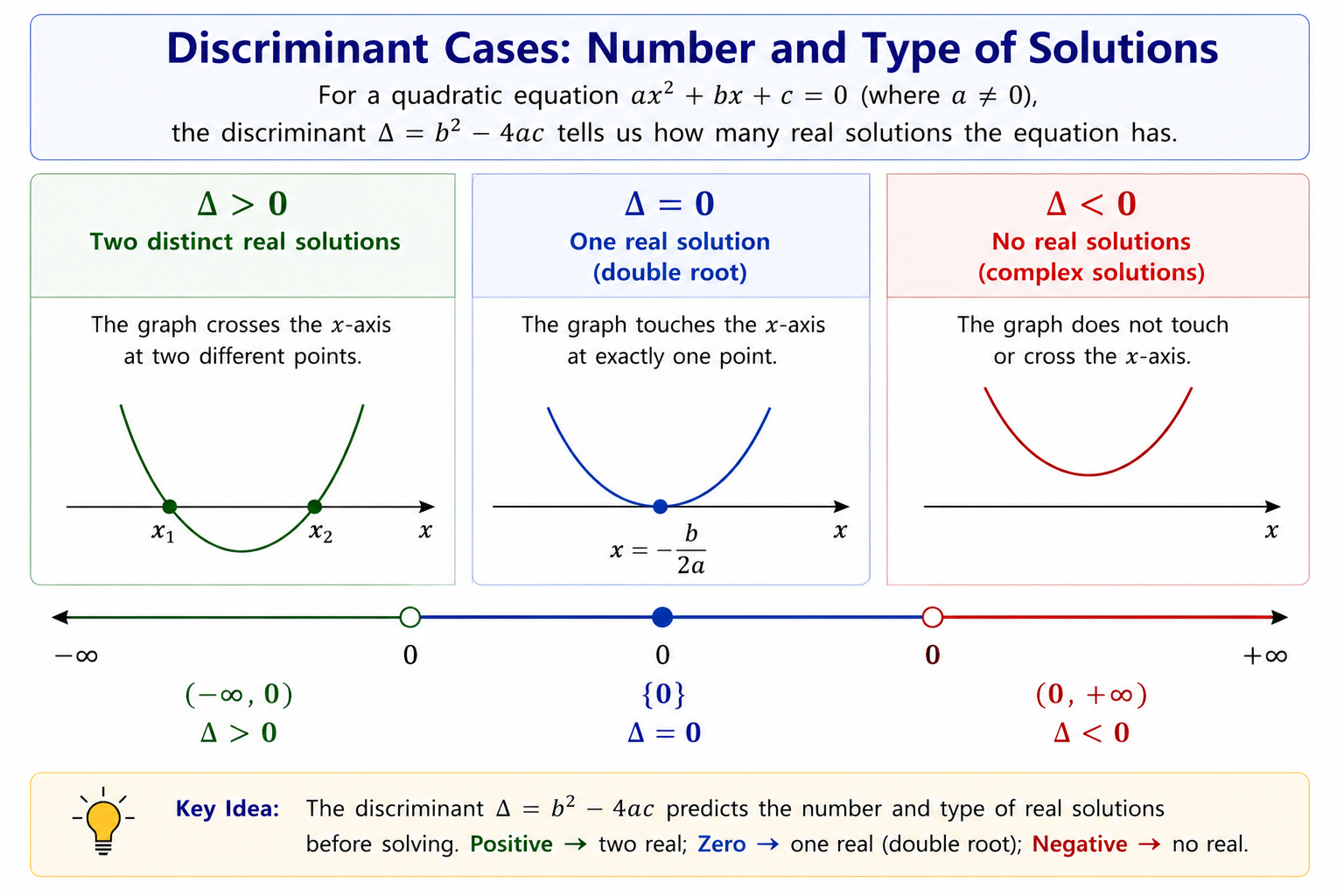
The expression under the square root, \[ \Delta = b^2 - 4ac, \] is called the discriminant. It tells you what kind of solutions to expect:
- \(\Delta > 0\) → two distinct real solutions
- \(\Delta = 0\) → one real solution (double root)
- \(\Delta < 0\) → no real solutions (complex solutions)
Common Problem Types
1. Using the Formula Directly
Plug in \(a\), \(b\), \(c\), compute the discriminant, and evaluate.
2. Predicting Solutions Using the Discriminant
Decide how many real solutions exist before solving.
3. Solving When Factoring Is Hard
Quadratic formula works even when factoring is messy or impossible.
4. Solving Perfect Square Trinomials
Discriminant = 0 indicates a repeated root.
Strategies
- Always write down \(a\), \(b\), and \(c\) clearly.
- Compute the discriminant first—it’s a quick “preview” of the solution type.
- Be extra careful with signs, especially \(-b\) and \(b^2 - 4ac\).
- If the quadratic is factorable but you’re unsure, the quadratic formula is a safe fallback.
- Simplify radicals when possible.
Worked Examples
Example 1 — Two Real Solutions
Solve: \[ 2x^2 - 3x - 2 = 0 \]
Solution:
Identify coefficients:
\(a = 2\), \(b = -3\), \(c = -2\)Compute discriminant: \[ \Delta = (-3)^2 - 4(2)(-2) = 9 + 16 = 25 \]
Use formula: \[ x = \frac{-(-3) \pm \sqrt{25}}{2(2)} = \frac{3 \pm 5}{4} \]
Two solutions: \[ x = 2, \quad x = -\frac{1}{2} \]
Example 2 — One Real Solution (Double Root)
Solve: \[ x^2 - 6x + 9 = 0 \]
Solution:
- \(a = 1\), \(b = -6\), \(c = 9\)
- Discriminant: \[ \Delta = (-6)^2 - 4(1)(9) = 36 - 36 = 0 \]
- Formula: \[ x = \frac{6}{2} = 3 \]
One repeated solution: \(x = 3\)
- Plugging in wrong signs for \(a\), \(b\), or \(c\).
- Dropping the \(\pm\) and only computing one solution.
- Miscomputing the discriminant (especially the \(-4ac\) term).
Practice Problems
- Solve using the quadratic formula: \(x^2 + 4x - 5 = 0\)
- Solve: \(3x^2 - 2x + 1 = 0\)
- Determine the number of real solutions for \(x^2 + 2x + 5 = 0\)
- Solve: \(2x^2 + 7x + 3 = 0\)
- Use the quadratic formula: \(x^2 - 8x + 16 = 0\)
1.
\(a=1\), \(b=4\), \(c=-5\)
\(\Delta = 36\)
\(x = \frac{-4 \pm 6}{2}\)
Solutions: \(1\), \(-5\)
2.
\(a=3\), \(b=-2\), \(c=1\)
\(\Delta = -8\)
No real solutions.
3.
\(a=1\), \(b=2\), \(c=5\)
\(\Delta = -16\)
No real solutions.
4.
\(a=2\), \(b=7\), \(c=3\)
\(\Delta = 25\)
\(x = \frac{-7 \pm 5}{4}\)
Solutions: \(x = -\frac{1}{2}\), \(-3\)
5.
\(a = 1\), \(b = -8\), \(c = 16\)
\(\Delta = 0\)
\(x = \frac{8}{2} = 4\)
Single repeated root: \(x = 4\)
Summary
- The quadratic formula solves any quadratic equation.
- The discriminant \(b^2 - 4ac\) predicts how many real solutions exist.
- A positive discriminant → two real solutions.
- Zero → one real, repeated solution.
- Negative → no real solutions.
- When factoring is difficult, the quadratic formula is the most reliable method.
- Write down \(a\), \(b\), \(c\) explicitly before plugging in.
- Compute the discriminant first—it saves time.
- Keep track of negatives when evaluating \(-b\) and \(b^2 - 4ac\).
- The quadratic formula works even when nothing else does.