Systems of Inequalities
By the end of this lesson, you’ll be able to:
- Graph systems of linear inequalities in the coordinate plane.
- Identify the overlapping solution region.
- Determine whether a point satisfies a system of inequalities.
- Interpret the feasible region in real-world modeling questions.
Key Ideas
A system of inequalities is a set of two or more inequalities considered at the same time.
Example:
\[ \begin{cases} y \le x + 2 \\ y > -2x + 1 \end{cases} \]
Each inequality has its own shaded region.
The solution to the system is the region where all shaded regions overlap.
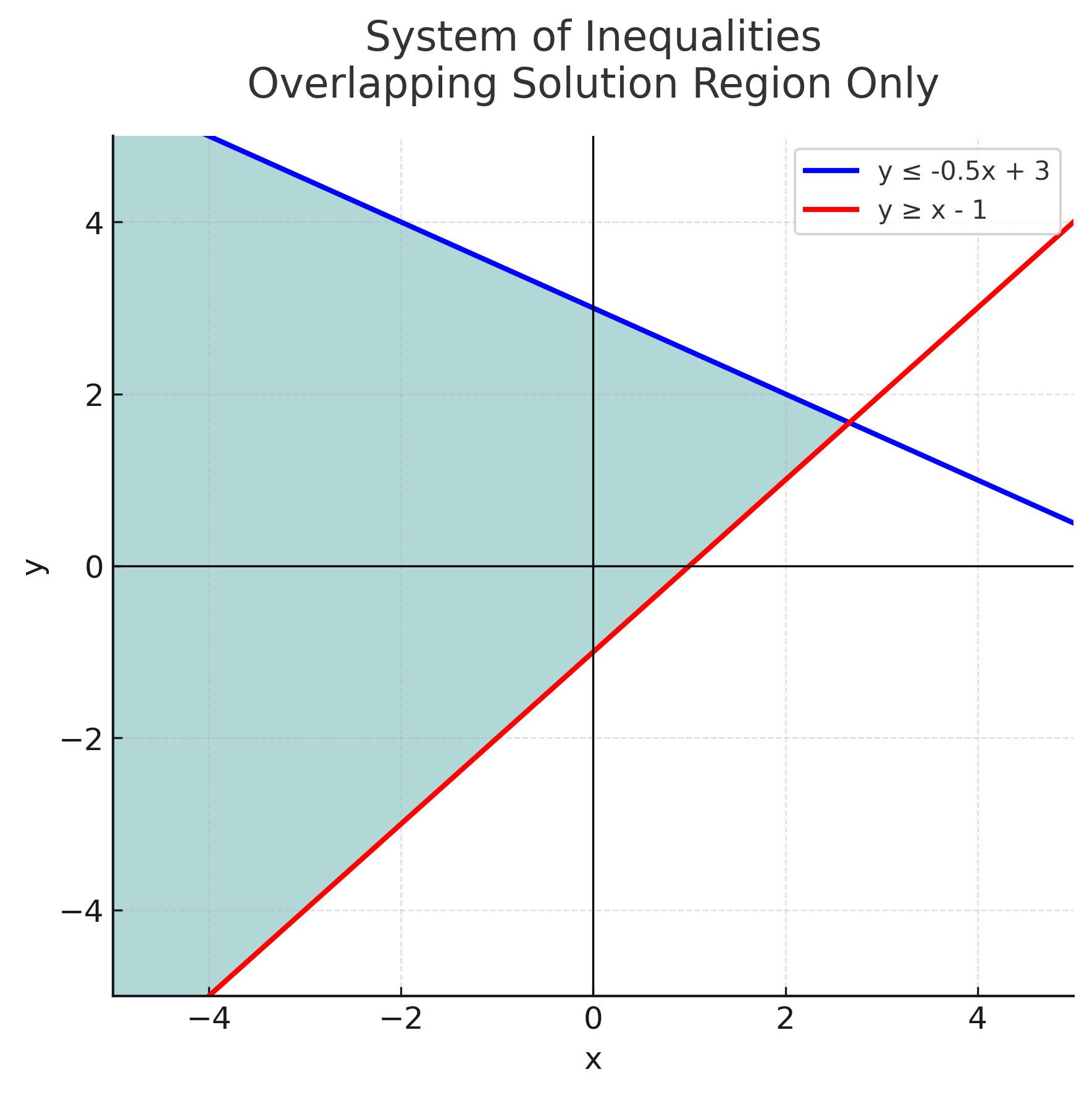
A point is a solution only if it satisfies every inequality in the system.
Think of a system as multiple restrictions happening at once.
Before graphing a system, use the same rules from graphing a single linear inequality:
- \(\le\) or \(\ge\) → solid boundary line
- \(<\) or \(>\) → dashed boundary line
- \(y > mx+b\) or \(y \ge mx+b\) → shade above
- \(y < mx+b\) or \(y \le mx+b\) → shade below
The Overlapping Region
The overlap is the most important idea in this lesson.
If a point is in only one shaded region, it is not a solution to the system.
If a point is in all shaded regions, it is a solution to the system.
Feasible Region
The overlapping solution region is often called the feasible region.
A feasible region is the set of points that satisfies all the restrictions in a problem.
Many problems use systems of inequalities to model restrictions such as budgets, time limits, or minimum and maximum requirements.
The feasible region represents all possible solutions that satisfy every condition.
Common Problem Types
1. Identify the Overlapping Region
To graph a system:
- Graph the first inequality.
- Graph the second inequality.
- Keep only the region where the shadings overlap.
Example:
\[ \begin{cases} y \le x + 2 \\ y > -2x + 1 \end{cases} \]
- \(y \le x+2\) uses a solid line and shades below.
- \(y > -2x+1\) uses a dashed line and shades above.
- The solution is the region that satisfies both.
2. Determine Whether a Point Is a Solution
A point must satisfy every inequality in the system.
Example:
Does \((2,3)\) satisfy the system?
\[ \begin{cases} y \le x + 2 \\ y > -x \end{cases} \]
Check the first inequality:
\[ 3 \le 2 + 2 \]
\[ 3 \le 4 \]
True.
Check the second inequality:
\[ 3 > -2 \]
True.
Since both statements are true, \((2,3)\) is a solution.
3. Determine Whether a Point Is Not a Solution
Example:
Does \((3,2)\) satisfy the system?
\[ \begin{cases} y \ge x - 1 \\ y < -2x + 5 \end{cases} \]
Check the first inequality:
\[ 2 \ge 3 - 1 \]
\[ 2 \ge 2 \]
True.
Check the second inequality:
\[ 2 < -2(3) + 5 \]
\[ 2 < -1 \]
False.
Since one inequality is false, \((3,2)\) is not a solution.
4. Systems with No Overlap
Sometimes two inequalities have no common solution region.
This can happen when the shaded regions point away from each other.
Example:
\[ \begin{cases} y > x + 4 \\ y < x - 2 \end{cases} \]
The boundary lines are parallel.
The first inequality shades above the higher line.
The second inequality shades below the lower line.
There is no overlap, so the system has no solution.
Strategies
- Graph each inequality separately.
- Shade lightly so the overlap is easy to see.
- The final solution must satisfy all inequalities.
- When checking a point, plug it into every inequality.
- If a point fails even one inequality, it is not a solution.
- For modeling questions, think of each inequality as a restriction or condition.
Worked Examples
Example 1
Graph the system:
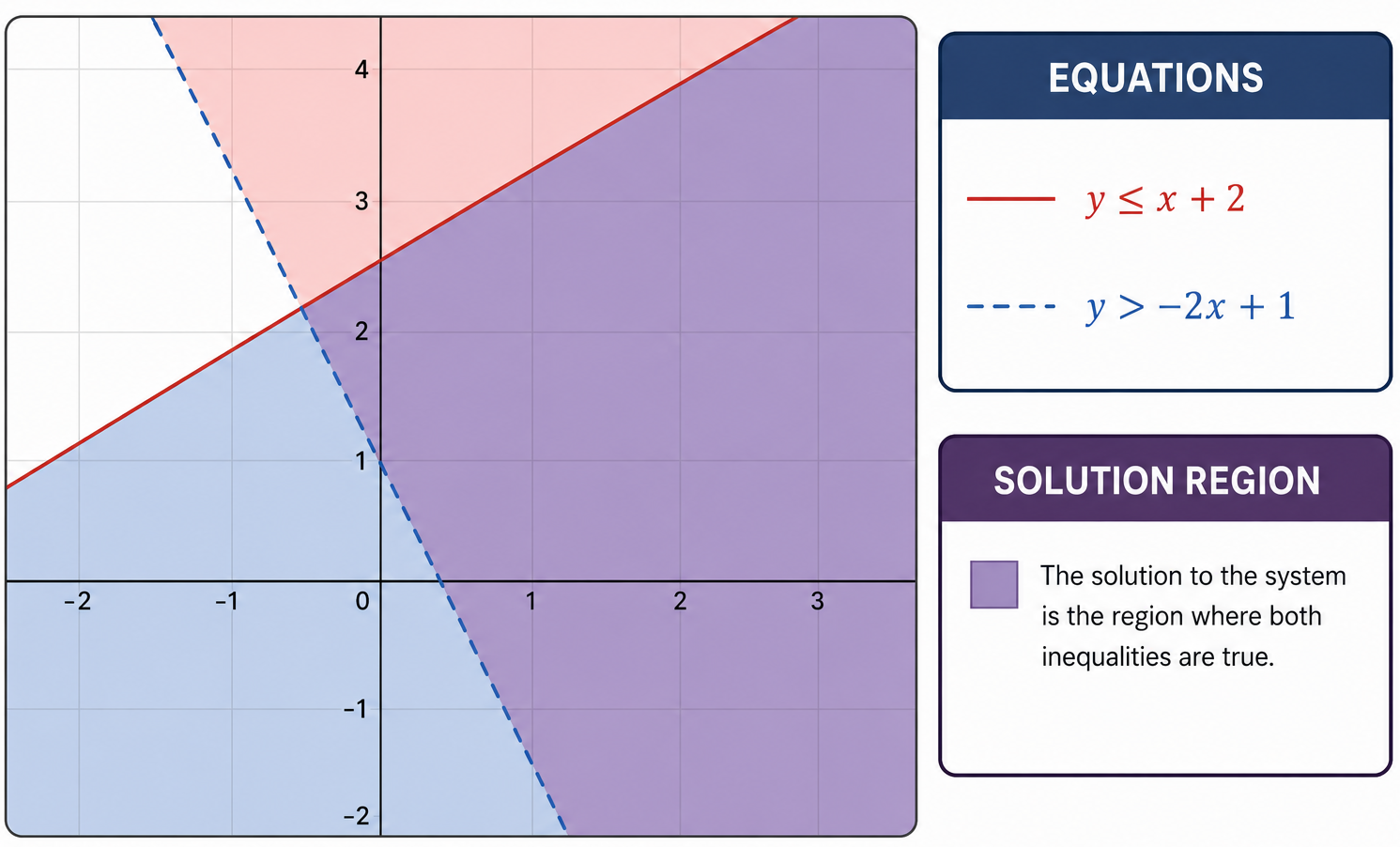
\[ \begin{cases} y \le x + 2 \\ y > -2x + 1 \end{cases} \]
Step 1: Graph the first boundary line.
\[ y = x + 2 \]
Since the inequality is \(\le\), use a solid line and shade below.
Step 2: Graph the second boundary line.
\[ y = -2x + 1 \]
Since the inequality is \(>\), use a dashed line and shade above.
Step 3: The solution is the overlapping region.
Example 2 — Test a Point
Does \((0,0)\) satisfy the system?
\[ \begin{cases} y < 3x + 5 \\ y \ge -x - 1 \end{cases} \]
Check the first inequality:
\[ 0 < 3(0)+5 \]
\[ 0 < 5 \]
True.
Check the second inequality:
\[ 0 \ge -0 - 1 \]
\[ 0 \ge -1 \]
True.
Since both inequalities are true, \((0,0)\) is a solution.
Example 3 — Interpret a Feasible Region
A school club is selling two types of tickets:
- \(x\) = number of student tickets
- \(y\) = number of adult tickets
Suppose the restrictions are:
\[ \begin{cases} x \ge 0 \\ y \ge 0 \\ x + y \le 100 \end{cases} \]
The feasible region contains all possible combinations of student and adult tickets.
The inequality
\[ x+y \le 100 \]
means the club can sell at most \(100\) total tickets.
A point such as \((40,50)\) is feasible because:
\[ 40+50 \le 100 \]
\[ 90 \le 100 \]
But \((70,40)\) is not feasible because:
\[ 70+40 \le 100 \]
\[ 110 \le 100 \]
is false.
- Graphing both inequalities correctly but choosing the wrong region.
- Forgetting that the solution must satisfy every inequality.
- Thinking a point is a solution just because it satisfies one inequality.
- Ignoring whether a boundary line is solid or dashed.
- Forgetting that boundary points are included only for \(\le\) or \(\ge\).
Practice Problems
- Graph the system:
\[ \begin{cases} y < 2x + 3 \\ y \ge -x + 1 \end{cases} \]
- Does \((3,2)\) satisfy the system?
\[ \begin{cases} y \ge x - 1 \\ y < -2x + 5 \end{cases} \]
- Does \((1,4)\) satisfy the system?
\[ \begin{cases} y \le 2x + 3 \\ y > x \end{cases} \]
What type of boundary line is used for \(y > -4x - 2\)?
A feasible region is described by:
\[ \begin{cases} x \ge 0 \\ y \ge 0 \\ x+y \le 50 \end{cases} \]
Does the point \((20,25)\) belong to the feasible region?
1.
For
\[ y < 2x + 3, \]
use a dashed line and shade below.
For
\[ y \ge -x + 1, \]
use a solid line and shade above.
The solution is the overlapping region.
2.
Check \((3,2)\).
First inequality:
\[ 2 \ge 3 - 1 \]
\[ 2 \ge 2 \]
True.
Second inequality:
\[ 2 < -2(3)+5 \]
\[ 2 < -1 \]
False.
So \((3,2)\) is not a solution.
3.
Check \((1,4)\).
First inequality:
\[ 4 \le 2(1)+3 \]
\[ 4 \le 5 \]
True.
Second inequality:
\[ 4 > 1 \]
True.
So \((1,4)\) is a solution.
4.
The symbol \(>\) means the boundary line is dashed.
5.
Check \((20,25)\).
\[ 20 \ge 0 \]
True.
\[ 25 \ge 0 \]
True.
\[ 20+25 \le 50 \]
\[ 45 \le 50 \]
True.
So \((20,25)\) belongs to the feasible region.
Summary
- A system of inequalities contains two or more inequalities.
- The solution is the overlap of all shaded regions.
- A point is a solution only if it satisfies every inequality.
- The overlapping solution region is often called the feasible region.
- If there is no overlap, the system has no solution.
- Graph each inequality separately.
- Keep only the overlap.
- A point must satisfy all inequalities to be a solution.
- If a point fails even one inequality, it is not a solution.
- In context problems, the feasible region represents all possible answers.