What Is a System of Equations?
By the end of this lesson, you’ll be able to:
- Understand what a system of linear equations is.
- Interpret solutions as the point where two lines intersect.
- Recognize when systems have one solution, no solution, or infinitely many solutions.
Key Ideas
A system of equations is a set of two or more equations that must be true at the same time. You’re looking for values of \(x\) and \(y\) that make every equation in the system true.
Typical example:
\[ \begin{cases} 2x + y = 7 \\ x - y = 1 \end{cases} \]
A solution is the ordered pair \((x, y)\) that satisfies both equations.
Graphical Interpretation
- One solution: The lines intersect at exactly one point.
- No solution: The lines are parallel (same slope, different intercepts).
- Infinitely many solutions: The lines lie on top of each other (same line).
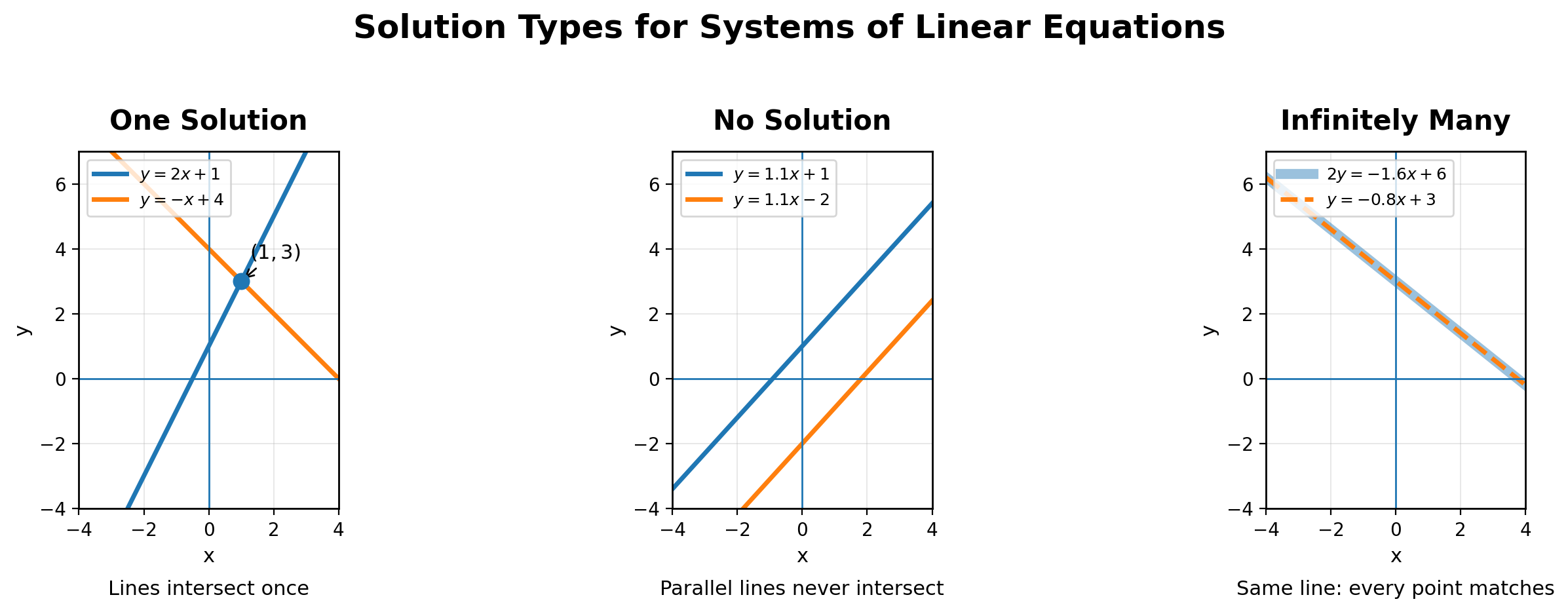
These three cases appear constantly in algebra and standardized tests.
Common Problem Types
Systems with One Solution
Two lines intersect at a single point.
Systems with No Solution
Lines are parallel with identical slopes but different intercepts.
Systems with Infinitely Many Solutions
Equations are equivalent and describe the same line.
Simple Add/Subtract Elimination
Systems where adding or subtracting the equations eliminates a variable immediately.
Quick Graph-Based Identification
Deciding solution type using slope-intercept form.
Strategies
- Put equations in slope-intercept form to compare slopes and intercepts.
- If solving algebraically, consider whether substitution or elimination is cleaner.
- When equations already line up nicely, use addition/subtraction to eliminate a variable quickly.
- Always check your final solution pair in both equations.
Worked Examples
Example 1 — Solve Using Elimination
Solve the system:
\[ \begin{cases} x + y = 6 \\ x - y = 2 \end{cases} \]
Add the equations:
\[ 2x = 8 \Rightarrow x = 4 \]
Substitute back:
\[ 4 + y = 6 \Rightarrow y = 2 \]
Solution: \((4, 2)\)
This means the graphs of the two equations intersect at the point \((4,2)\).
Example 2 — Identify Solution Type
Consider:
\[ y = 2x + 4 \]
\[ 2y = 4x + 8 \]
Rewrite second:
\[ y = 2x + 4 \]
Same equation → infinitely many solutions.
- Solving only one equation and forgetting to check the second.
- Assuming parallel lines have infinitely many solutions (parallel = no solutions).
- Forgetting that the solution must satisfy both equations simultaneously.
Practice Problems
Solve the system:
\[ \begin{cases} x + y = 5 \\ x - y = 1 \end{cases} \]Identify solution type:
\(y = 3x + 1\)
\(3x - y = 7\)Identify solution type:
\(y = 2x + 4\)
\(y = 2x - 1\)
1.
Add equations:
\(2x = 6 \Rightarrow x = 3\)
Then: \(3 + y = 5 \Rightarrow y = 2\)
Solution: \((3, 2)\)
2.
Rewrite second: \(y = 3x - 7\).
Same slope, different intercept → no solution.
3.
Slopes match, intercepts differ → no solution.
Summary
- A system of equations requires finding \((x, y)\) values that satisfy all equations.
- Intersection point = one solution.
- Parallel lines = no solution.
- Identical lines = infinitely many solutions.
- Algebraic methods (substitution, elimination) help find solutions efficiently.
- Compare slopes first—this often reveals the solution type instantly.
- Use elimination when variables line up cleanly.
- Always check the final point in both equations.
- Remember: parallel ≠ infinite; parallel = none.