Special Cases: No Solution & Infinite Solutions
By the end of this lesson, you’ll be able to:
- Recognize when a system has no solution or infinitely many solutions.
- Interpret special cases during substitution or elimination.
- Use slopes, intercepts, and equation patterns to classify systems quickly.
Key Ideas
Most systems of equations have one solution: one ordered pair \((x,y)\) that makes both equations true.
But sometimes, the system does not lead to one point.
There are two important special cases:
- No solution
- Infinitely many solutions
These cases can appear either from the graph or from the algebra.
The Big Shortcut
For two linear equations written as:
\[ y = mx + b \]
compare the slope \(m\) and the y-intercept \(b\).
| Slopes | Intercepts | Result |
|---|---|---|
| Different slopes | Any intercepts | One solution |
| Same slope | Different intercepts | No solution |
| Same slope | Same intercept | Infinitely many solutions |
Special Case 1: No Solution
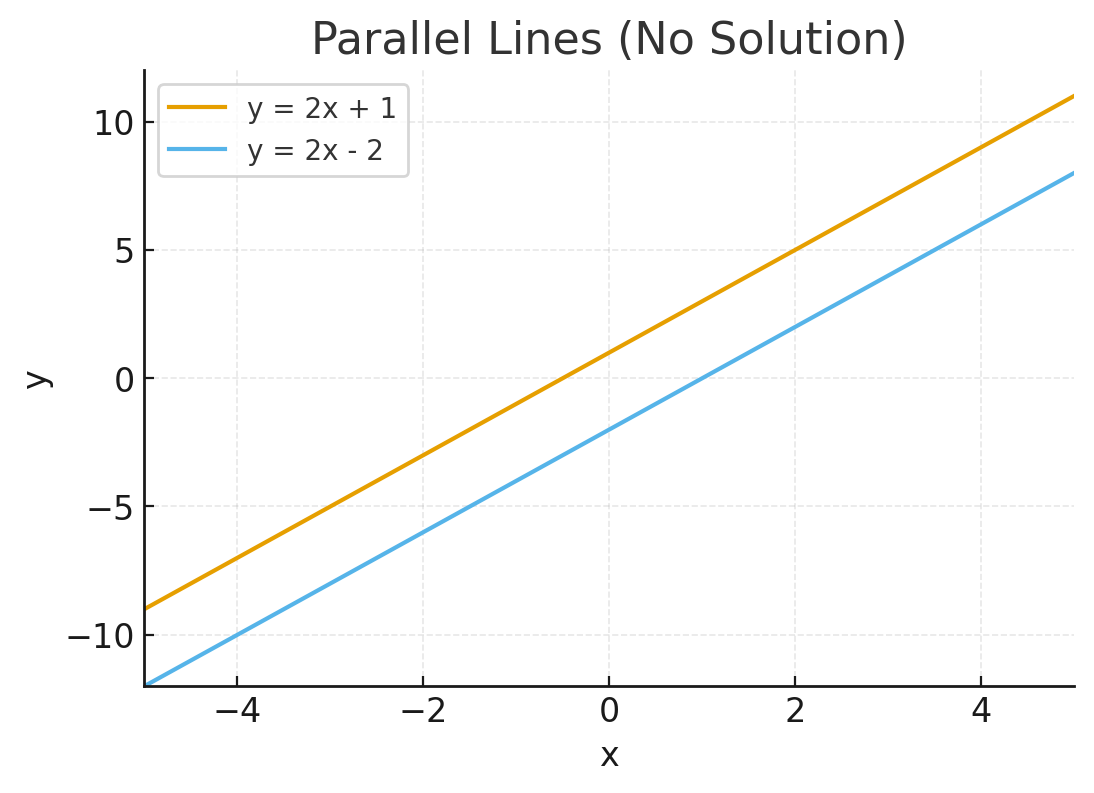
A system has no solution when the lines are parallel.
That means:
- same slope
- different y-intercepts
Example:
\[ \begin{split} y &= 3x + 2 \\ y &= 3x - 4 \end{split} \]
Both lines have slope \(3\), but their y-intercepts are different.
So the lines never meet.
Result: no solution.
Special Case 2: Infinitely Many Solutions
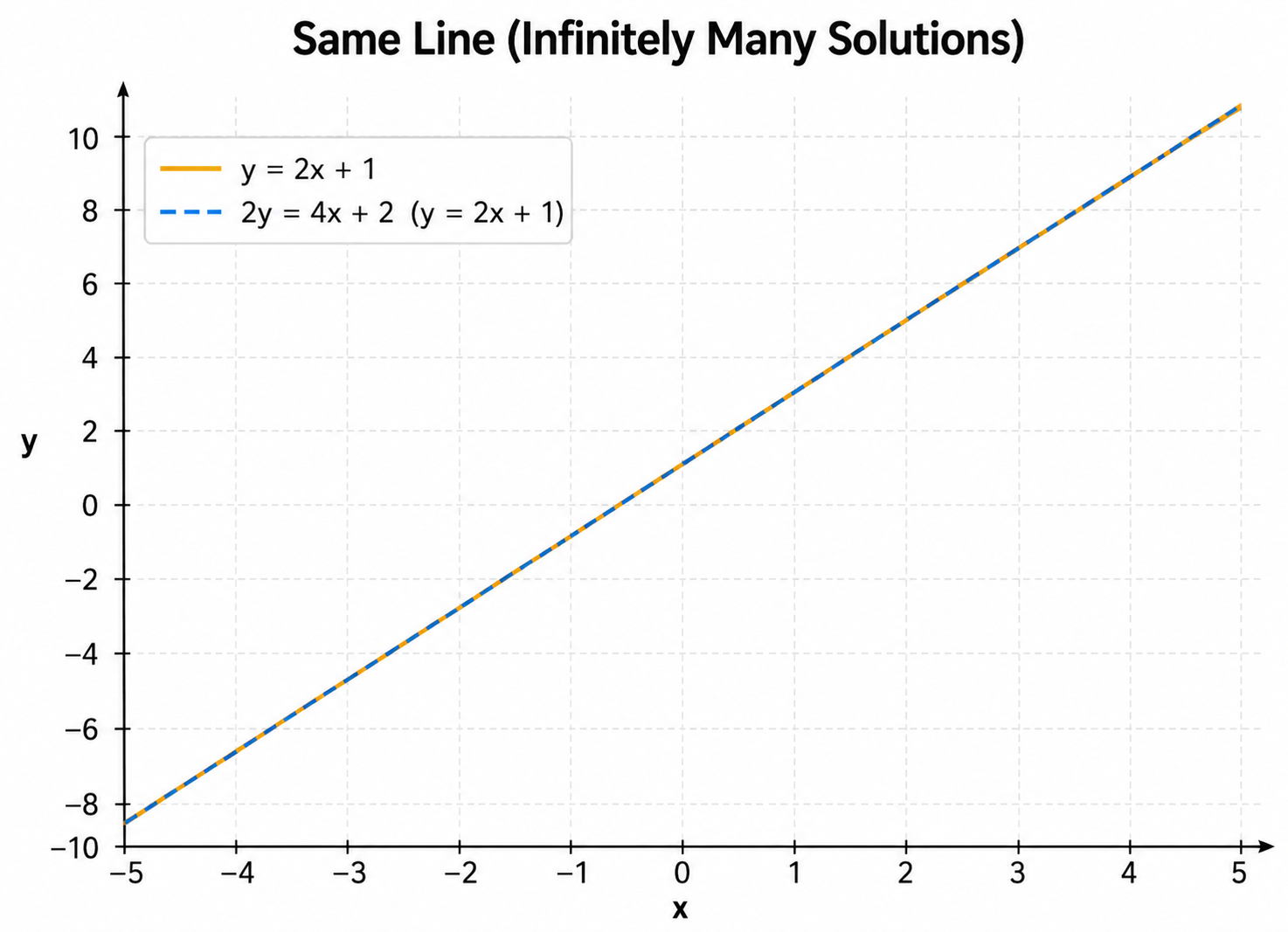
A system has infinitely many solutions when both equations describe the same line.
Example:
\[ \begin{split} 2x + 4y &= 8 \\ x + 2y &= 4 \end{split} \]
The first equation can be divided by \(2\):
\[ x + 2y = 4 \]
Now both equations are exactly the same.
So every point on the line works.
Result: infinitely many solutions.
What Happens During Elimination?
Special cases often show up when solving by elimination.
False Statement → No Solution
Consider:
\[ \begin{cases} x + y = 3 \\ x + y = 7 \end{cases} \]
Subtract the equations:
\[ (x+y)-(x+y)=3-7 \]
\[ 0=-4 \]
This is impossible.
So the system has no solution.
True Statement → Infinitely Many Solutions
Consider:
\[ \begin{cases} x + y = 3 \\ 2x + 2y = 6 \end{cases} \]
Multiply the first equation by \(2\):
\[ 2x + 2y = 6 \]
That matches the second equation exactly.
If you eliminate, you get:
\[ 0=0 \]
This is always true.
So the system has infinitely many solutions.
Common Problem Types
1. Same Slope, Different Intercepts
Example:
\[ y = 4x + 1 \]
\[ y = 4x - 6 \]
Same slope, different intercepts.
Result: no solution.
2. Equivalent Equations
Example:
\[ 3x + 6y = 12 \]
\[ x + 2y = 4 \]
The first equation is \(3\) times the second equation.
Result: infinitely many solutions.
3. Elimination Produces a Contradiction
Example:
\[ 0 = 5 \]
This is false.
Result: no solution.
4. Elimination Produces an Identity
Example:
\[ 0 = 0 \]
This is true for all values.
Result: infinitely many solutions.
Strategies
- Rewrite equations in slope-intercept form when comparing graphs.
- Compare slopes first.
- If the slopes are different, the system has one solution.
- If the slopes are the same, compare intercepts.
- During elimination:
- false statement like \(0=5\) → no solution
- true statement like \(0=0\) → infinitely many solutions
Worked Examples
Example 1 — No Solution
Determine the solution type:
\[ \begin{cases} y = 5x - 1 \\ 10x - 2y = 8 \end{cases} \]
Rewrite the second equation:
\[ 10x - 2y = 8 \]
Subtract \(10x\):
\[ -2y = -10x + 8 \]
Divide by \(-2\):
\[ y = 5x - 4 \]
Now compare:
\[ y = 5x - 1 \]
\[ y = 5x - 4 \]
The slopes are the same, but the intercepts are different.
Solution type: no solution.
Example 2 — Infinitely Many Solutions
Determine the solution type:
\[ \begin{cases} 3x + 6y = 12 \\ x + 2y = 4 \end{cases} \]
Divide the first equation by \(3\):
\[ x + 2y = 4 \]
This matches the second equation exactly.
So both equations describe the same line.
Solution type: infinitely many solutions.
Example 3 — One Solution, Not a Special Case
Determine the solution type:
\[ \begin{cases} y = -3x + 5 \\ 6x + 2y = 10 \end{cases} \]
Rewrite the second equation:
\[ 6x + 2y = 10 \]
Subtract \(6x\):
\[ 2y = -6x + 10 \]
Divide by \(2\):
\[ y = -3x + 5 \]
Both equations are the same.
Solution type: infinitely many solutions.
- Thinking parallel lines eventually meet somewhere far away. They do not.
- Seeing the same slope and immediately saying “no solution” without checking intercepts.
- Forgetting that equivalent equations have infinitely many solutions, not just one.
- Treating \(0=0\) and \(0=5\) as the same type of result.
Practice Problems
- Determine the solution type:
\[ y = 4x + 1 \]
\[ 2y = 8x + 4 \]
- Determine the solution type:
\[ y = -3x + 5 \]
\[ 6x + 2y = 10 \]
- Determine the solution type:
\[ 2x - 3y = 7 \]
\[ 4x - 6y = 14 \]
- Determine the solution type:
\[ \begin{cases} x + y = 8 \\ x + y = 2 \end{cases} \]
1.
Rewrite the second equation:
\[ 2y = 8x + 4 \]
\[ y = 4x + 2 \]
Compare:
\[ y = 4x + 1 \]
\[ y = 4x + 2 \]
Same slope, different intercepts.
Answer: no solution.
2.
Rewrite the second equation:
\[ 6x + 2y = 10 \]
\[ 2y = -6x + 10 \]
\[ y = -3x + 5 \]
This matches the first equation exactly.
Answer: infinitely many solutions.
3.
Compare:
\[ 2x - 3y = 7 \]
\[ 4x - 6y = 14 \]
The second equation is exactly \(2\) times the first equation.
Answer: infinitely many solutions.
4.
Subtract the equations:
\[ (x+y)-(x+y)=8-2 \]
\[ 0=6 \]
This is false.
Answer: no solution.
Summary
- Different slopes → one solution.
- Same slope, different intercepts → no solution.
- Same slope, same intercept → infinitely many solutions.
- During elimination:
- \(0=0\) means infinitely many solutions.
- \(0=c\), where \(c\neq 0\), means no solution.
- Compare slopes first.
- Same slope does not automatically mean no solution. Check the intercepts.
- Equivalent equations describe the same line.
- A false statement means no solution.
- A true identity means infinitely many solutions.