Triangle Inequality Theorem
By the end of this lesson, you’ll be able to:
- Apply the Triangle Inequality Theorem to determine whether a triangle can exist.
- Find possible ranges for the third side of a triangle.
- Use inequalities to compare sums and differences of side lengths.
- Interpret triangle feasibility problems in real-world or problem-solving contexts.
Key Ideas
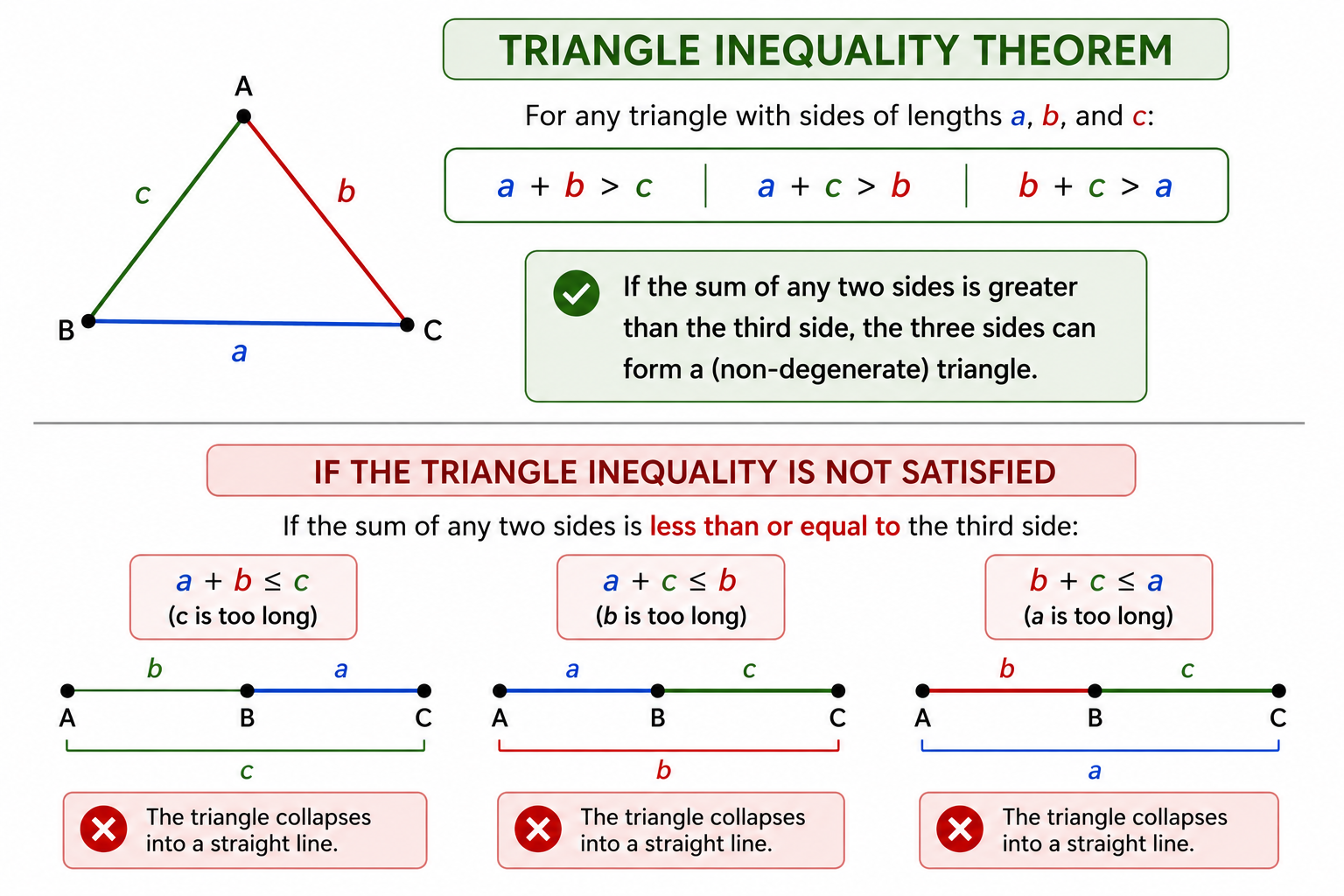
The Triangle Inequality Theorem states:
The sum of any two sides of a triangle must be greater than the third side.
For sides \(a\), \(b\), and \(c\):
\[ a + b > c,\quad b + c > a,\quad a + c > b. \]
Important Consequences
- If any of these fail, a triangle cannot exist.
- For two fixed sides, the third side must be between their difference and their sum.
Range of possible third side \(x\):
\[ |a - b| < x < a + b. \]
Common Problem Types
1. Checking if Three Sides Form a Triangle
Use all three inequalities.
Example:
Sides 3, 4, 10 → not a triangle because \(3 + 4 < 10\).
2. Finding the Range of a Third Side
Given two sides, determine all possible values of the third.
Example:
Sides 7 and 11 → third side \(x\) must satisfy:
- \(x > |7 - 11| = 4\)
- \(x < 7 + 11 = 18\)
So \(4 < x < 18\).
3. Selection Problems: “Which of the following could be the third side?”
Check which answer choice lies in the allowed interval.
4. Using Inequalities to Compare Sides
Given two sides and relationships among angles, infer size relationships among sides.
(Example: Opposite larger angles are larger sides.)
5. Interpreting Impossible Triangles
When the angle sum or side-length inequality fails, no triangle can form.
Strategies
- Always test sum of two > third three times when checking validity.
- For “possible length” questions, find the open interval
\((|a-b|, a+b)\).
- For integer lengths, list integer values strictly inside the interval.
- Draw a sketch when comparing side lengths or interpreting angle/side relationships.
Worked Examples
Example 1 — Can these sides form a triangle?
Sides: 5, 8, 13
Check:
- \(5 + 8 = 13\) → not greater, so no triangle exists.
The sides lie in a straight line.
Example 2 — Range of possible third side
Two sides are 9 and 14. Find the range for the third side \(x\).
Calculate:
- \(x > |14 - 9| = 5\)
- \(x < 14 + 9 = 23\)
So:
\[
5 < x < 23.
\]
Example 3 — Selection Problem
Two sides are 6 and 10. Which of the following could be the third side?
Range:
\(4 < x < 16\)
Choices: 3, 4, 9, 16 → only 9 works.
Example 4 — Integer Solutions
Sides: 7 and 12. How many integer values can the third side have?
Range:
\(12 - 7 = 5\)
\(12 + 7 = 19\)
So possible integer values: 6–18 → 13 integers.
- Using ≥ instead of > (equality makes a straight line, not a triangle).
- Forgetting to check all three inequalities when verifying sides.
- Mixing up “difference” and “sum” in the third-side range.
- Choosing an endpoint (like 18 or 4) when the interval is open \((4, 18)\).
Practice Problems
- Do sides 4, 9, and 15 form a triangle?
- Two sides are 10 and 13. Find the range for the third side.
- Sides: 5 and 8. Which could be the third side: 2, 5, 9, 14?
- Two sides are 6 and 6. How many integer third sides are possible?
- For sides 9 and \(x\), a triangle exists and the third side is 12. Find all possible values of \(x\).
1.
Check: \(4 + 9 = 13 < 15\) → no triangle.
2.
Range:
\(|10 - 13| = 3\), \(10 + 13 = 23\)
So \(3 < x < 23\).
3.
Range: \(|5 - 8| = 3\), \(5 + 8 = 13\) → \(3 < x < 13\).
Only 9 works.
4.
Range: \(|6 - 6| = 0\), \(6 + 6 = 12\) → \(0 < x < 12\).
Possible integers: 1–11 → 11 values.
5.
Triangle sides: 9, x, 12 → inequalities:
- \(9 + x > 12 \Rightarrow x > 3\)
- \(9 + 12 > x \Rightarrow x < 21\)
- \(x + 12 > 9\) (always true if \(x > -3\))
So \(3 < x < 21\).
Summary
- A triangle exists only if the sum of any two sides is greater than the third.
- The third side must lie in the open interval
\[|a-b| < x < a+b.\] - Endpoints do not form a triangle.
- The theorem is frequently used in triangle-feasibility problems.
- Think “difference < third side < sum.”
- Endpoints create a straight segment, not a triangle.
- When possible answers are integers, count carefully.